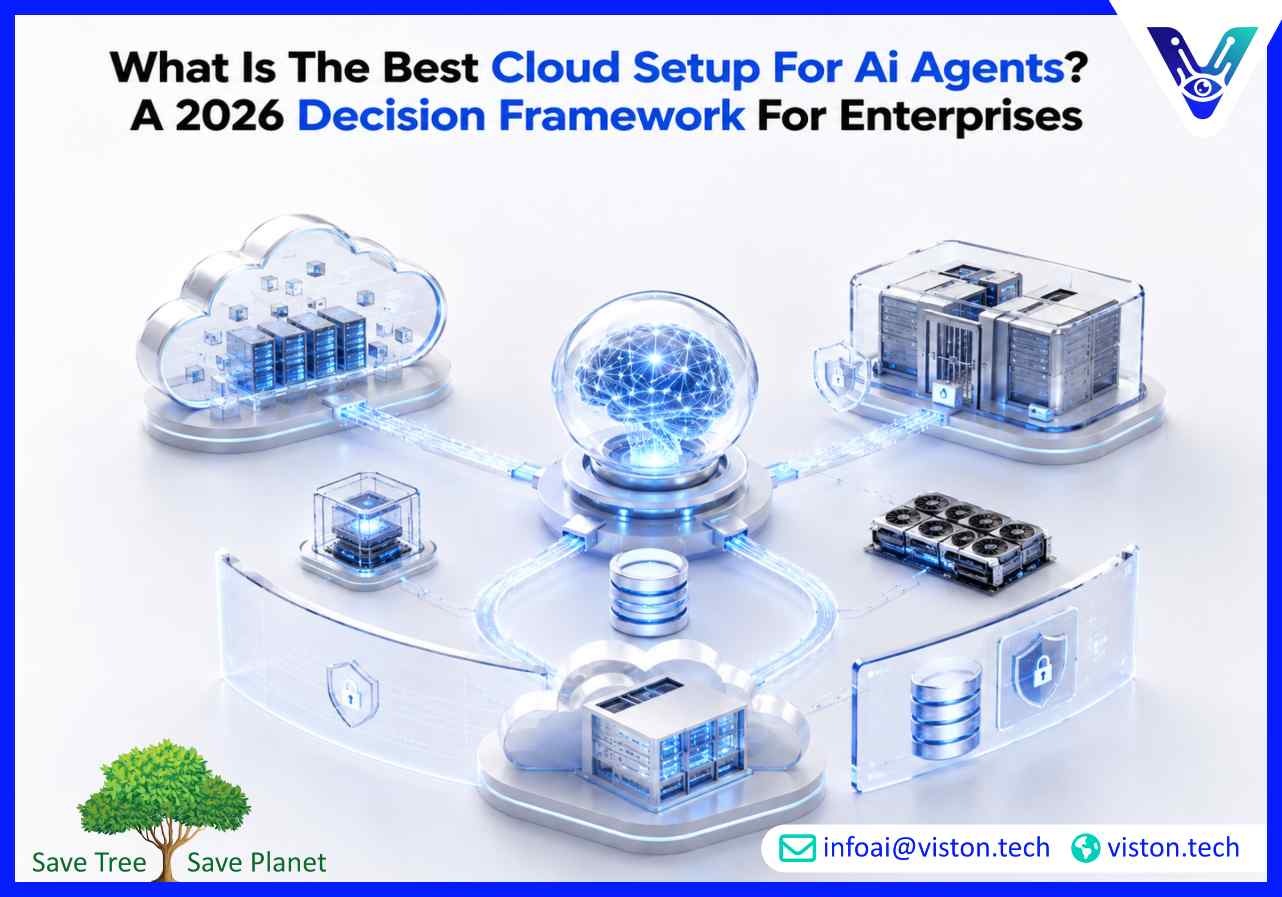
What Is the Best Cloud Setup for AI Agents? A 2026 Decision Framework for Enterprises
Introduction
The question is no longer if your business will deploy AI agents, but where they will run—and how reliably. For enterprise decision-makers, the cloud setup for AI agents directly determines security posture, operational costs, and whether pilot projects scale into production. Getting this wrong means brittle automations, compliance exposures, and unpredictable GPU bills.
Why Standard Cloud Infrastructure Falls Short for AI Agents
Traditional cloud architectures were designed for stateless applications and predictable traffic patterns. AI agents operate differently. They execute untrusted code, maintain conversational memory, spawn asynchronous workflows, and require low-latency access to both models and enterprise data.Most organizations discover the gap during the transition from proof-of-concept to production. A chatbot that works beautifully in a sandbox fails when it needs to query a live database, respect role-based access controls, or run a multi-step task that spans several minutes. The infrastructure layer—not the model—becomes the bottleneck.
Core Components of an Agent-Ready Cloud Architecture
Compute and Isolation
The most critical decision involves how you isolate agent-executed code. AI agents often generate and run code that may be untrusted. Container-level isolation, such as standard Docker, shares the host kernel, creating risk. MicroVM isolation using technologies like Firecracker or Kata Containers provides stronger security boundaries.For production deployments, look for platforms offering:
MicroVM-based sandboxes for untrusted code execution
Both ephemeral environments for short-lived tasks and persistent environments for stateful agents
GPU availability for inference without quota requests
State Management and Memory
Stateful agents need to remember conversation history, user preferences, and intermediate results across sessions. This requires a storage layer that balances speed and persistence. In-memory stores like Redis work for short-term session state, while vector databases handle semantic memory for retrieval-augmented generation, or RAG.The architecture must also answer a practical question: what happens when an agent crashes mid-conversation? Session affinity routing or shared state stores prevent users from losing context.
Orchestration and Observability
Production agent deployments require orchestration for scaling, health checking, and rolling updates. Kubernetes has become the standard for managing inference workloads, with horizontal pod autoscaling triggered by queue depth or GPU utilization.Observability deserves special attention. Traditional application performance monitoring tools miss agent-specific signals. You need structured logging of the agent’s reasoning process, token usage tracking, and distributed tracing for multi-agent workflows. Without this visibility, debugging failures becomes guesswork.
Deployment Models: Cloud, On-Premises, and Hybrid
Public Cloud with Managed Services
Public cloud remains the fastest path to deployment. AWS Bedrock, Google Cloud’s Vertex AI, and Azure AI Foundry provide managed access to frontier models with built-in security controls. The trade-off involves data governance: even with strong provider commitments, some regulated industries cannot route sensitive data through third-party endpoints.
Private Cloud and On-Premises
For organizations with strict data sovereignty requirements—healthcare, financial services, government—private cloud or on-premises deployment is non-negotiable. The operational burden is substantial: you own hardware procurement, GPU driver management, model updates, and capacity planning. However, the control over data and compliance posture justifies the investment at scale.According to industry data, 53% of organizations now identify data privacy as their foremost concern with AI agent implementation, surpassing integration challenges and deployment costs.
Bring Your Own Cloud (BYOC)
BYOC has emerged as a compelling middle ground. Your data stays within your VPC across AWS, GCP, or Azure, while the orchestration layer runs on top. This satisfies data residency requirements without requiring you to manage the entire infrastructure stack. For enterprises with existing cloud commitments, BYOC preserves investments while adding agent-specific capabilities.
Key Evaluation Criteria for 2026
When assessing cloud setups for AI agents, evaluate platforms against these dimensions:
Isolation Model: MicroVM vs. container-level security for untrusted code execution. MicroVMs provide stronger guarantees but may have higher overhead.
Ephemeral vs. Persistent: Does the platform support both stateless sandboxes for short tasks and persistent environments for agents with memory? Some platforms impose hard session limits that break long-horizon workflows.
GPU Availability: Can you access GPUs on demand without quota requests? Inference requires GPU compute, and procurement delays kill agility.
BYOC Support: Can you run execution inside your own cloud account for data residency compliance?
Pricing Model: Per-second billing vs. reserved instances. Cost structures vary dramatically at scale. One analysis showed total monthly costs for 200 sandboxes ranging from $2,060 BYOC to over $35,000 PaaS depending on the platform and deployment model.
Observability Tooling: What agent-specific telemetry does the platform provide out of the box?
The Security Imperative
The most sophisticated cloud architecture fails if security is an afterthought. Recent incidents have demonstrated the risks: AI agents granted excessive permissions have deleted production environments. The lesson is not to avoid agent automation but to design guardrails.Effective security layers for agent infrastructure include:
Network isolation with no public inference endpoints
mTLS encryption for all service-to-service communication
Least-privilege access controls for both models and data
Human-in-the-loop checkpoints for irreversible operations
How Viston AI Approaches Agent Infrastructure
Viston AI specializes in enterprise AI agent development and deployment, helping organizations navigate precisely these infrastructure decisions. Based in Ahmedabad and serving global clients across finance, healthcare, manufacturing, and logistics, Viston AI brings practical experience deploying agents that balance performance with governance.The company’s approach centers on understanding each client’s unique constraints: data residency requirements, existing cloud investments, team capabilities, and compliance obligations. Viston AI’s engineering team works with major cloud providers and open-source tooling to design architectures that scale predictably. Rather than forcing a one-size-fits-all solution, they evaluate trade-offs across isolation models, state management strategies, and deployment topologies.For organizations lacking dedicated MLOps teams, Viston AI provides the specialized expertise needed to move from prototype to production without accumulating technical debt. Their offerings span AI strategy consulting, custom agent development, and ongoing optimization—all with attention to security, governance, and measurable ROI.
Frequently Asked Questions
What is the difference between container-level and microVM isolation for AI agents?
Container isolation shares the host kernel, which is efficient but creates security risk for untrusted code. MicroVMs, such as Firecracker and Kata Containers, provide stronger isolation by running each workload in a lightweight virtual machine with its own kernel.
Can I run AI agents entirely within my existing cloud account?
Yes, through Bring Your Own Cloud deployments. Your data stays within your VPC while the orchestration layer manages sandboxes, scaling, and observability. This satisfies data residency requirements without building everything from scratch.
How much GPU capacity do I need to start?
For inference with a 7-billion-parameter model, a single GPU with 24GB+ VRAM suffices. For 70-billion-parameter models, plan on two to four GPUs with tensor parallelism. Start small and scale based on actual usage patterns.
What is the biggest mistake companies make with agent infrastructure?
Granting agents excessive permissions. Agents should receive the minimum privileges needed for their tasks, with human approval required for irreversible actions like deleting data or modifying production configurations.
How do I know if I need on-premises vs. cloud deployment?
If your data cannot leave your network due to compliance requirements such as HIPAA, FedRAMP, or financial regulations, on-premises or private cloud is mandatory. Otherwise, cloud deployment offers faster time-to-value and lower operational overhead.
Conclusion
Selecting the best cloud setup for AI agents requires balancing security, cost, and operational complexity. Public cloud offers speed and managed services. Private infrastructure provides control for regulated industries. BYOC sits in the middle, preserving data residency while reducing management burden.The right choice depends on your specific compliance requirements, team capabilities, and scalability needs. What works for a retail chatbot will fail for a healthcare claims processor. Organizations that succeed treat infrastructure as a strategic decision, not an afterthought.For enterprises seeking to deploy AI agents without building specialized infrastructure expertise internally, specialist partners like Viston AI provide the technical depth needed to navigate these trade-offs. The goal is not perfect infrastructure from day one, but an architecture that scales with your agents—and your business.