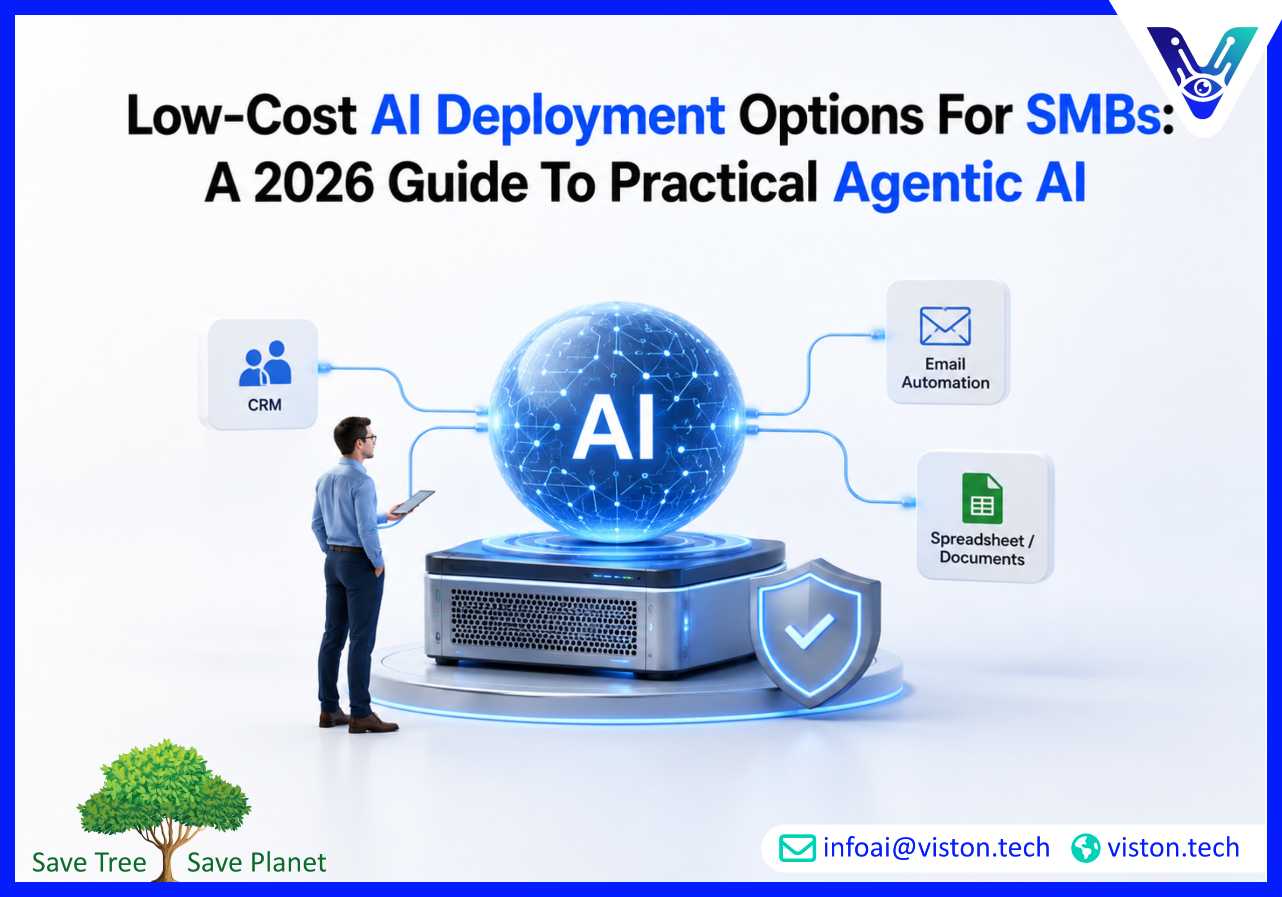
Low-Cost AI Deployment Options for SMBs: A 2026 Guide to Practical Agentic AI
For most small and medium businesses, the journey from “we should use AI” to “we are seeing tangible ROI from AI” has been blocked by two things: cost anxiety and technical complexity. In 2024, the conventional wisdom was that you needed a six-figure budget and a team of ML engineers. In 2026, that is no longer true.The market has fundamentally shifted. The bottleneck is no longer access to intelligence—it’s the ability to deploy that intelligence into specific business workflows without breaking the bank. This guide outlines low-cost, high-impact AI deployment strategies for SMBs, focusing specifically on AI agent development and deployment as the most practical path to automation.
Why 2026 is the Year of Affordable Agentic AI
Business leaders have moved past the “chatbot curiosity” phase. They want action. They want systems that don’t just generate text but execute tasks—updating CRM records, cross-referencing inventory, or drafting procurement orders.Three specific market shifts have made this affordable for SMBs:
The Rise of Small Language Models (SLMs): You don’t need GPT-4 for everything. Open-source models like Llama, Phi, and Mistral now run effectively on consumer-grade hardware or CPUs, reducing inference costs by orders of magnitude.
Open-Source Orchestration: Agentic frameworks like LangGraph, CrewAI, and OpenClaw allow businesses to orchestrate complex tasks without paying for proprietary “enterprise” licenses.
API Cost Collapse: With the introduction of highly efficient models like DeepSeek and Gemini 2.5 Flash, the cost per million tokens has dropped significantly for many basic tasks, making experimentation far more accessible.
The Spectrum of AI Deployment and Where SMBs Should Focus
Before selecting a tool, you must understand the Complexity Trap. A recent industry analysis suggests that 80% of business use cases do not require autonomous, multi-agent systems. In fact, over-engineering leads to higher failure rates.Here is the practical 2026 maturity model for SMBs:
Level 1: Rule-Based Automation: If-this-then-that workflows. Lowest cost. Great for data entry and syncing. Monthly cost: ~$50.
Level 2: Reactive Chatbots: Retrieval Augmented Generation. Basic Q&A over your own documents, such as policies and FAQs. Monthly cost: ~$200.
Level 3: Context-Aware Assistants: Human-in-the-loop agents that remember history and suggest next steps but require human approval. This is the sweet spot for SMBs.
Level 4: Tool-Using Agents: Semi-autonomous agents that read emails, write to APIs, and update databases.
Level 5: Fully Autonomous Multi-Agent Systems: High risk and high maintenance cost. Rarely suitable for SMBs without dedicated DevOps teams.
Strategic Recommendation: Aim for Level 3 or 4. Keep a human in the loop for any action that costs money or touches a customer directly. This lowers compliance risk and reduces the engineering burden.
Low-Cost Tech Stack Options for 2026
You do not need to build your own data center. Here is how to structure a lean stack.
1. The Open-Source Agentic Stack
For businesses with light technical resources, or a good IT partner, open-source is the most cost-effective route.Orchestration: Use n8n or OpenClaw. These are self-hostable alternatives to Zapier or Make. n8n handles structured, trigger-based workflows, such as “When a form is filled, create a contact.” OpenClaw handles autonomous reasoning.Models: Use Ollama to run open-source models like Qwen or Llama locally if you have privacy concerns. For cloud, route simple tasks to cheaper models and complex reasoning to higher-tier models.Cost: Software is free. Pay only for the server, typically $10–$50/month, plus API usage, usually $50–$300/month depending on volume.
2. The Suite-First Approach
If you are a Microsoft 365 or Google Workspace shop, you have AI available right now.Microsoft 365: Copilot integrates directly with Microsoft Graph data. You can extend it via Copilot Studio to create custom agents that query SharePoint or internal databases.Google Workspace: Gemini for Workspace integrates with Drive and Gmail. For deeper grounding, use Vertex AI Search to connect agents to internal wikis.Cost: Around $30/user/month for copilots, with usage-based pricing for advanced support bots on some platforms.
3. Model Bundling for Efficiency
One of the most underrated cost levers in 2026 is model bundling. Instead of running dedicated hardware for every model, platforms now bundle multiple models, such as a small router model plus a large reasoning model, on the same infrastructure. This allows for speculative decoding, where a cheap model drafts a response and an expensive one verifies it, reducing latency and cost.
The Pilot Project Blueprint: Customer Support Automation
Theory is useless without a pilot. For SMBs, the lowest-risk entry point is automated Tier-1 support.The Goal: Resolve 50–60% of common inquiries, such as hours, return policies, and order status, without a human touching the keyboard.
The Low-Cost Build
Data Source: Export your FAQs and policy docs into a clean text format.
Embedding: Use a cheap embedding model to vectorize this data.
The Agent: Build a RAG agent using an open-source framework like Dify or Flowise.
Guardrails: Program the agent to never issue refunds or change orders autonomously. It must hand off to a human via Slack or Teams for any actionable intent.
Deployment: Embed the chat widget on your Contact Us page.
The Budget:
API calls for 1,000 conversations: ~$15–$30
Hosting/UI: ~$20/month
Total first month: <$100
Why Specialized Agent Development Matters
Building a proof-of-concept chatbot is easy. Building a reliable, secure, and integrated agent that talks to your legacy ERP or CRM without hallucinating or breaking compliance is hard.Generic AI tools fall short when they encounter domain-specific logic. For example, an off-the-shelf chatbot cannot understand your unique Margin Approval Matrix or navigate a proprietary database schema. This is where specialized AI agent development becomes a competitive necessity.For SMBs, the risk isn’t just financial; it’s operational. A bad automation script can wipe a database or email a customer the wrong order details.
How Viston AI Supports SMB AI Agent Deployment
Navigating the trade-off between open-source flexibility and enterprise reliability is the central challenge for SMBs in 2026. Viston AI specializes in bridging this gap, offering AI Agent Development & Deployment specifically tailored for the resource constraints and data realities of mid-market businesses.Rather than selling expensive, off-the-shelf licenses, Viston AI focuses on custom, lightweight agent architectures. The company helps clients identify high-volume, low-ambiguity workflows—such as claims validation, contract clause extraction, or invoice processing—and deploys small language models that run efficiently on existing infrastructure.Their approach prioritizes human-in-the-loop governance, ensuring that while agents handle the legwork, financial and compliance decisions remain under client control. For businesses in regulated industries or those concerned about data sovereignty, Viston AI offers deployment options that keep agents within the company’s private cloud, avoiding the risks of public API usage.
Frequently Asked Questions
What is the cheapest way to start with AI agents in 2026?
The cheapest way is to use open-source orchestration tools, such as n8n or Dify, combined with API access to small models like Gemini Flash or Claude Haiku. You can build a functional internal tool for under $100/month.
Can AI agents run on my existing business software like Excel or Google Sheets?
Yes. Tool-using agents can connect to Google Sheets via API or use Python scripts to manipulate Excel files. Most low-code agent builders have native connectors for spreadsheets, allowing agents to read data, validate entries, or generate reports.
How do I prevent AI agents from making costly mistakes?
Implement a human-in-the-loop approval workflow. Set guardrails so that if an agent tries to execute a high-stakes action, such as deleting a record or sending a mass email, it pauses and asks a human for confirmation.
Are open-source AI models as good as paid ones for business tasks?
For specific, narrow tasks such as classification, data extraction, and summarization, fine-tuned small models often outperform generic large models. They are faster, cheaper, and easier to audit. For general creative brainstorming, large paid models still lead.
Do I need to hire a data scientist to deploy AI agents?
Not necessarily. Many 2026 frameworks, including CrewAI, AutoGen, and Dify, are designed for prompt engineering rather than heavy coding. However, for deep integration with legacy APIs, ERP systems, or proprietary CRMs, you may need a developer or a specialized partner to handle the middleware.
Conclusion
The barrier to AI deployment has shifted from capital to strategy. SMBs no longer have a budget excuse. The market now offers a spectrum of viable options, ranging from open-source agents running on low-cost servers to integrated copilots built into existing office suites.The key takeaway for 2026 is to right-size your complexity. Avoid the allure of autonomous, multi-agent systems. Instead, focus on tool-using agents with human approval loops. By starting with a single, high-volume pain point—like customer support or invoice data entry—and leveraging low-cost API models, businesses can achieve ROI within 90 days. AI Agent Development & Deployment is no longer a luxury reserved for enterprises; it is a practical, affordable utility available to any business willing to define its logic and guardrails clearly.