
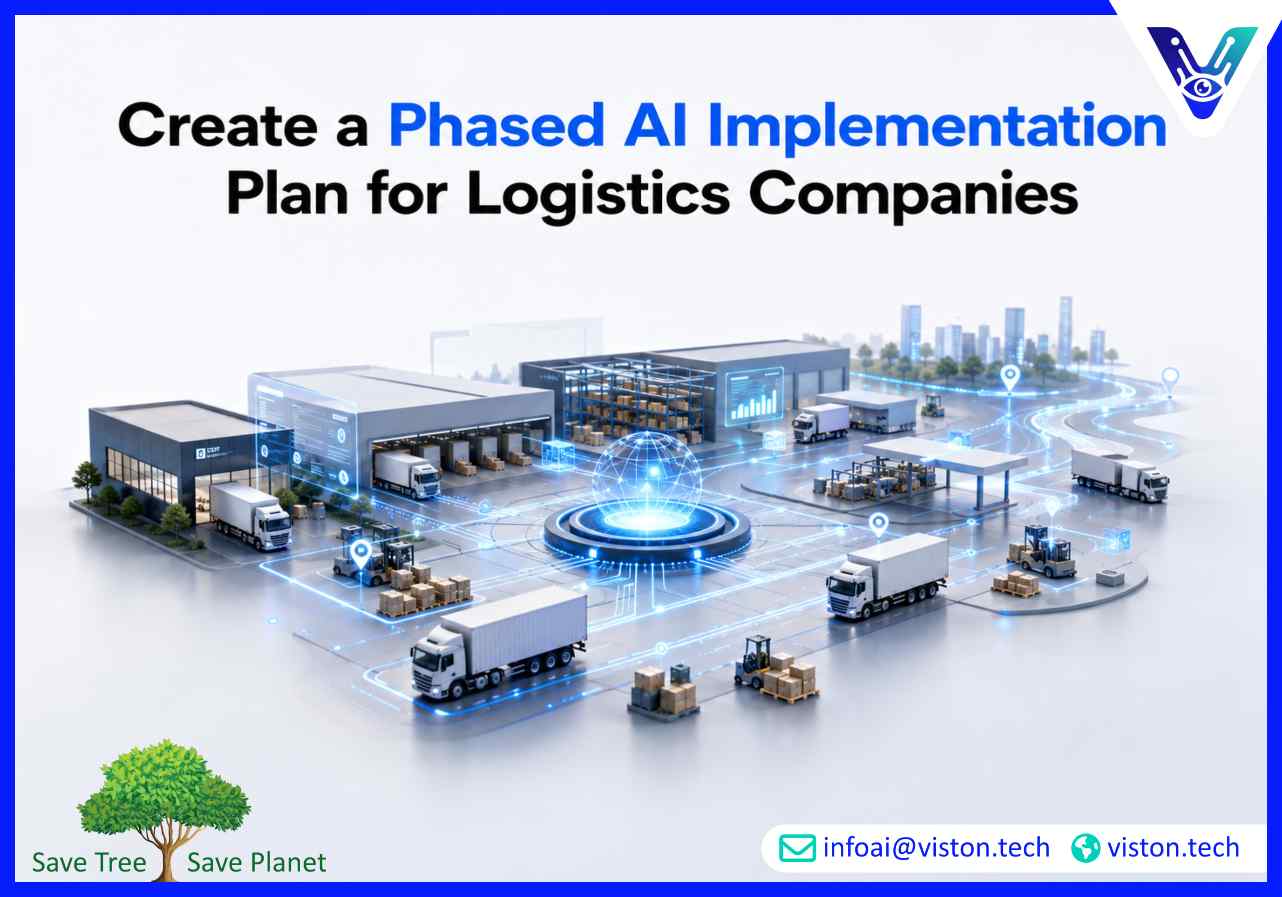
AI adoption in logistics is no longer limited to large global enterprises. In 2026, logistics companies are using AI to improve route optimization, warehouse operations, shipment visibility, forecasting, customer support, and operational efficiency. However, successful adoption depends on having a structured implementation plan that aligns AI initiatives with operational realities, integration requirements, and measurable business outcomes.
Many logistics organizations struggle with fragmented systems, manual workflows, siloed operational data, and increasing pressure to reduce delivery times while controlling costs. AI can address these challenges, but implementing too much too quickly often creates operational disruption instead of efficiency.
A phased implementation strategy allows logistics businesses to:
Instead of treating AI as a standalone technology initiative, logistics companies should approach it as an operational transformation program.
Before designing an implementation roadmap, organizations need to identify where AI can realistically improve operations.
AI models can analyze:
This enables dynamic route planning and more accurate ETA predictions.
AI supports warehouse operations through:
Machine learning models can identify equipment failures before they occur by analyzing sensor data from vehicles, conveyors, forklifts, and warehouse systems.
AI-powered agents can automate:
AI improves operational visibility by connecting data from:
This allows logistics businesses to identify delays, bottlenecks, and operational risks earlier.
The first phase focuses on understanding operational maturity, system architecture, and business priorities.
AI initiatives should begin with measurable operational goals such as:
Without clear objectives, AI projects often become disconnected from operational value.
Logistics companies typically operate across multiple platforms including:
Organizations must assess:
AI systems are only as effective as the operational data supporting them.
Rather than deploying AI across the entire organization immediately, businesses should prioritize use cases with:
For many logistics companies, shipment tracking automation, predictive ETA systems, and warehouse forecasting are practical starting points.
Once operational priorities are identified, the next phase focuses on infrastructure and integration readiness.
AI systems require connected and consistent data pipelines.
Logistics organizations often need to unify data from:
This may involve:
Poor integration planning is one of the most common reasons logistics AI projects fail to scale.
AI deployment in logistics involves operationally sensitive information including:
Companies must establish governance around:
Security becomes especially important when integrating AI with real-time logistics workflows.
Successful AI implementation requires collaboration between:
Operational teams should remain closely involved throughout implementation to ensure workflows remain practical and scalable.
Pilot deployments help validate assumptions before large-scale investment.
Early AI pilots should focus on specific operational areas such as:
This limits operational disruption while generating measurable performance data.
An AI-powered support system can automate delivery inquiries and reduce customer support workload.
Expected outcomes may include:
Machine learning models can continuously optimize routes using live transportation data.
Potential benefits include:
AI forecasting tools can help predict:
This improves operational planning and reduces waste.
Every pilot should include measurable metrics such as:
Clear performance tracking helps leadership determine whether scaling is justified.
Once pilot systems demonstrate value, organizations can expand implementation.
At this stage, logistics companies often integrate AI into:
The focus shifts from isolated automation to connected operational intelligence.
AI-driven workflows can automate repetitive operational processes including:
Automation reduces operational bottlenecks while improving scalability.
Advanced AI deployments can support:
This enables faster operational decision-making across logistics networks.
AI implementation is not a one-time deployment project. Logistics environments change constantly, requiring ongoing optimization.
AI systems must be continuously evaluated for:
Regular monitoring ensures AI outputs remain operationally reliable.
AI should support operational teams, not eliminate operational accountability.
Human oversight remains important for:
The most effective logistics AI strategies combine automation with experienced operational leadership.
The logistics AI landscape continues evolving rapidly in 2026 with advancements in:
Companies that continuously optimize their AI ecosystems will remain more competitive and operationally agile.
Disconnected AI tools create operational silos rather than efficiency.
Integration architecture should be planned before deployment begins.
AI projects should solve operational problems, not simply introduce new technology.
Operational workflows must remain the priority.
Incomplete or inconsistent logistics data can severely reduce AI performance.
Data governance must be addressed early.
Rapid enterprise-wide deployment without validated pilots often leads to operational disruption and poor adoption.
Phased expansion is typically more sustainable.
For logistics businesses planning AI adoption, integration complexity is often one of the largest barriers. AI systems must connect with operational platforms, data pipelines, customer workflows, warehouse systems, and transportation infrastructure without disrupting ongoing operations.
Viston AI specializes in Agent Integration Services that help organizations build scalable AI ecosystems aligned with real operational workflows. Its capabilities support businesses looking to integrate AI-driven automation, intelligent workflows, operational assistants, and connected AI systems into logistics environments.
For logistics companies, this may include:
Rather than approaching AI as isolated tooling, the focus is on building practical operational systems that improve visibility, automation, efficiency, and scalability while maintaining reliability across logistics operations.
As logistics organizations continue modernizing their supply chains in 2026, structured AI integration strategies are becoming increasingly important for long-term operational success.
A phased AI implementation plan introduces AI gradually through structured stages such as operational assessment, pilot projects, integration planning, scaling, and optimization. This reduces risk and improves adoption.
Common high-impact areas include route optimization, warehouse forecasting, shipment tracking, customer support automation, inventory management, and predictive maintenance.
Many projects fail due to poor data quality, weak integration planning, unclear business objectives, lack of operational alignment, or attempting large-scale deployment too early.
Implementation timelines vary depending on infrastructure complexity, operational scale, and integration requirements. Many organizations begin with pilot deployments before scaling over several phases.
AI platforms often integrate with transportation management systems, warehouse management systems, ERP platforms, CRM systems, fleet software, IoT devices, and customer support platforms.
Viston AI provides Agent Integration Services that help logistics companies connect AI systems with operational platforms, automate workflows, and build scalable AI-driven operational environments.
Creating a phased AI implementation plan for logistics companies is essential for achieving sustainable operational transformation in 2026. AI can significantly improve forecasting, automation, routing, warehouse efficiency, and supply chain visibility, but successful adoption requires structured execution, strong integration planning, and measurable operational goals.
A phased approach allows logistics businesses to reduce risk, validate ROI, and scale AI capabilities strategically across operations. For organizations exploring Agent Integration Services, companies like Viston AI can help build practical and scalable AI integration frameworks aligned with real logistics workflows and long-term operational objectives.
