
Business leaders no longer ask whether to automate workflows. They ask which platforms can handle the complexity of AI-driven processes without breaking existing systems. The landscape shifted dramatically in the past year, moving from simple robotic process automation (RPA) to what analysts now call agentic process automation (APA)—where AI agents don’t just follow rules but reason, decide, and coordinate across departments.
For organisations evaluating AI agent platforms for workflow automation, the decision comes down to a few critical questions: Can the platform orchestrate work across systems, people, and existing automation? Does it provide governance that satisfies compliance requirements? And most importantly, will it scale without creating new operational silos?
The difference between a promising AI tool and a production-ready platform comes down to three capabilities. First, orchestration—the ability to sequence tasks across multiple agents, APIs, and human decision points within a single process. Second, context management—retrieving the right information for each step without flooding the system with irrelevant data. Third, governance—testing, monitoring, and controlling AI-driven work before and after deployment.
In 2026, leading platforms have moved beyond isolated AI agents. The most mature solutions now offer what industry researchers call “decision-grade systems” that incorporate knowledge graphs and causal reasoning, moving beyond large language model (LLM)-only architectures. This matters for workflow automation because many business processes require understanding cause and effect, not just pattern matching.
Several platforms have established themselves as enterprise-grade solutions for AI-driven workflow automation. Each takes a distinct approach, and the right choice depends heavily on your existing infrastructure and use case requirements.
Automation Anywhere has evolved its Agentic Process Automation platform significantly in 2026. The platform now includes a Context Intelligence Graph that draws from over 400 million automation executions to deliver relevant context for each task. For organisations running complex, multi-system processes, this matters because generic AI systems often retrieve too much information, slowing execution and exposing unnecessary data.
The platform recently launched Autonomous IT and Autonomous Finance solutions, pre-built offerings that include more than 45 AI agents for IT operations and 55 for finance functions. These come with built-in KPIs, governance controls, and three-year roadmaps—useful for enterprises that need predictability. Early adopters report over 90% straight-through processing in accounts payable, with measurable reductions in days sales outstanding and improved invoice accuracy.
For customer service workflows, Zendesk’s Resolution Platform represents a different philosophy. Rather than treating automation as standalone bots, Zendesk builds what it calls an “Autonomous Service Workforce”—a system where specialised AI agents handle messaging, email, voice, and backend systems.
The platform’s key differentiator is the Resolution Learning Loop, where AI agents and copilots improve over time by learning from every interaction. Zendesk has also adopted the Model Context Protocol (MCP), allowing agents to autonomously select the right tools for a task. This matters for workflow automation because customer service rarely follows predictable paths—agents need to reason across systems, not just execute predefined rules.
JobRouter takes a different approach, embedding AI agents directly within low-code workflow processes. Version 2026.1 enables companies to build and deploy agents that operate as part of the process logic, accessing approved data and writing results back in structured formats.
For organisations in regulated industries, JobRouter’s commitment to European data centres and GDPR compliance matters. The platform explicitly states that models do not learn from customer data, and all actions are auditable. This addresses a growing concern among enterprise buyers: how to deploy AI without creating compliance liabilities.
Talkdesk focuses on Customer Experience Automation with its Automation Flows orchestration engine. The platform connects customer interactions directly to backend workflows, handling long-running processes like mortgage refinancing that require document collection, compliance validation, underwriting decisions, and CRM updates within a single governed workflow.
The platform’s extension of agentic AI to email channels is notable. Unlike rule-based email bots, Talkdesk’s Autopilot uses reasoning to interpret intent, analyse content, and determine appropriate actions without human intervention.
A critical shift in 2026 thinking challenges the assumption that full autonomy is always better. Industry experts now argue that connected, repeatable workflows outperform autonomous AI agents for most go-to-market and operational processes.
The reasoning is straightforward. Individual AI agents operating independently create fragmented workflows. A lead generation agent doesn’t know what content marketing is publishing. An outreach agent doesn’t know which accounts customer success flagged as at-risk. This fragmentation leads to misaligned messaging and missed opportunities.
Workflows, by contrast, manage entire processes from start to finish. They connect sales, marketing, operations, and customer success within the same system, working toward shared goals with shared data. When a lead enters the pipeline, a workflow triggers a coordinated sequence: marketing enriches the account, sales receives a personalised briefing, and outreach is tailored based on engagement history.
For business decision-makers, this means evaluating AI agent platforms not on their ability to automate individual tasks but on their capacity to orchestrate end-to-end processes.
No discussion of AI agent platforms in 2026 is complete without addressing security and governance. Enterprise AI researchers predict that trust will become the gating factor for scale, and organisations without proper governance frameworks will stall deployments.
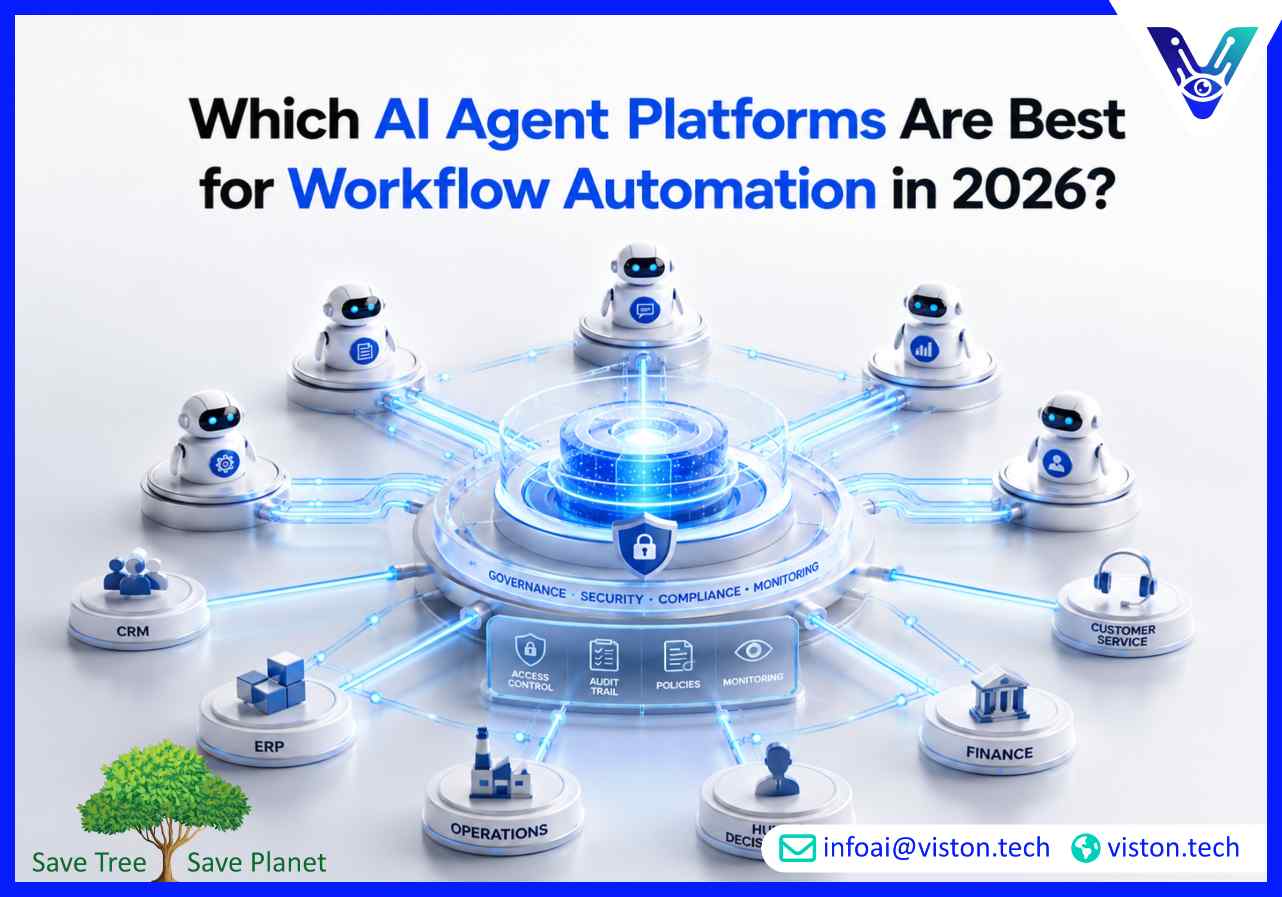
The architectural consensus emerging from industry leaders is clear: AI must never directly execute critical business transactions without appropriate controls. Instead, AI interaction should be mediated through a governance layer that enforces access control, orchestrates across systems, and maintains audit trails.
Platforms that embed these controls natively offer significant advantages over bolt-on solutions. Look for features like design-time testing environments, runtime performance monitoring, and the ability to simulate real-world scenarios including failures and edge cases before deployment.
Selecting the right AI agent platform is only half the challenge. The real work begins when you need to connect that platform to your existing systems, data sources, and business processes. This is where Viston AI provides specialised expertise in AI automation and workflow bots.
Viston AI works with organisations to evaluate their current automation maturity, identify processes suitable for agentic automation, and select platforms that align with their technical infrastructure and compliance requirements. Rather than pushing a one-size-fits-all solution, Viston AI focuses on the practical work of integration: connecting AI agents to CRMs, ERPs, and custom applications; building governance frameworks that satisfy internal and external audit requirements; and designing workflows that coordinate AI agents, human decision-makers, and legacy automation.
For businesses in regulated industries or those operating across multiple regions, Viston AI brings experience navigating compliance landscapes including GDPR and sector-specific requirements. The company’s approach emphasises measurable outcomes—reduced processing times, lower manual effort, and improved accuracy—rather than technology for technology’s sake.
Traditional RPA follows rule-based instructions for repetitive tasks. AI agent platforms add reasoning capabilities, allowing agents to interpret context, make decisions, and adapt to variations. In 2026, leading platforms combine both approaches, using AI agents to handle exceptions and complex decisions while maintaining deterministic automation for standard processes.
Start by mapping your critical workflows and identifying where decisions are made. If your processes span multiple systems with complex handoffs, prioritise platforms with strong orchestration capabilities. If compliance is paramount, evaluate governance features including audit trails and testing environments. Most organisations benefit from a pilot on a single high-value process before committing.
Leading platforms offer pre-built connectors for common enterprise systems including Salesforce, ServiceNow, SAP, and major ERPs. For custom applications, look for platforms supporting API integrations or the Model Context Protocol (MCP), which standardises how AI agents connect to external tools.
The primary risks include data exposure, unauthorised actions, and hallucinated outputs. Mitigation requires strict access controls, human-in-the-loop oversight for high-stakes decisions, and comprehensive logging. Platforms that offer design-time testing and runtime monitoring reduce these risks significantly.
Deployment timelines vary by complexity. Simple workflows connecting two systems can go live in weeks. Enterprise-wide deployments spanning multiple departments typically take three to six months, including process discovery, platform configuration, testing, and change management.
AI agent platforms for workflow automation have matured significantly in 2026. The market now offers enterprise-grade solutions capable of orchestrating complex, multi-system processes with built-in governance and measurable outcomes. The key for business decision-makers is moving beyond the hype of autonomous agents to evaluate platforms on their ability to coordinate work across people, systems, and existing automation.
The most successful deployments treat AI agents as part of a broader workflow strategy, not as standalone solutions. By focusing on end-to-end processes rather than isolated tasks, organisations can avoid the fragmentation that plagues many AI initiatives. Viston AI helps businesses navigate this landscape, providing the technical expertise needed to select, integrate, and govern AI agent platforms that deliver real operational results.
