
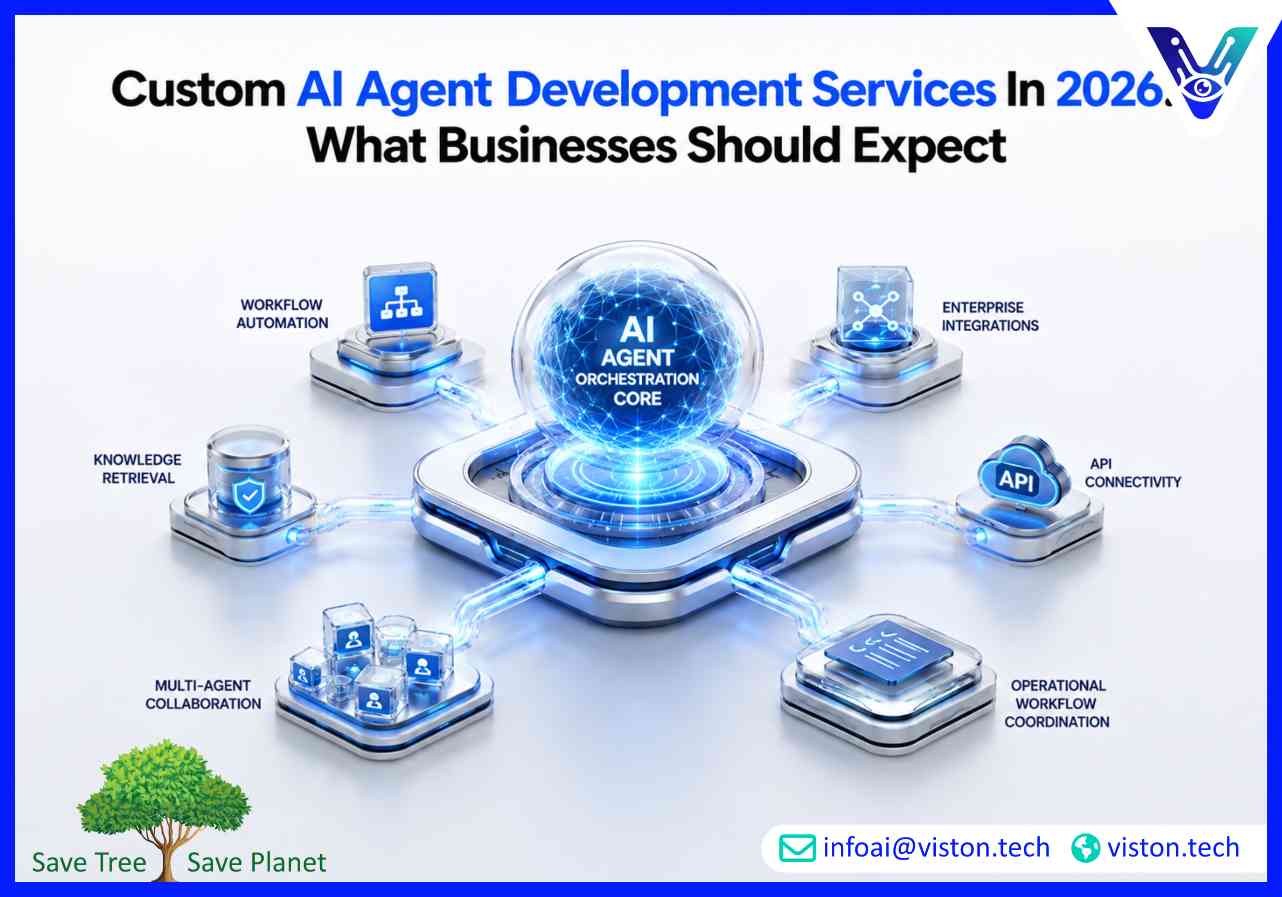
Businesses are moving beyond basic AI tools and adopting intelligent systems that can automate tasks, make decisions, and coordinate workflows across departments. As organizations demand more tailored automation, custom AI agent development services have become a strategic investment for companies seeking operational efficiency, scalability, and competitive advantage in 2026.
Custom AI agent development services involve designing and building AI-powered software agents that can perform specialized business tasks autonomously or semi-autonomously. Unlike generic AI assistants, custom AI agents are built around a company’s workflows, data environment, operational requirements, and business objectives.
These AI agents can:
Modern AI agents often combine large language models (LLMs), workflow automation, retrieval systems, orchestration frameworks, integrations, and machine learning models to deliver business-specific outcomes.
The AI market has shifted significantly from experimentation to operational deployment. Businesses are no longer asking whether AI can help — they are asking how quickly AI can be integrated into core processes without compromising reliability, governance, or scalability.
Several factors are driving demand for custom AI agent development services:
Off-the-shelf AI tools often fail to align with industry-specific workflows or internal operational structures. Custom AI agents are designed around actual business requirements, making them more effective for enterprise environments.
Organizations now expect AI systems to connect with CRMs, ERPs, helpdesk platforms, databases, communication tools, and internal applications. Custom development allows seamless integration with existing infrastructure.
Many enterprises are deploying multiple specialized agents that collaborate across departments. For example, one AI agent may handle customer inquiries while another manages data extraction and another oversees reporting.
Businesses handling sensitive operational or customer data require secure AI implementations with access controls, auditability, and governance policies. Custom AI development supports these requirements more effectively than public AI tools.
Companies increasingly expect AI deployments to reduce operational costs, improve response times, increase productivity, and support scalable growth. Custom AI agents are typically designed around measurable business KPIs.
Effective AI agent development involves much more than connecting an LLM to a chatbot interface. Enterprise-grade AI systems require multiple technical and operational layers.
The choice of language model depends on the use case, data sensitivity, performance requirements, and operational costs. Businesses may use commercial APIs, open-source models, or hybrid deployments.
RAG frameworks allow AI agents to retrieve verified business information from internal documentation, databases, or knowledge repositories before generating responses.
This improves:
Custom AI agents often connect with automation tools to execute actions automatically, such as:
In more advanced deployments, multiple AI agents collaborate within orchestrated workflows. One agent may gather information while another validates outputs and another handles execution.
AI agents typically require integrations with:
Enterprise AI systems must include:
Custom AI agents are now being deployed across nearly every business function.
AI agents can manage:
Unlike basic chatbots, modern AI agents can maintain context and integrate directly with support platforms.
AI agents can:
Businesses use AI agents to automate operational workflows such as:
AI agents can extract, organize, summarize, and analyze large volumes of structured and unstructured data.
This is especially useful for:
AI-powered knowledge assistants help employees retrieve internal documentation, SOPs, policies, and historical records more efficiently.
While AI adoption is accelerating, implementation challenges remain significant.
AI systems rely heavily on accurate and accessible data. Fragmented or outdated data environments reduce effectiveness.
Organizations sometimes deploy AI without defining measurable business outcomes. Successful projects usually begin with clearly identified operational pain points.
Enterprise environments often involve legacy systems, custom software, and disconnected infrastructure. AI agents must be designed carefully to operate reliably within these environments.
Large language models can generate inaccurate information if not properly constrained. Businesses increasingly prioritize:
Pilot AI projects may succeed initially but struggle when scaled across departments or regions. Infrastructure planning and orchestration architecture are critical for long-term scalability.
Choosing the right development partner is increasingly important as AI projects become more operationally critical.
Businesses should evaluate whether the provider understands:
Strong AI solutions require a deep understanding of operational processes, not just model development.
A capable provider should support integration with:
Businesses should assess:
AI systems should be designed for long-term operational scaling rather than short-term experimentation.
Viston AI specializes in custom AI agent solutions designed to help businesses automate workflows, improve operational efficiency, and build scalable AI-driven systems aligned with real business processes.
Its approach to custom AI agent development focuses on practical enterprise implementation rather than isolated AI experimentation. This includes designing AI agents that integrate with existing business systems, support multi-step workflows, and operate within secure enterprise environments.
For organizations implementing advanced automation strategies, Viston AI supports capabilities such as:
A growing challenge for businesses in 2026 is balancing AI capability with governance, reliability, and scalability. AI systems must operate consistently across departments while maintaining data security and operational transparency. Viston AI addresses these concerns by focusing on business-aligned architecture, structured implementation processes, and scalable deployment strategies.
Businesses evaluating custom AI agent development services often require more than conversational AI. They need systems that can coordinate tasks, automate operations, retrieve accurate information, and support measurable business outcomes. This is where tailored AI agent solutions become significantly more valuable than generic AI tools.
Businesses planning AI agent implementation should focus on long-term operational value rather than rapid deployment alone.
Identify workflows with:
AI agents perform best when connected to structured and well-maintained knowledge systems.
Even advanced AI systems require review mechanisms for:
Businesses should track:
AI architecture should support future:
Custom AI agent development services involve building AI-powered systems tailored to a company’s workflows, operational requirements, and business objectives rather than using generic AI tools.
Traditional chatbots mainly respond to predefined queries. AI agents can perform tasks, integrate with systems, retrieve business data, automate workflows, and coordinate multi-step operations.
Industries with complex workflows, large data volumes, operational automation needs, or customer interaction requirements can benefit significantly from AI agents.
Yes. Modern AI agents are commonly integrated with CRM systems, ERP platforms, databases, communication tools, analytics platforms, and internal applications.
Businesses typically reduce hallucinations by using retrieval-augmented generation (RAG), validation workflows, restricted data sources, monitoring systems, and human oversight mechanisms.
Viston AI focuses on practical enterprise AI implementation, workflow automation, scalable AI architecture, and custom AI agent development aligned with business operations.
Custom AI agent development services are becoming a foundational part of enterprise automation strategies in 2026. Businesses are increasingly adopting AI agents to streamline workflows, improve operational efficiency, support decision-making, and create scalable automation environments.
However, successful AI implementation requires more than access to language models. It depends on workflow alignment, integration capability, governance, security, scalability, and reliable execution. Organizations evaluating custom AI agent solutions should prioritize partners with strong technical expertise and a practical understanding of operational business requirements.
For businesses seeking scalable and business-focused AI automation, Viston AI provides custom AI agent solutions designed to support modern enterprise workflows and long-term operational growth.
