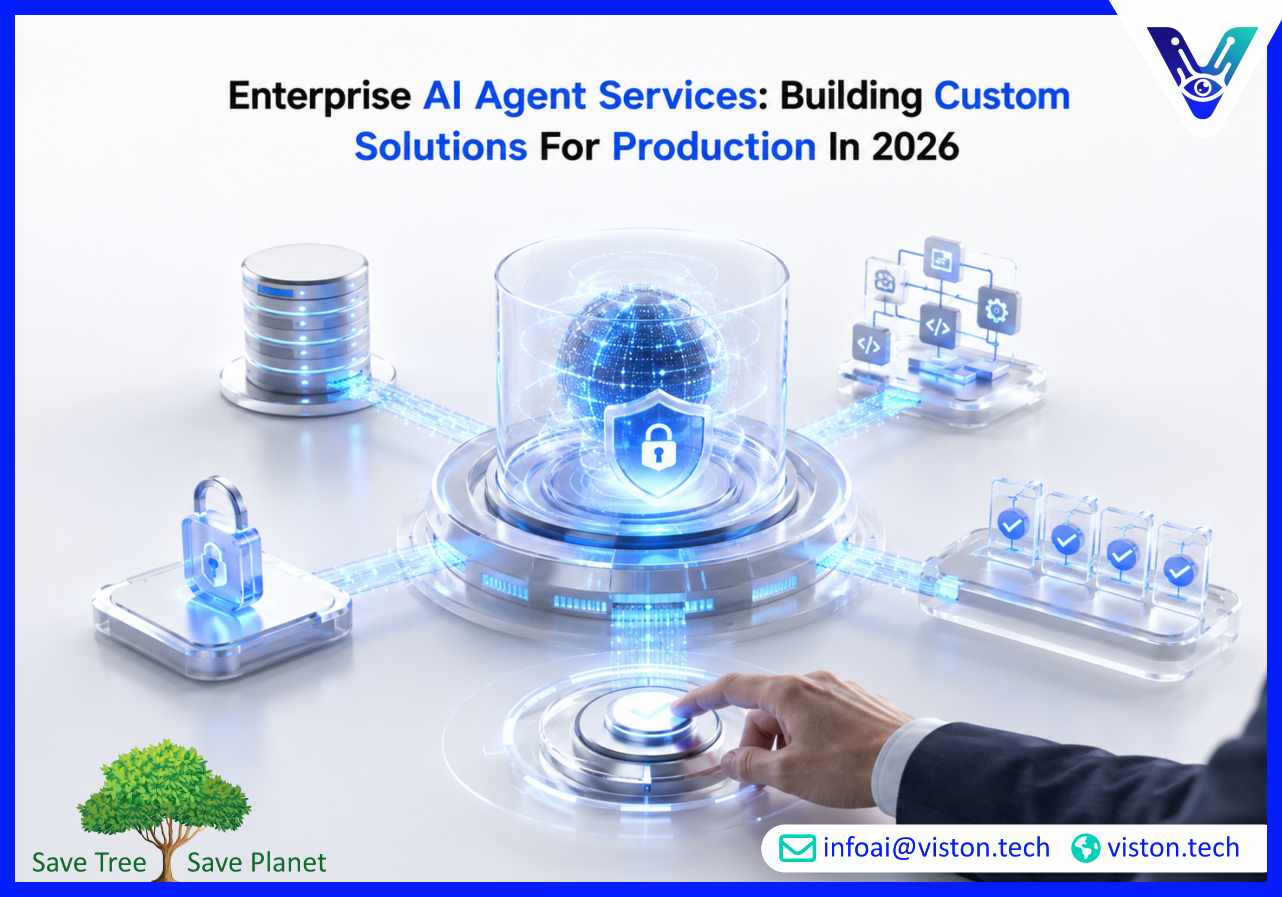
Enterprise AI Agent Services: Building Custom Solutions for Production in 2026
Introduction
The enterprise AI conversation has shifted. Through 2024 and 2025, businesses experimented with AI assistants and copilots. In 2026, the focus is on deployment and scale. Organizations are no longer asking whether AI agents can work, but rather how to integrate them into production environments safely, cost-effectively, and with clear accountability.
What Enterprise AI Agent Services Actually Deliver in 2026
Enterprise AI agent services encompass the design, development, and deployment of autonomous software systems capable of reasoning, planning, and executing multi-step workflows across internal tools and data sources. Unlike basic chatbots, AI agents can call APIs, query databases, coordinate with other agents, and take action on behalf of users—all within predefined guardrails.The distinction matters for business decision-makers. A chatbot answers questions. An AI agent completes tasks. For enterprises, this is the difference between a tool that assists and a system that participates in operations.
Why 2026 Is Different: From Experimentation to Production
Several factors make this the year agentic AI becomes practical at scale:
Control planes have matured. Major platforms now offer governance layers specifically designed for agent fleets, including identity management, permissions, and observability.
Standards are emerging. The Model Context Protocol (MCP) adoption is rising, enabling consistent tool integration across different agent frameworks. AIUC-1, the first compliance standard built specifically for AI agents, now includes agent identity and permissions controls.
The market has clarity. Gartner placed “Agentic AI Demands Cybersecurity Oversight” at the top of its 2026 cybersecurity trends list, reflecting that agent governance is no longer an afterthought.
The Real Barriers to Agent Deployment
Despite progress, deploying AI agents in production remains challenging. Research based on interviews with practitioners across twelve companies reveals four recurring barriers:
Context window limitations. Industrial codebases and workflows often contain millions of lines of documentation and data across diverse locations, exceeding what LLMs can effectively process without a context management layer.
Performance gaps on proprietary systems. Many agents perform well on open-source benchmarks but struggle with company-specific programming languages, legacy systems, and internal APIs.
Non-determinism vs. compliance. Safety-regulated industries require predictable, auditable outcomes. LLM non-determinism creates friction with qualification standards.
Data confidentiality. Even with enterprise data agreements, organizations remain cautious about sending sensitive information to cloud-based models.
These barriers explain why most enterprises remain at lower maturity levels. The research found that seven of twelve companies operate at the “AI Assistants” level, with only one reaching multi-agent orchestration in production.
Core Capabilities of Custom Enterprise AI Agents
When evaluating enterprise AI agent services, decision-makers should look for these foundational capabilities:
Identity and Access Governance
Every agent requires a unique, verifiable identity with just-in-time credentials scoped per task. Persistent access for autonomous agents is a security risk. Standards like SPIFFE for workload identity and OAuth 2.0 Token Exchange for delegated actions are becoming baseline requirements.
Tool and API Integration
Agents need clean interfaces to internal systems. This means well-documented APIs, consistent authentication patterns, and tool registries that enforce least-privilege access at runtime.
Observability and Audit Trails
Production agents require full tracing of every action: what was called, by which agent, on whose behalf, and with what result. OpenTelemetry-based tracing is becoming standard for agent observability.
Human-in-the-Loop Controls
Autonomy is staged, not binary. Custom solutions should support graduated autonomy: read-only operations first, actions with approvals, then autonomous execution once metrics stabilize.
Evaluation Frameworks
Offline testing against golden datasets, online evaluation of production runs, and regression detection are essential. Teams need to measure task success rate, tool-use correctness, and human intervention rate.
Security and Compliance: Non-Negotiable Requirements
For enterprise buyers, security is the top concern. The IBM Cost of a Data Breach Report found that 13% of organizations suffered a breach of an AI model or application, and 97% of those lacked proper AI access controls.The OWASP Top 10 for Agentic Applications 2026 lists “Identity and Privilege Abuse” among the top three risks. This reflects a core truth: AI agents are not service accounts. Service accounts are static with predictable behavior. Agents decide at runtime what tools to call and what data to access. A successful prompt injection can rewrite intent mid-session.Custom agent solutions must therefore include:
Unique cryptographic identity per agent
Just-in-time, short-lived credentials
Explicit allow-listing of tools and data sources
Complete audit trails with human delegation chains
Automated deprovisioning at end of lifecycle
Industry Use Cases Gaining Traction
Financial services. Reconciliation agents match ledger entries with bank feeds and vendor invoices, escalating anomalies beyond threshold amounts. The measurable outcome: reduced period-close time and lower manual error rates.Healthcare and life sciences. Agents automate compliance documentation, giving scientists more time for high-value research work. Security and data confidentiality controls are paramount.Manufacturing. Multi-agent systems monitor supplier networks for risk, execute contingency plans, and manage conditional procurement within predefined constraints. Interoperability protocols like Agent2Agent (A2A) enable agents from different developers to coordinate.Internal IT and employee service. Triage agents route requests, detect duplicates, link configuration items, and assess impact—operating alongside human teams with full auditability.
How Viston AI Delivers Custom AI Agent Solutions
Viston AI specializes in custom AI agent solutions for enterprises moving from experimentation to production. The company focuses on the practical requirements that determine whether agents actually deliver value: identity governance, tool integration, observability, and staged autonomy.Where many vendors provide generic agent frameworks, Viston AI builds purpose-specific agents integrated with existing enterprise systems. The approach includes:
Production-ready governance. Every agent receives unique identity, just-in-time credentials, and full audit trails, meeting AIUC-1 control requirements.
Integration with existing toolchains. Agents connect to CRM, ITSM, ERP, and data platforms through secure, audited APIs.
Staged deployment. Viston AI implements graduated autonomy: observe, suggest, act with approval, autonomous execution. Human intervention rates and task success metrics gate each stage.
Evaluation-driven development. Pre-deployment testing against golden datasets, production monitoring, and regression detection ensure agents perform as expected before touching live systems.
For enterprises in regulated industries—financial services, healthcare, manufacturing—Viston AI builds solutions that satisfy compliance requirements while delivering measurable operational improvements. The company focuses on internal workflows first, where risk is contained and ROI is clear, before expanding to customer-facing applications.
Frequently Asked Questions
What is the difference between an AI assistant and an AI agent?
An AI assistant generates responses based on prompts. An AI agent reasons through complex tasks, plans multi-step workflows, calls tools and APIs, coordinates with other agents, and takes action within defined guardrails.
How do enterprises ensure AI agents are secure?
Security requires unique cryptographic identity per agent, just-in-time credentials scoped per task, tool allow-listing, complete audit trails, and automated deprovisioning. Standards like SPIFFE for workload identity and OAuth 2.0 Token Exchange for delegated actions provide the technical foundation.
What should I measure to know if an AI agent is working?
Key metrics include task success rate, tool-use correctness, human intervention rate, and cost per completed workflow. These should be measured before deployment on golden datasets and continuously in production.
Can AI agents work with our existing software stack?
Yes, through API integrations and emerging standards like the Model Context Protocol (MCP). Agents require well-documented, accessible APIs. The most successful deployments focus on internal systems first—CRM, ITSM, ERP, data platforms—where APIs are already established.
What industries are adopting custom AI agents first?
Financial services, healthcare, manufacturing, and internal IT operations lead adoption. Common use cases include reconciliation agents, compliance documentation, supplier risk monitoring, and request triage.
How long does it take to deploy a custom AI agent solution?
Timelines vary by complexity, but staged deployment is standard: two to four weeks for scoping and sandbox testing, followed by gradual autonomy rollout. Organizations should expect three to six months from project start to production deployment with measured ROI.
Conclusion
Enterprise AI agent services in 2026 are about production readiness, not experimentation. The technology has matured, control planes exist, and standards are emerging. But successful deployment still requires expertise in governance, integration, observability, and staged autonomy. For business decision-makers, the path forward is clear: focus on internal workflows first, prioritize security and auditability, measure everything, and work with specialists who understand production requirements.Viston AI delivers custom AI agent solutions built for enterprises that need more than proof-of-concept demos. With a focus on identity governance, secure tool integration, and measurable outcomes, Viston AI helps organizations deploy autonomous systems that work alongside existing teams—not replace them. Whether you operate in financial services, healthcare, manufacturing, or any data-intensive industry, Viston AI builds agents that perform reliably, comply with security requirements, and deliver ROI you can track.