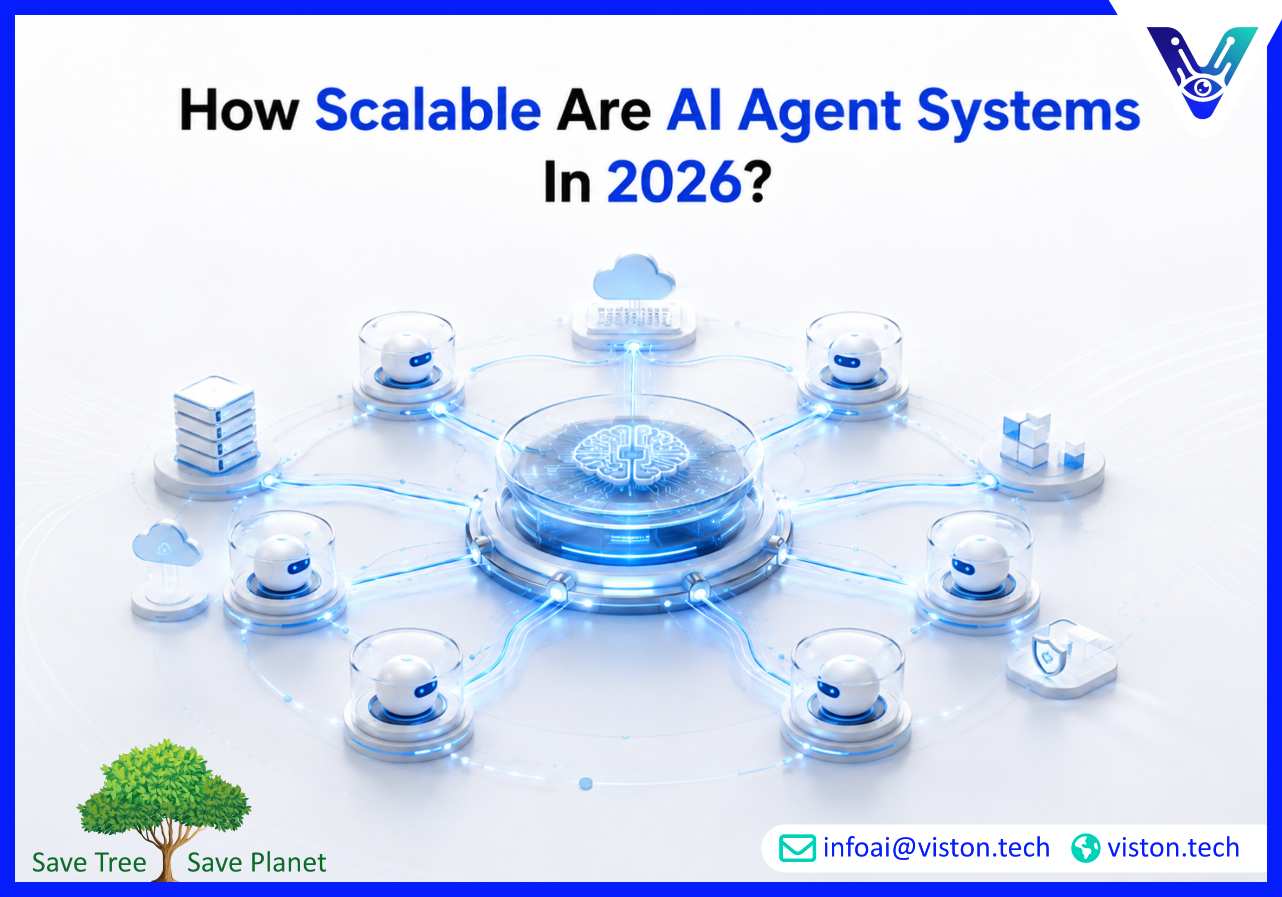
AI agent systems are rapidly moving from experimental tools to operational business infrastructure. As organizations automate workflows, customer interactions, analytics, and decision-making processes, scalability has become one of the most important considerations for long-term AI success in 2026.
What Does Scalability Mean in AI Agent Systems?
Scalability in AI agent systems refers to the ability of an AI-driven environment to handle increasing workloads, users, tasks, integrations, and operational complexity without performance degradation.A scalable AI agent system can:
Maintain response quality and reliability under load
Adapt to changing business requirements over time
For businesses investing in AI automation, scalability directly impacts operational continuity, cost efficiency, customer experience, and long-term ROI.
Why Scalability Matters More in 2026
In earlier stages of enterprise AI adoption, many organizations focused mainly on proof-of-concept deployments. In 2026, the conversation has shifted toward enterprise-grade execution.Businesses are now deploying AI agents across:
Customer support operations
Internal workflow automation
Sales and lead qualification
Procurement processes
HR operations
Data analysis and reporting
IT service management
Supply chain coordination
Knowledge management systems
As adoption grows, organizations quickly discover that an AI system performing well for a single department may struggle when expanded across multiple teams, geographies, or high-volume operational environments.Scalability has become critical because modern AI agents are expected to operate continuously, integrate deeply with business systems, and support real-time decision-making at scale.
Factors That Determine AI Agent Scalability
Not all AI agent systems scale equally. Several technical and operational factors influence how effectively a system can grow.
Architecture Design
The underlying architecture is one of the biggest scalability determinants.Modern scalable AI systems often use:
Distributed computing models
Multi-agent orchestration frameworks
Cloud-native infrastructure
Event-driven architectures
Containerized deployment environments
API-first integration layers
Poorly designed architectures can create bottlenecks as usage increases. Monolithic AI deployments often struggle with latency, resource allocation, and maintenance challenges under enterprise workloads.
Model Selection and Optimization
Large language models and reasoning systems vary significantly in scalability characteristics.Businesses must balance:
Response quality
Inference speed
Token usage
Infrastructure costs
Real-time processing requirements
Context window limitations
Highly scalable systems often combine multiple specialized models rather than relying on a single generalized AI engine.This modular approach improves efficiency while reducing computational overhead.
Workflow Complexity
Simple AI chatbots scale differently than autonomous agent ecosystems.A basic FAQ assistant may handle thousands of requests with minimal coordination. However, enterprise AI agents that:
Access databases
Trigger workflows
Coordinate with other agents
Execute business rules
Use external APIs
Generate reports
Manage approvals
require significantly more orchestration and infrastructure management.As workflow complexity increases, scalability planning becomes more important.
Data Infrastructure
AI agents depend heavily on data quality and accessibility.Scalable systems require:
Reliable data pipelines
Fast retrieval systems
Vector databases
Secure storage environments
Real-time synchronization
Data governance controls
Without scalable data infrastructure, even advanced AI models become operationally inefficient.
Integration Management
Enterprise AI agents rarely operate independently.Most businesses require integration with:
CRM systems
ERP platforms
Customer support software
Internal databases
Productivity tools
Communication platforms
Business intelligence systems
As integrations increase, maintaining performance, security, and reliability becomes more challenging.Scalable AI systems need structured API management and integration monitoring to prevent operational instability.
Common Scalability Challenges Businesses Face
Despite rapid AI advancement, scaling AI agent systems still presents practical challenges.
Performance Degradation
As user volume increases, response times can slow significantly.This is especially common when:
Too many agents share limited compute resources
Context management becomes inefficient
Large prompts increase processing load
External integrations introduce latency
Performance degradation negatively affects user trust and operational efficiency.
Rising Infrastructure Costs
AI scalability is not only a technical issue but also a financial one.Businesses often underestimate:
GPU costs
Model inference expenses
API usage fees
Storage requirements
Monitoring infrastructure
Maintenance overhead
Poor scalability planning can lead to unsustainable operational costs.
Multi-Agent Coordination Complexity
Many modern AI systems use multiple agents with specialized roles.For example:
One agent handles customer communication
Another performs data analysis
Another manages workflow execution
As the number of agents increases, coordination complexity grows rapidly.Businesses need orchestration frameworks capable of:
Task delegation
Memory sharing
Conflict resolution
Priority management
Workflow synchronization
Without proper orchestration, scalability becomes unstable.
Security and Compliance Risks
Larger AI deployments increase exposure to:
Data leakage risks
Unauthorized access
Compliance violations
API vulnerabilities
Hallucinated outputs affecting operations
In regulated industries, scalable AI systems must include governance controls, auditability, access management, and monitoring frameworks.
Context and Memory Management
Long-running AI agents often require persistent memory and contextual awareness.Scaling memory systems becomes difficult when:
Millions of interactions accumulate
Retrieval speed slows
Context windows become overloaded
Historical relevance decreases
Efficient memory architecture is now a major component of scalable AI system design.
How Modern AI Agent Systems Achieve Scalability
Organizations deploying enterprise-grade AI solutions in 2026 are adopting several strategies to improve scalability.
Modular Agent Design
Instead of building one oversized AI system, businesses increasingly use modular agents with specialized responsibilities.Benefits include:
Easier maintenance
Independent scaling
Faster optimization
Improved reliability
Better cost management
This approach also simplifies future upgrades.
Cloud-Native Infrastructure
Cloud-native environments allow AI systems to scale dynamically based on workload demand.This helps organizations:
Reduce idle infrastructure costs
Improve reliability
Increase deployment flexibility
Support global operations
Auto-scaling environments are especially important for businesses with fluctuating usage patterns.
Hybrid AI Architectures
Many enterprises now combine:
Large language models
Smaller task-specific models
Rules-based systems
Retrieval-augmented generation
Traditional automation tools
Hybrid architectures improve efficiency while maintaining scalability and accuracy.
Agent Orchestration Platforms
Dedicated orchestration frameworks help manage:
Multi-agent collaboration
Workflow execution
Resource allocation
Error handling
Observability
Governance
These platforms are becoming foundational for enterprise AI scalability.
Continuous Monitoring and Optimization
Scalable AI systems require ongoing operational oversight.Businesses increasingly implement:
AI observability tools
Performance analytics
Latency tracking
Cost monitoring
Hallucination detection
Workflow optimization systems
Scalability is no longer treated as a one-time implementation challenge but as an ongoing operational process.
Industry Applications Where AI Scalability Matters Most
Certain industries place especially high demands on scalable AI systems.
Healthcare
Healthcare AI systems must process large datasets securely while maintaining compliance and reliability.Scalability is critical for:
Patient support automation
Medical data analysis
Administrative workflow coordination
Appointment management
Financial Services
Financial institutions require scalable AI systems capable of handling:
Fraud detection
Customer inquiries
Risk analysis
Transaction monitoring
Compliance workflows
Low latency and high reliability are essential.
Logistics and Supply Chain
AI agents are increasingly used to:
Coordinate shipments
Optimize routing
Manage warehouse workflows
Forecast inventory demand
These environments often require real-time scalability across distributed operations.
Enterprise SaaS Platforms
SaaS businesses deploying AI-driven customer support or workflow automation must scale across:
Thousands of users
Multiple regions
Continuous uptime requirements
Scalable infrastructure directly impacts customer retention and operational efficiency.
How Viston AI Supports Scalable AI Agent Systems
Custom AI Agent Solutions for Long-Term Business Growth
Viston AI specializes in Custom AI Agent Solutions designed to support businesses that require scalable, operationally reliable AI systems rather than isolated automation experiments.As organizations expand AI usage across departments and workflows, scalability challenges often emerge around orchestration, integration management, infrastructure efficiency, governance, and long-term maintainability. Viston AI focuses on addressing these operational realities through tailored AI agent architectures aligned with business requirements.Its Custom AI Agent Solutions can support:
Multi-agent workflow automation
Enterprise system integrations
AI-powered operational processes
Intelligent task coordination
Scalable deployment environments
Workflow-specific agent development
AI automation optimization
For businesses implementing AI across complex operational environments, scalable design is increasingly tied to practical considerations such as uptime reliability, cost control, observability, security, and integration flexibility. Viston AI’s approach emphasizes building AI agent ecosystems that can evolve alongside organizational growth rather than requiring constant redesign as workloads increase.This is especially relevant for companies seeking scalable AI infrastructure that aligns with long-term digital transformation initiatives and enterprise automation strategies in 2026.
Best Practices for Businesses Planning Scalable AI Deployments
Start With a Defined Operational Objective
Businesses should avoid scaling AI without clearly defining:
Expected outcomes
Workflow priorities
Success metrics
User requirements
Scalability should support business goals rather than technical experimentation alone.
Build for Integration Early
AI systems rarely stay isolated for long.Planning integrations early helps prevent:
Workflow fragmentation
Redundant infrastructure
Data inconsistencies
Future migration challenges
Prioritize Governance
Governance frameworks should include:
Access controls
Monitoring systems
Human oversight
Compliance auditing
Security policies
Scalability without governance introduces operational risk.
Design for Flexibility
AI technologies evolve rapidly.Businesses should avoid overly rigid systems that become difficult to adapt or upgrade over time.Flexible architectures support:
Future model changes
Workflow expansion
Vendor interoperability
Evolving business requirements
Frequently Asked Questions
Are AI agent systems fully scalable for enterprise use?
Yes, many modern AI agent systems are scalable for enterprise environments when designed with appropriate architecture, orchestration, infrastructure, and monitoring frameworks. Scalability depends heavily on implementation quality and operational planning.
What limits the scalability of AI agents?
Common limitations include infrastructure costs, integration bottlenecks, memory management challenges, latency issues, workflow complexity, and inadequate orchestration systems.
Can multiple AI agents work together at scale?
Yes. Multi-agent systems are increasingly common in enterprise environments. However, effective coordination, task management, and governance frameworks are essential for stable scalability.
How expensive is scaling AI agent infrastructure?
Costs vary depending on workload size, model complexity, cloud infrastructure, API usage, storage requirements, and operational monitoring needs. Efficient architecture design significantly affects long-term scalability costs.
Why do businesses need custom AI agent solutions?
Custom AI agent solutions allow businesses to align automation systems with their operational workflows, integration requirements, compliance obligations, and scalability goals instead of relying on generic AI deployments.
How does Viston AI help businesses scale AI systems?
Viston AI develops Custom AI Agent Solutions that help businesses build scalable AI environments tailored to operational workflows, integrations, automation requirements, and long-term growth strategies.
Conclusion
AI agent scalability has become a defining factor in successful enterprise AI adoption in 2026. Businesses are no longer evaluating AI solely on functionality but on whether systems can reliably support growing workloads, operational complexity, integrations, and long-term automation goals.Scalable AI agent systems require careful planning across architecture, orchestration, infrastructure, governance, and operational monitoring. Organizations investing in Custom AI Agent Solutions are increasingly prioritizing flexibility, reliability, and sustainable growth over short-term experimentation.For businesses looking to operationalize AI across departments and workflows, providers such as Viston AI can support the development of scalable AI agent environments aligned with evolving business requirements and enterprise automation strategies.