
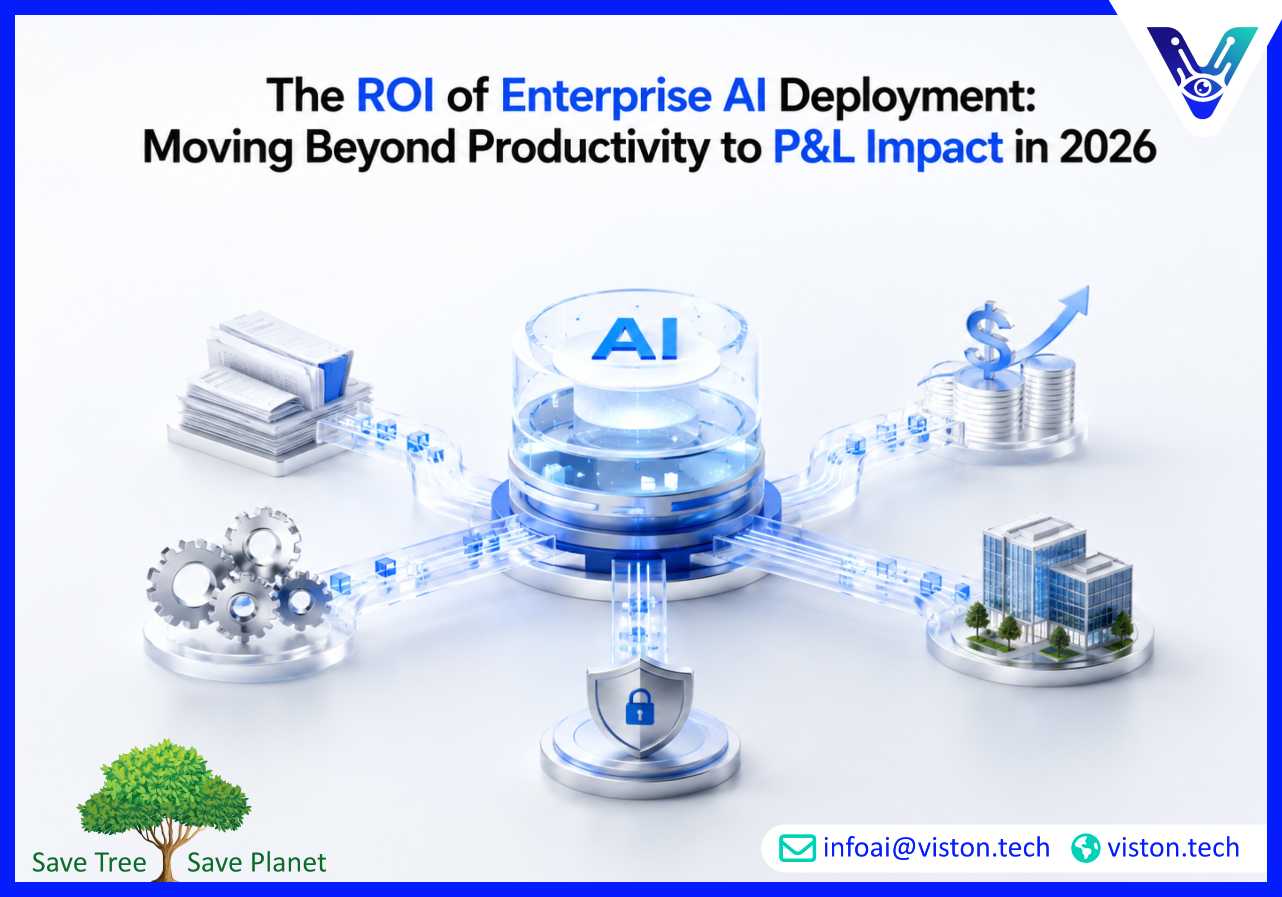
For most of 2024 and 2025, enterprises justified AI investments through productivity metrics—hours saved, tasks automated, headcount avoided. That era has ended. In 2026, decision-makers are demanding that every AI capability connect directly to top-line revenue growth or bottom-line profitability. Understanding the true ROI of enterprise AI deployment now requires a fundamentally different framework.
The shift is not subtle. According to The Futurum Group’s survey of 830 global IT decision-makers, productivity gains collapsed 5.8 percentage points as the primary success metric for enterprise AI. In its place, direct financial impact—combining revenue growth (10.6%) and profitability (11.1%)—nearly doubled to 21.7% of primary responses.
This reflects a broader maturation. Enterprises have moved past the pilot phase. AI agents—autonomous systems that execute tasks across workflows—are now in production at 54% of organizations, up from just 12% in 2024. But deployment alone does not guarantee returns. KPMG’s Q1 2026 AI Pulse found that 65% of organizations now cite difficulty scaling AI use cases, nearly double the prior quarter, while 62% point to skills gaps as a barrier to demonstrating ROI.
The constraint is no longer ambition, capital, or access to technology. Execution is.
Understanding ROI requires disaggregating how AI agents actually create value. Industry research identifies three distinct categories.
The most immediately quantifiable returns come from time savings that multiply across thousands of employees. When enterprise AI agents reduce the time knowledge workers spend on routine tasks—drafting communications, extracting data from documents, routing inquiries—the small per-employee savings aggregate into significant annual value.
Federal Reserve analysis found that workers using generative AI save 5.4% of their work hours on average, translating to approximately 2.2 hours per week. For an organization with 10,000 knowledge workers, that represents over 20,000 recovered hours annually.
However, 2026 buyers increasingly view productivity gains as table stakes, not differentiators. They fund deployments but do not alone justify strategic investment.
More significant ROI comes from critical discovery moments—when an AI agent surfaces knowledge that prevents a costly mistake, avoids redundant work, or unlocks a competitive opportunity.
In engineering, finding that a component has already been developed in another division saves hundreds of thousands in redundant R&D. In compliance, identifying a regulatory gap before an enforcement action saves millions in fines. In sales, surfacing a relevant case study or technical specification mid-conversation can close a deal that would otherwise stall.
Advanced agentic systems with retrieval-augmented generation are specifically designed for these scenarios, reasoning across multiple enterprise data sources to surface connections that human searches miss. A single high-value discovery can exceed the total cost of the platform.
The most powerful—and hardest to replicate—category occurs when AI agents become embedded in core business processes to the point that operating without them would fundamentally compromise competitiveness.
Consider a manufacturer whose maintenance agents diagnose equipment issues by reasoning across technical documentation, sensor data, and service history. Reverting to manual processes would double resolution times and increase downtime costs significantly. Or a financial services firm whose compliance agents monitor transactions and flag anomalies in real time—without them, regulatory risk becomes unmanageable at scale.
Organizations successfully deploying AI agents report an average ROI of 171%, with returns that compound as systems learn and scale. The companies that establish these capabilities early accumulate data, experience, and process advantages that become increasingly difficult for competitors to replicate.
AI agents are not chatbots. They are autonomous systems that execute tasks, route decisions, and automate workflows across functions. This distinction fundamentally changes how value is measured.
Traditional AI tools augment human work. AI agents replace discrete workflows entirely. When an agent can resolve a customer issue end-to-end, process a claim without human review, or generate a compliance report autonomously, the value is not about time saved—it is about work completed, revenue generated, and costs avoided.
Salesforce research found that 61% of CFOs say AI agents are changing how they evaluate ROI entirely, measuring success beyond traditional metrics to encompass a broader range of business outcomes.
However, this potential comes with significant execution challenges. KPMG notes that turning AI agents into consistent business performance is difficult because deploying technology is easier than redesigning how work actually gets done. Most organizations still operate with structures, incentives, and accountability models designed for human-only work.
ROI failures are rarely about the AI model. According to industry data, 70% of organizations discover that their data infrastructure is fundamentally lacking only after launching AI initiatives. The prerequisites for sustainable returns include:
Viston AI specializes in AI agent development and deployment for enterprises seeking to move beyond pilot programs to production-scale value. The company focuses on the execution layer that determines whether AI investments translate into business outcomes—building agents that integrate with existing workflows, respect governance requirements, and deliver measurable returns against P&L metrics.
Viston’s approach addresses the three categories of ROI directly: productivity gains through workflow automation, high-value discovery through advanced retrieval and reasoning, and competitive capability through agents embedded in core business processes. For organizations in the United States and global markets, Viston provides the technical expertise and delivery discipline required to scale AI deployment without the common failure points of inadequate infrastructure or unclear accountability. Its capabilities span agent design, secure data integration, governance implementation, and ongoing optimization—transforming AI from a technology experiment into a reliable driver of revenue growth and margin improvement.
Organizations successfully deploying AI agents report average ROI of 171%, with 74% achieving returns within the first year. However, results vary significantly based on use case, data infrastructure, and governance maturity.
The shift is from productivity metrics—hours saved—to direct financial impact: revenue growth and profitability. CFOs now demand that every AI capability connect to P&L outcomes rather than efficiency gains alone.
The primary failure drivers are inadequate data infrastructure, lack of governance frameworks, failure to capture baseline metrics before deployment, and attempting to scale before proving value at the use-case level.
Finance use cases show the fastest payback at approximately 8 months, followed by manufacturing at 12–14 months. Organization-wide deployments typically deliver measurable gains within the first quarter.
Chatbots augment human work. AI agents replace discrete workflows entirely—resolving issues, processing claims, and coordinating supply chains. The value is work completed and revenue generated, not just time saved.
Organizations need unified data connectivity across siloed systems, governance frameworks with clear accountability, workforce readiness for human-agent collaboration, and baseline metrics established before deployment begins.
The question of enterprise AI deployment ROI has fundamentally changed. In 2026, the answer is no longer about hours saved or tasks automated—it is about revenue growth, margin improvement, and competitive positioning. AI agents have moved from experimentation to production at more than half of organizations, but deployment alone guarantees nothing. Returns are now constrained by execution: data infrastructure, governance frameworks, workforce readiness, and measurement discipline.
For business decision-makers, the path to positive ROI requires moving beyond productivity arguments to P&L accountability, investing in the enabling infrastructure before scaling, and choosing deployment partners who understand that AI value comes from execution, not ambition. The organizations that get this right will accumulate advantages that become increasingly difficult to replicate.
