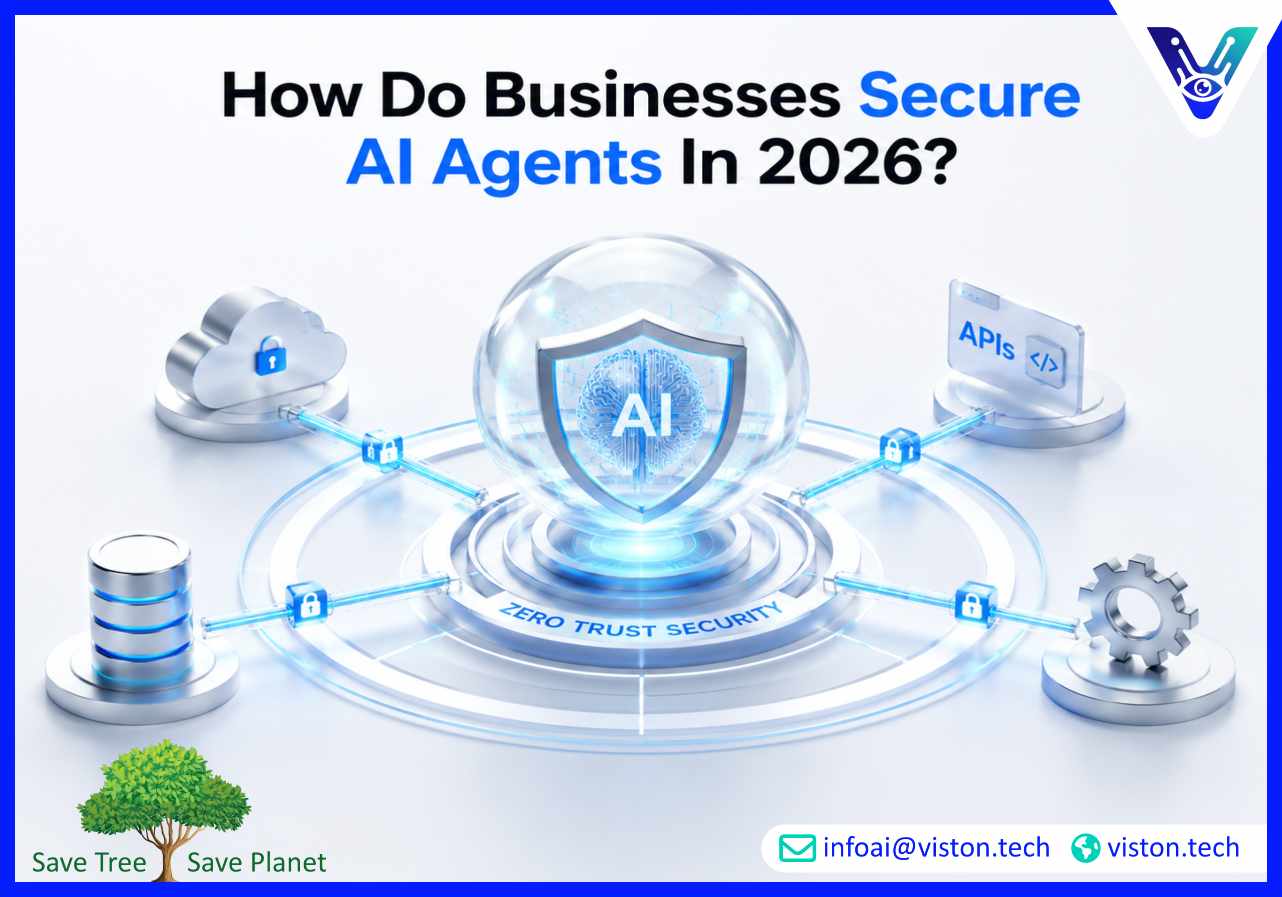
As AI agents become more deeply integrated into business operations, security has shifted from a technical concern to a strategic priority. Organizations using autonomous AI systems for customer support, workflow automation, analytics, and decision-making must ensure these agents operate safely, securely, and within defined business controls.
Why AI Agent Security Matters More in 2026
AI agents are no longer limited to simple chatbot interactions. Modern enterprise AI agents can:
Access internal databases
Trigger automated workflows
Interact with CRMs and ERPs
Execute tasks across cloud platforms
Handle sensitive business data
Make operational recommendations
This increased autonomy creates new security challenges. If poorly governed, AI agents can expose confidential information, misuse permissions, generate unsafe outputs, or create compliance risks.Businesses are now treating AI agent security as part of their broader cybersecurity, governance, and operational risk strategy.
What Makes AI Agents Different From Traditional Software?
Traditional software systems typically follow fixed rules and predictable execution paths. AI agents, especially those powered by large language models (LLMs), operate dynamically.They can:
Interpret instructions
Make contextual decisions
Interact with external systems
Learn from workflows
Execute multi-step tasks
Because of this flexibility, security strategies must go beyond standard application security practices.Businesses must secure:
The AI models
The agent framework
Data access layers
External integrations
User permissions
Prompt interactions
Automated actions
Monitoring systems
The Biggest Security Risks Associated With AI Agents
Unauthorized Data Access
AI agents often connect with enterprise systems containing customer records, financial information, contracts, or operational data.Without proper access controls, agents may:
Expose confidential information
Retrieve unnecessary data
Share sensitive content unintentionally
Access systems beyond their intended role
Role-based access control and least-privilege architecture are now considered essential.
Prompt Injection Attacks
Prompt injection remains one of the most discussed AI security risks in 2026.Attackers may attempt to manipulate an AI agent by:
Embedding malicious instructions
Overriding safety policies
Triggering unintended actions
Extracting hidden system prompts
Organizations now implement layered prompt validation, input sanitization, and contextual filtering to reduce these risks.
API and Integration Vulnerabilities
AI agents frequently rely on APIs to interact with:
Business applications
Cloud services
Internal tools
Automation platforms
Every integration expands the attack surface.Weak authentication, exposed tokens, or poorly configured APIs can allow attackers to misuse agent capabilities or gain unauthorized access to connected systems.
Hallucinated or Unsafe Outputs
AI agents can generate inaccurate recommendations or misleading responses when insufficient guardrails exist.In regulated environments, this may create:
Compliance violations
Financial risks
Legal exposure
Operational disruption
Businesses increasingly implement human-in-the-loop review systems for high-impact workflows.
Autonomous Workflow Abuse
Autonomous AI agents can execute actions automatically, including:
Sending emails
Updating records
Creating tickets
Triggering approvals
Managing transactions
Without governance controls, automation errors can escalate quickly across enterprise systems.
Core Security Principles Businesses Use for AI Agents
Identity and Access Management
Modern AI agents are secured using enterprise identity frameworks.Businesses now commonly implement:
Role-based permissions
Multi-factor authentication
OAuth-based integrations
Zero-trust access policies
Session-level authorization
AI agents should only access the minimum systems and data required for their function.
Data Isolation and Encryption
Sensitive business data must remain protected throughout the AI workflow lifecycle.Organizations typically secure:
Data in transit
Data at rest
Vector databases
Memory storage
Retrieval systems
Conversation histories
Encryption and segmented architecture reduce the risk of lateral exposure.
Continuous Monitoring and Observability
AI agent observability has become a major operational requirement.Businesses monitor:
Agent actions
Prompt activity
API calls
Decision patterns
Escalation events
Access requests
Failure scenarios
Comprehensive logging helps security teams detect misuse, anomalies, or policy violations quickly.
Human Approval Layers
Many enterprises do not allow AI agents to execute sensitive actions autonomously.Instead, businesses use:
Approval checkpoints
Human validation stages
Confidence thresholds
Escalation workflows
This is especially common in:
Finance
Healthcare
Legal operations
Procurement
Enterprise IT
Secure Model and Infrastructure Management
Businesses also secure the underlying AI infrastructure itself.This includes:
Private model hosting
Secure cloud environments
Infrastructure hardening
Patch management
Dependency scanning
Container security
Runtime protection
Organizations deploying AI agents internally often isolate environments to prevent cross-system compromise.
How Businesses Build Governance Around AI Agents
Security alone is not enough. Businesses also need governance frameworks that define how AI agents are designed, deployed, monitored, and maintained.
AI Usage Policies
Organizations now establish clear policies covering:
Approved AI use cases
Data handling rules
Compliance obligations
Human oversight requirements
Escalation procedures
These policies help align AI usage with operational and legal standards.
Compliance and Regulatory Alignment
In 2026, AI governance increasingly overlaps with:
GDPR
SOC 2
ISO 27001
HIPAA
AI transparency regulations
Data residency requirements
Businesses operating globally must ensure AI agents comply with regional privacy and security standards.
Auditability and Traceability
AI decisions and actions must be explainable.Organizations now prioritize:
Decision logs
Prompt traceability
Version control
Action histories
Model governance records
This improves accountability and supports compliance audits.
Best Practices for Secure AI Agent Deployment
Start With Narrow Use Cases
Businesses often begin with lower-risk workflows before expanding agent autonomy.Examples include:
Internal knowledge retrieval
Ticket summarization
Workflow assistance
Research support
Customer service triage
This approach reduces operational exposure during early deployment stages.
Limit External System Access
AI agents should not receive unrestricted access to enterprise infrastructure.Businesses typically:
Restrict API permissions
Segment environments
Use sandbox testing
Enforce scoped credentials
Rotate authentication tokens regularly
Implement Retrieval Guardrails
Many AI agents rely on retrieval-augmented generation (RAG) systems.To secure retrieval pipelines, organizations:
Filter indexed content
Validate retrieval permissions
Restrict sensitive document access
Monitor query behavior
This helps prevent unintended exposure of internal knowledge.
Red Team AI Systems Regularly
AI security testing has become a standard enterprise practice.Businesses now conduct:
Prompt injection testing
Adversarial simulations
Workflow abuse testing
Security stress testing
Data leakage assessments
Regular testing helps identify weaknesses before deployment at scale.
Train Employees on AI Security
Human misuse remains one of the largest AI security risks.Businesses now educate teams on:
Sensitive data handling
AI usage policies
Prompt safety
Access control responsibilities
Escalation procedures
Security awareness is increasingly treated as part of AI adoption strategy.
AI Agent Security Challenges Across Industries
Financial Services
Financial institutions require:
Strong audit trails
Transaction monitoring
Fraud prevention controls
Regulatory compliance
Approval-based automation
Healthcare
Healthcare organizations prioritize:
Patient privacy
HIPAA compliance
Clinical accuracy
Secure medical data handling
Controlled automation
E-commerce and Retail
Retail businesses focus on:
Customer data protection
Secure integrations
Fraud monitoring
Scalable automation governance
Enterprise Operations
Large enterprises must manage:
Multi-system integrations
Department-level permissions
Operational reliability
Governance consistency
How Viston AI Supports Secure AI Agent Development and Deployment
For businesses adopting AI-driven automation, secure implementation is now as important as functionality. Viston AI focuses on AI agent development and deployment with an emphasis on practical business integration, operational scalability, and controlled AI execution.Organizations implementing AI agents often need support with:
Workflow orchestration
Secure system integrations
Permission-aware automation
Enterprise AI architecture
Monitoring and observability
Deployment governance
AI agent environments typically involve multiple moving parts, including APIs, data pipelines, enterprise software, cloud infrastructure, and automation layers. Building secure, production-ready systems requires careful attention to access controls, workflow reliability, and operational safeguards.Viston AI’s AI agent development and deployment capabilities are aligned with modern enterprise requirements where businesses need AI systems that can operate effectively while remaining manageable, observable, and secure. This is especially important for organizations scaling AI across operational workflows, customer interactions, and internal process automation.As AI adoption matures in 2026, businesses increasingly prioritize partners that understand both AI functionality and the operational realities of deploying AI safely in production environments.
Frequently Asked Questions
How do businesses prevent AI agents from accessing sensitive data?
Businesses use role-based permissions, encryption, identity management, and least-privilege access policies to limit what AI agents can retrieve or modify.
Are AI agents vulnerable to cyberattacks?
Yes. AI agents can be targeted through prompt injection attacks, API exploitation, credential misuse, and insecure integrations if proper safeguards are not implemented.
What is the safest way to deploy AI agents?
The safest approach involves controlled deployment, human oversight, restricted permissions, continuous monitoring, and strong governance frameworks.
Do AI agents require compliance monitoring?
In many industries, yes. Businesses using AI agents may need to comply with regulations such as GDPR, HIPAA, SOC 2, or industry-specific AI governance requirements.
Can AI agents operate fully autonomously?
Some can, but many organizations use approval workflows and human-in-the-loop controls for sensitive business actions to reduce operational risk.
Why do businesses work with AI agent development specialists like Viston AI?
Businesses often require secure integrations, scalable deployment architecture, workflow automation expertise, and operational governance when implementing enterprise AI agents. Specialized providers can help design systems that balance automation with security and reliability.
Conclusion
As AI agents become central to modern business operations, security has become a foundational requirement rather than an optional consideration. Businesses must secure not only AI models themselves but also the surrounding infrastructure, workflows, integrations, permissions, and governance processes.Effective AI agent security in 2026 depends on layered protection strategies that combine identity controls, monitoring, compliance alignment, human oversight, and secure deployment architecture. Organizations investing in AI agent development & deployment must prioritize operational reliability and risk management from the beginning.For companies scaling enterprise AI adoption, experienced providers such as Viston AI can help support secure, scalable, and business-ready AI agent implementations aligned with modern operational requirements.