
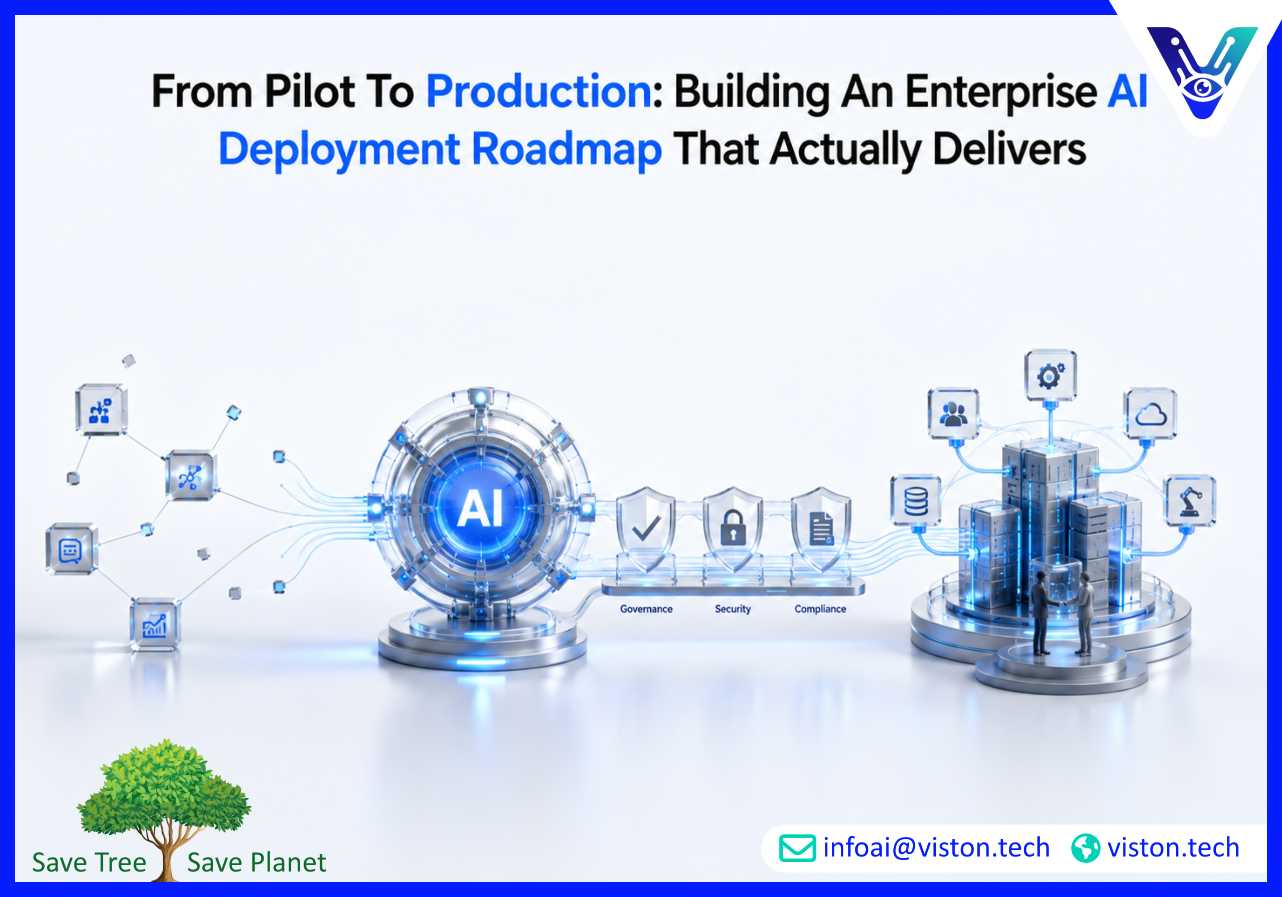
Enterprise leaders have moved past the question of “whether” to adopt AI. The real conversation in 2026 centers on a far more challenging problem: how to move from isolated pilots to production-grade, business-critical AI systems that deliver measurable returns.
The data makes this gap painfully clear. According to a November 2025 IDC survey of over 900 organizations, only 3% of companies are successfully scaling agentic AI across multiple departments, even as 62% actively experiment with these technologies. Meanwhile, Gartner predicts that 40% of enterprise applications will embed task-specific AI agents by the end of 2026—up from less than 5% at the start of the year.
This disconnect between ambition and execution is where well-intentioned AI strategies stall. An enterprise AI deployment roadmap bridges that gap. It transforms scattered experiments into a deliberate, phased strategy that aligns technical implementation with business outcomes, security requirements, and operational readiness.
The era of “letting a thousand flowers bloom” with AI experimentation is over. Google Cloud’s COO recently made this explicit: while scattered activity feels like progress, it rarely delivers the return on investment that leadership expects. The alternative is what industry leaders now call “cultivated bouquets”—a deliberate strategy focusing on five to seven high-impact use cases tightly aligned with core business goals.
For operations-heavy sectors and regulated industries, this shift is even more urgent. Finance, healthcare, and manufacturing face three converging pressures: high-volume workflows ripe for automation, clear ROI metrics that justify investment, and regulatory mandates that create forcing functions for automated, auditable processes.
The organizations succeeding in 2026 aren’t those with the flashiest AI demos. They’re the ones that integrate AI into human workflows with discipline, governance, and a clear eye on operational realities.
Before selecting any platform or writing a single line of integration code, start with a systematic inventory of candidate workflows. The most common mistake enterprises make is choosing technology before understanding what problems they’re solving.
Map each workflow against two dimensions:
Focus on high-volume, repetitive tasks that currently consume disproportionate staff time. Common prime candidates include invoice processing, ticket routing, data reconciliation, quality exception handling, and tier-one support queries.
One major healthcare provider, for example, upgraded its endpoint fleet to AI-enabled devices and saw faster diagnostic imaging processing and higher clinician productivity almost immediately. The key was targeting a specific, high-friction workflow rather than attempting wholesale transformation.
The architecture you choose determines what’s possible at scale. Enterprise AI agents operate across five critical layers, each requiring independent decisions:
For most enterprises, a hybrid architecture makes the most sense. Cloud-based AI offers speed and scalability for experimentation. Edge processing handles tasks requiring low latency, data privacy, or strict compliance. The key is designing systems where AI runs closer to where data is captured—on factory floors, in retail stores, at branch offices—while cloud resources handle computationally heavy workloads.
Integration readiness, not model capability, is the primary barrier to scale. An MIT study found that approximately 95% of generative AI pilots stall due to flawed enterprise integration. Your deployment roadmap must dedicate serious attention to API strategy, legacy system connectivity, and data unification before any agent goes live.
Governance cannot be an afterthought retrofitted after deployment. In agentic systems, every service-to-service call, tool invocation, and document artifact must be designed with identity, authorization, and traceability built in.
Ask these five questions before your first production deployment:
Without clear answers, you’re exposing your organization to “agent sprawl”—the uncontrolled proliferation of autonomous agents operating without oversight. Microsoft has identified this as “the next identity sprawl,” where decentralized agent creation creates new risk vectors that many enterprises are only beginning to recognize.
Regulated industries need particular rigor. Look for platforms and partners that maintain SOC 2 Type II, ISO 27001, HIPAA alignment, and GDPR compliance as baseline requirements. Real-time PII tokenization, tenant isolation, and immutable audit trails should apply to every agent action.
Deploy in stages, not all at once. The most reliable pattern starts internal-facing with lower-stakes tasks before progressing to customer-facing or decision-critical workflows.
A sensible sequencing:
This staging means governance frameworks, observability tooling, and agent trust models should be in place before Stage 2—not retrofitted afterward when problems have already emerged.
Change management deserves equal attention. Invest in upskilling teams to work alongside AI agents, not against them. The goal isn’t replacement; it’s creating a hybrid workforce where digital workers handle repetitive tasks while humans focus on complex judgment, relationship building, and strategic decisions.
Building an enterprise AI deployment roadmap is one thing. Executing it requires specialized expertise in AI automation and workflow bots—the very capabilities that turn strategic plans into operational reality. This is where Viston AI delivers measurable value.
Viston AI specializes in designing, building, and deploying AI automation and workflow bots that integrate seamlessly with existing enterprise systems. Rather than selling generic AI platforms, Viston works alongside internal teams to identify the highest-value automation opportunities, architect secure integrations with your ERP, CRM, and operational databases, and deploy production-ready bots that operate within your governance boundaries.
What distinguishes Viston’s approach is practical delivery focus. They don’t just hand over technology; they ensure your teams understand how to manage, monitor, and optimize automated workflows over time. For organizations in regulated industries or complex operational environments, this combination of technical capability and change management support makes the difference between a pilot that stalls and a deployment that scales.
Most organizations complete a focused pilot in 4–8 weeks, scale to production across a single department in 3–6 months, and achieve full enterprise-wide deployment in 12–18 months. Organizations with clean data infrastructure move faster.
Design agents with “bounded autonomy”—clearly defined action spaces specifying what an agent can read, write, trigger, or approve. Include human-in-the-loop gates for decisions above defined thresholds or in ambiguous situations.
Traditional RPA follows rigid, rule-based scripts. AI workflow bots reason, adapt, and handle ambiguity. They navigate multi-step processes that would break deterministic automation, making them suitable for far more complex business scenarios.
Costs vary significantly based on scope. Department-level deployments typically run $50,000–$150,000 annually. Full enterprise adoption with custom agentic workflows ranges from $250,000–$1 million per year. Calculate ROI based on hours saved, error reduction, and revenue impact from faster processes.
At minimum, look for SOC 2 Type II, ISO 27001, and GDPR compliance. For healthcare, HIPAA alignment is essential. For financial services or government work, verify FedRAMP authorization and PCI DSS certification where payment data is involved.
An enterprise AI deployment roadmap transforms abstract AI potential into concrete business results. The organizations winning in 2026 aren’t those with the most advanced models or the largest budgets. They’re the ones that approach deployment with strategic discipline: prioritizing the right use cases, designing for integration from day one, building governance into architecture, and managing the organizational change that technology alone cannot solve.
AI automation and workflow bots represent the practical vehicle for this transformation. They embed intelligence directly into the systems your teams already use, automating repetitive work without disrupting established processes. Viston AI brings the specialized expertise needed to navigate this transition—from roadmap to deployment to measurable outcomes. The question is no longer whether your enterprise will adopt AI at scale. It’s whether you’ll build the roadmap that makes it succeed.
