
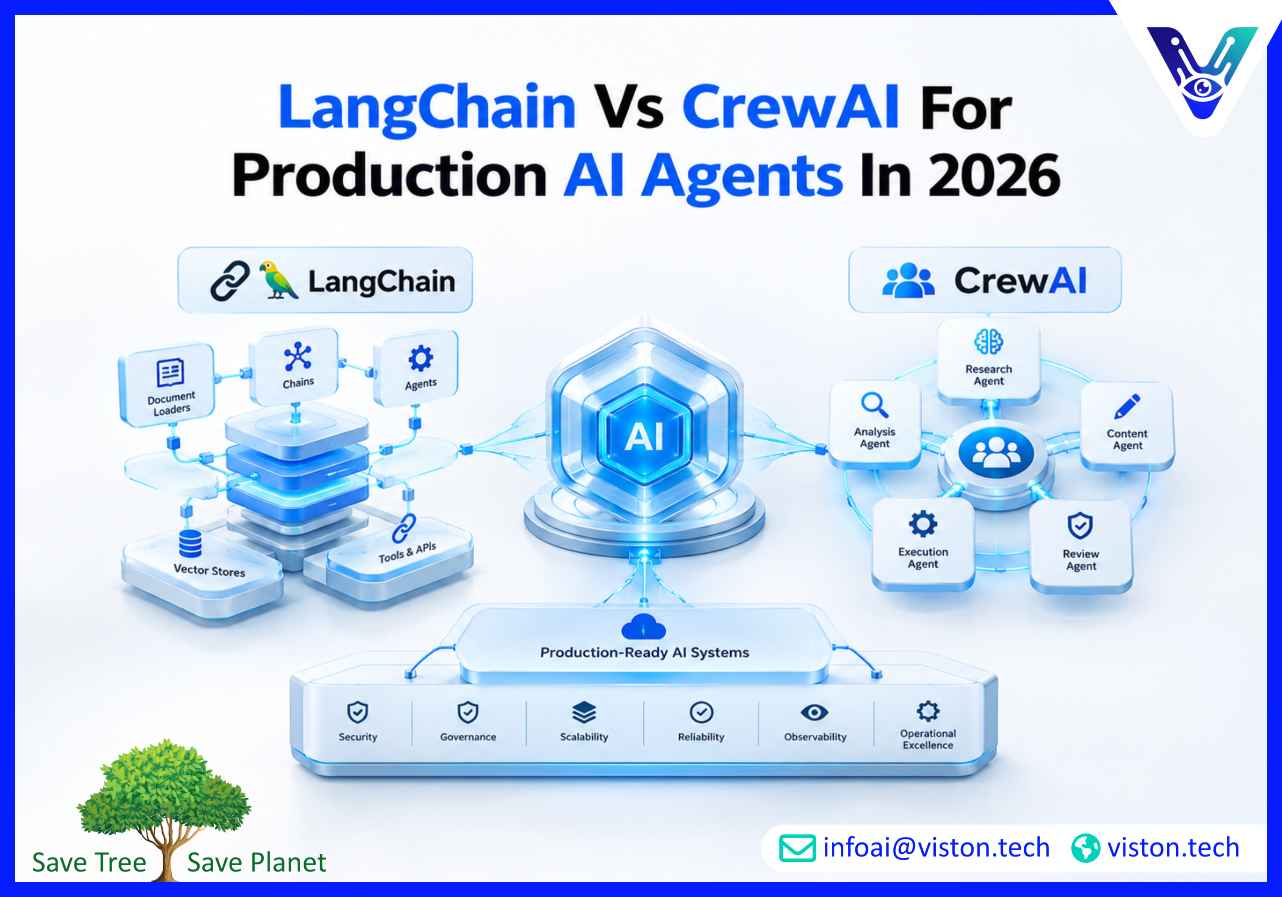
AI agents are moving beyond experimentation and into production business environments where reliability, scalability, governance, and orchestration matter. For companies building enterprise-grade AI systems in 2026, choosing between LangChain and CrewAI is no longer a simple framework preference. It directly impacts deployment complexity, maintainability, workflow automation, and long-term operational performance.
Both LangChain and CrewAI are widely used frameworks for developing AI-powered applications and autonomous agents, but they are designed with different architectural philosophies and production goals.
LangChain is a modular orchestration framework designed for building LLM-powered applications. It provides tools for:
LangChain is often used as an infrastructure layer for sophisticated AI systems that require custom pipelines, integrations, and enterprise-grade orchestration.
CrewAI focuses specifically on multi-agent collaboration. It allows developers to create autonomous AI “crews” where multiple agents operate with assigned roles, goals, and delegated responsibilities.
CrewAI emphasizes:
It is particularly attractive for organizations experimenting with collaborative AI workflows and autonomous task delegation.
Production AI systems now require far more than prompt engineering. Businesses deploying AI agents at scale must address:
The choice between LangChain and CrewAI often depends on whether the organization prioritizes flexibility and infrastructure control or rapid multi-agent orchestration.
LangChain acts as a foundational framework for building highly customizable AI systems. Developers assemble chains, tools, retrievers, memories, and agents into complex architectures.
It behaves more like a full AI application infrastructure layer than a single-purpose agent framework.
CrewAI is purpose-built for orchestrating collaborative AI agents. It abstracts much of the orchestration complexity and focuses on agent teamwork and delegation.
This makes CrewAI easier to prototype with, especially for role-based autonomous workflows.
LangChain is generally stronger for large-scale production environments because it supports:
Organizations running high-volume AI operations often prefer LangChain because they can fully customize infrastructure behavior.
LangChain also integrates well with:
CrewAI simplifies multi-agent coordination, but infrastructure customization is more limited compared to LangChain.
For many businesses, this is not necessarily a disadvantage. Teams wanting faster deployment cycles and simpler orchestration may benefit from CrewAI’s lightweight architecture.
However, highly complex enterprise deployments may eventually require additional orchestration layers beyond CrewAI alone.
This is where CrewAI becomes highly competitive.
CrewAI was specifically built for coordinated agent collaboration. It handles:
This makes it highly effective for workflows such as:
CrewAI reduces the amount of orchestration logic developers must manually create.
LangChain also supports multi-agent systems, but implementation usually requires more custom engineering.
Developers often need to design:
The advantage is greater flexibility, but the tradeoff is increased development complexity.
LangChain has a steeper learning curve because of its modular architecture.
Teams must understand:
For experienced AI engineering teams, this flexibility is valuable. For smaller teams, it can slow implementation timelines.
CrewAI is generally easier to adopt.
Its workflow-centric design allows developers to focus on:
This simplicity accelerates prototyping and MVP development.
Production AI agents require strong monitoring capabilities.
LangChain offers mature integrations with:
The ecosystem around LangChain observability has matured significantly in 2026, making it suitable for enterprise governance requirements.
CrewAI supports workflow monitoring, but advanced enterprise observability often requires additional tooling.
For smaller deployments, this may be acceptable. For regulated or mission-critical systems, additional infrastructure planning is usually necessary.
One of LangChain’s largest advantages is ecosystem maturity.
It supports extensive integrations with:
This makes LangChain highly adaptable for enterprise AI transformation initiatives.
CrewAI’s ecosystem is growing rapidly, especially for agent collaboration use cases.
However, LangChain still maintains broader integration maturity for complex production architectures.
Enterprise AI deployments increasingly require:
LangChain’s flexibility enables organizations to build governance directly into orchestration layers.
This is particularly important for:
CrewAI can support governance workflows, but organizations may need additional infrastructure to enforce enterprise policies consistently.
LangChain allows deep optimization of:
For large-scale deployments, these optimizations can significantly reduce operational costs.
CrewAI simplifies autonomous execution but can introduce inefficiencies if agent delegation is not carefully designed.
Organizations must monitor:
Viston AI specializes in AI agent development & deployment for businesses seeking scalable, production-ready AI systems. As organizations evaluate frameworks such as LangChain and CrewAI, the real challenge is rarely just selecting a tool. It is designing an operational architecture that aligns with business workflows, security requirements, integration complexity, scalability expectations, and long-term maintainability.
Viston AI helps organizations build practical AI agent ecosystems tailored to real operational environments rather than isolated prototypes. Depending on project requirements, this may include:
For businesses deploying AI agents into customer operations, internal automation, analytics workflows, or decision-support systems, framework selection is only one part of the larger architecture strategy. Production readiness depends heavily on orchestration quality, scalability planning, security implementation, and operational oversight.
Before selecting LangChain or CrewAI, businesses should evaluate:
Does the team have strong AI engineering capabilities?
Is custom infrastructure development realistic?
Are workflows collaborative and multi-agent driven?
Or highly customized and integration-heavy?
Are compliance, auditability, and security major concerns?
Will the system eventually handle enterprise-scale operations?
Is rapid prototyping more important than infrastructure flexibility?
LangChain is often preferred for enterprise-scale AI infrastructure because of its flexibility, integrations, and orchestration depth. CrewAI is highly effective for collaborative multi-agent workflows and faster implementation.
Yes. CrewAI can support production AI systems, especially for autonomous task delegation and collaborative workflows. However, larger enterprise deployments may require additional infrastructure and governance layers.
Yes. LangChain supports multi-agent architectures, but they usually require more custom orchestration and engineering compared to CrewAI’s built-in collaboration model.
CrewAI is generally easier to learn because it abstracts much of the orchestration complexity. LangChain offers greater flexibility but has a steeper learning curve.
The decision depends on workflow complexity, scalability requirements, governance needs, infrastructure preferences, and internal engineering capabilities.
Yes. Viston AI provides AI agent development & deployment services focused on scalable orchestration, automation workflows, integrations, deployment architecture, and production readiness.
The comparison between LangChain and CrewAI ultimately comes down to production priorities. LangChain offers deeper infrastructure control, broader integrations, and enterprise customization, making it highly suitable for complex AI ecosystems. CrewAI excels in collaborative multi-agent orchestration and faster workflow-centric development.
For businesses deploying AI agents in 2026, the most important factor is not simply selecting a framework, but ensuring the overall architecture supports scalability, governance, operational reliability, and measurable business outcomes. Organizations investing in AI agent development & deployment should evaluate both technical capabilities and long-term operational requirements before choosing the right orchestration strategy.
