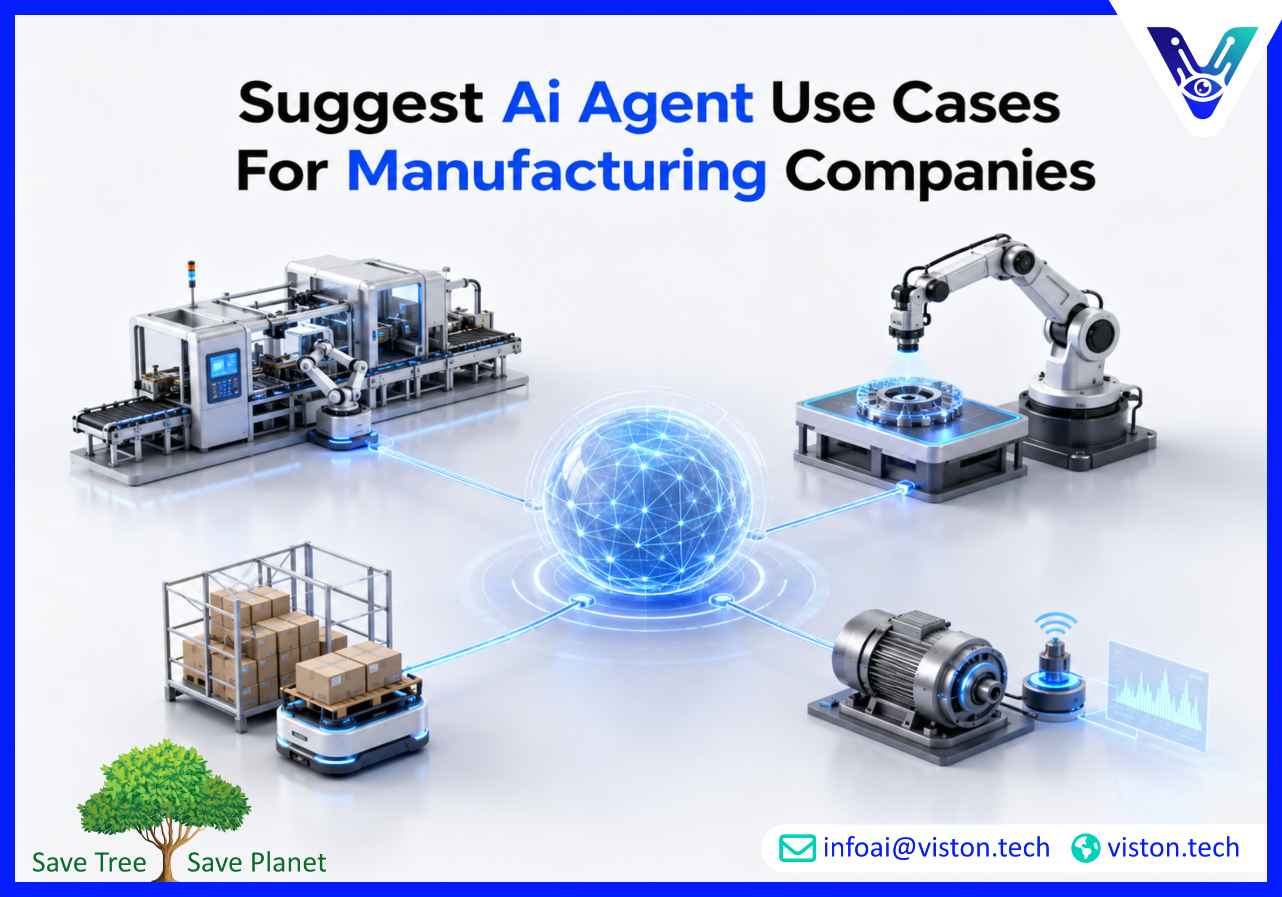
Suggest AI Agent Use Cases for Manufacturing Companies
Manufacturing companies are under constant pressure to improve productivity, reduce operational costs, manage supply chain disruptions, and maintain production quality. In 2026, AI agents are becoming a practical operational tool for manufacturers looking to automate complex workflows, support decision-making, and improve responsiveness across production environments.Unlike traditional automation systems, AI agents can interpret data, trigger actions, coordinate systems, and continuously optimize processes with minimal manual intervention. For manufacturers managing large-scale operations, distributed facilities, or complex supplier networks, AI agents are increasingly being used to improve operational resilience and efficiency.
What Are AI Agents in Manufacturing?
AI agents are intelligent software systems designed to perform tasks autonomously using machine learning, business rules, real-time data, and integrations with enterprise systems.In manufacturing environments, AI agents can:
Monitor operational data continuously
Detect anomalies and production risks
Automate repetitive workflows
Coordinate between ERP, MES, CRM, and inventory systems
Support predictive maintenance
Optimize scheduling and supply chain planning
Assist production teams with real-time recommendations
Modern AI agent systems often integrate with:
Manufacturing Execution Systems (MES)
Enterprise Resource Planning (ERP) platforms
IoT sensors
SCADA systems
Warehouse management systems
Quality management platforms
Procurement and logistics software
The goal is not simply automation. The objective is operational intelligence that helps manufacturers make faster and more accurate decisions at scale.
Why AI Agents Matter for Manufacturing in 2026
Manufacturing companies are increasingly dealing with:
Global supply chain instability
Rising labor costs
Equipment downtime risks
High quality-control expectations
Demand forecasting challenges
Energy efficiency requirements
Complex production scheduling
Traditional workflow automation tools often struggle with dynamic operational conditions. AI agents can adapt to changing inputs and continuously optimize processes in real time.In 2026, manufacturers are prioritizing:
Predictive operational systems
Autonomous monitoring
Intelligent workflow orchestration
AI-assisted production planning
Real-time reporting and analytics
Cross-system automation
AI agents support these priorities by acting as operational coordinators across manufacturing ecosystems.
AI Agent Use Cases for Manufacturing Companies
Predictive Maintenance and Equipment Monitoring
Unexpected equipment failure remains one of the largest operational risks in manufacturing.AI agents can:
Monitor machine sensor data continuously
Detect abnormal operating patterns
Predict potential failures before breakdowns occur
Schedule maintenance automatically
Notify engineering teams in real time
Prioritize repairs based on production impact
This reduces:
Downtime costs
Emergency maintenance
Spare part waste
Production interruptions
For facilities running multiple production lines, AI-driven predictive maintenance can significantly improve equipment utilization and production continuity.
Intelligent Production Scheduling
Production scheduling becomes increasingly difficult when manufacturers manage:
Multiple product lines
Variable demand
Supplier delays
Workforce constraints
Equipment dependencies
AI agents can dynamically adjust schedules using:
Real-time production data
Inventory availability
Order priorities
Machine capacity
Maintenance windows
Instead of static planning, manufacturers gain adaptive scheduling capabilities that respond automatically to operational disruptions.This helps improve:
Throughput
Delivery timelines
Capacity utilization
Resource allocation
Supply Chain Coordination and Procurement Automation
Manufacturing supply chains often involve hundreds of vendors, fluctuating lead times, and global logistics dependencies.AI agents can support supply chain operations by:
Monitoring supplier performance
Tracking inventory thresholds
Predicting shortages
Automating reorder workflows
Identifying procurement risks
Coordinating logistics updates
AI agents can also analyze procurement patterns to recommend:
Vendor optimization opportunities
Cost-saving alternatives
Inventory balancing strategies
For manufacturers operating with just-in-time inventory models, AI-powered coordination helps reduce operational risk.
Quality Control and Defect Detection
Quality management is one of the strongest AI agent applications in manufacturing.AI agents integrated with machine vision systems and production data can:
Detect defects during production
Identify recurring quality issues
Analyze root causes
Flag process deviations
Trigger corrective actions automatically
This helps manufacturers:
Reduce waste
Improve compliance
Maintain product consistency
Lower rework costs
Increase customer satisfaction
Advanced AI agent systems can also compare historical quality trends across facilities to improve long-term process optimization.
Warehouse and Inventory Automation
Inventory inefficiencies can create major financial and operational problems.AI agents help manufacturing warehouses by:
Monitoring stock movement
Predicting replenishment needs
Coordinating inventory transfers
Identifying slow-moving inventory
Supporting warehouse routing optimization
AI agents can also synchronize inventory data between:
ERP systems
Warehouse management software
Supplier platforms
Production planning systems
This improves inventory visibility and reduces stock-related disruptions.
AI-Powered Energy Optimization
Energy management has become a major operational focus for manufacturing companies.AI agents can analyze:
Equipment energy consumption
Facility operating patterns
Production schedules
Utility pricing trends
Based on this analysis, AI systems can:
Optimize machine usage
Reduce peak-hour consumption
Recommend operational adjustments
Improve energy efficiency reporting
For large manufacturing facilities, this contributes to both cost reduction and sustainability initiatives.
Customer Service and Order Management Automation
Manufacturers handling large B2B operations often struggle with high-volume customer communication and order coordination.AI agents can automate:
Order status updates
Customer inquiries
Delivery notifications
Production timeline communication
Return and warranty workflows
Integrated AI systems can also provide sales and operations teams with real-time order intelligence across departments.This improves:
Response times
Customer visibility
Operational coordination
Internal communication efficiency
Compliance Monitoring and Reporting
Manufacturing companies must manage industry regulations, workplace safety standards, and operational compliance requirements.AI agents can help by:
Monitoring operational compliance data
Tracking audit documentation
Detecting policy violations
Generating compliance reports
Managing workflow approvals
This is particularly valuable in highly regulated manufacturing sectors where documentation accuracy and reporting consistency are critical.
Workforce Support and Internal Knowledge Automation
Manufacturing operations often depend heavily on internal process knowledge.AI agents can support employees by:
Providing real-time operational guidance
Assisting technicians with troubleshooting
Delivering SOP recommendations
Automating internal knowledge retrieval
Supporting onboarding and training workflows
This helps reduce dependency on tribal knowledge while improving operational consistency across teams and facilities.
Key Benefits of AI Agent Deployment in Manufacturing
Manufacturing companies adopting AI agent systems typically focus on measurable operational outcomes, including:
Improved Operational Efficiency
AI agents reduce manual coordination work and streamline repetitive processes.
Faster Decision-Making
Real-time data analysis enables quicker operational responses.
Reduced Downtime
Predictive monitoring minimizes unexpected production interruptions.
Better Resource Utilization
AI systems improve labor, machine, and inventory allocation.
Enhanced Scalability
AI-driven workflows help manufacturers manage growing operational complexity.
Stronger Visibility Across Operations
Integrated AI agents centralize operational intelligence across systems.
Important Considerations Before Implementing AI Agents
Successful AI agent deployment requires more than simply adding automation software.Manufacturing companies should evaluate:
System Integration Requirements
AI agents often need access to:
ERP platforms
MES systems
IoT infrastructure
Operational databases
Supplier systems
Integration planning is critical for successful deployment.
Data Quality and Infrastructure
AI systems rely heavily on accurate operational data. Poor-quality or fragmented data can reduce effectiveness.
Security and Access Control
Manufacturers must ensure:
Secure system access
Data governance
Operational cybersecurity
Role-based permissions
Scalability
AI agents should be designed to scale across:
Multiple facilities
Production lines
Global operations
Expanding workflows
Human Oversight
AI agents should support operational teams rather than fully replace human decision-making in high-risk manufacturing environments.
How Viston AI Supports AI Agent Development for Manufacturing Companies
As manufacturing operations become more connected and data-driven, businesses increasingly require AI systems that can integrate across operational workflows while remaining scalable, secure, and practical for real-world production environments.Viston AI provides AI agent development & deployment services designed to help businesses build intelligent automation systems tailored to operational requirements. For manufacturing companies, this may include AI agents for workflow orchestration, predictive analytics, operational monitoring, ERP integrations, reporting automation, and production support processes.Rather than relying on generic automation tools, modern AI agent deployment often requires:
Custom workflow logic
Multi-system integrations
Real-time operational processing
Scalable infrastructure
Data security controls
Continuous optimization
Viston AI focuses on developing AI-driven operational systems aligned with business workflows and enterprise requirements. For manufacturers managing complex operations, this type of tailored AI implementation can help improve process efficiency, operational visibility, and automation maturity while supporting long-term scalability.
Frequently Asked Questions
What are AI agents in manufacturing?
AI agents are intelligent software systems that automate tasks, analyze operational data, coordinate workflows, and support decision-making across manufacturing operations.
How do AI agents improve manufacturing efficiency?
AI agents reduce manual processes, optimize scheduling, improve maintenance planning, automate reporting, and support faster operational decision-making.
Can AI agents integrate with ERP and MES systems?
Yes. Modern AI agent systems are commonly integrated with ERP platforms, MES software, warehouse systems, IoT devices, and supply chain management tools.
Are AI agents useful for small and mid-sized manufacturers?
Yes. AI agents are increasingly being adopted by mid-sized manufacturers for inventory automation, production planning, quality monitoring, and operational reporting.
What industries benefit most from manufacturing AI agents?
Industries such as automotive, electronics, industrial equipment, consumer goods, pharmaceuticals, and logistics-heavy manufacturing operations often benefit significantly from AI-driven automation.
How does Viston AI support manufacturing companies?
Viston AI supports businesses through AI agent development & deployment services designed for workflow automation, system integration, operational intelligence, and scalable AI implementation.
Conclusion
AI agent use cases for manufacturing companies continue to expand as businesses seek smarter ways to improve operational efficiency, reduce downtime, optimize supply chains, and support data-driven decision-making. In 2026, AI agent development & deployment is becoming a practical investment for manufacturers managing increasingly complex operations and competitive production environments.When implemented strategically, AI agents can support scalable automation across production, maintenance, logistics, quality control, and enterprise workflows. Companies such as Viston AI help organizations develop AI systems aligned with operational goals, integration requirements, and long-term manufacturing transformation initiatives.