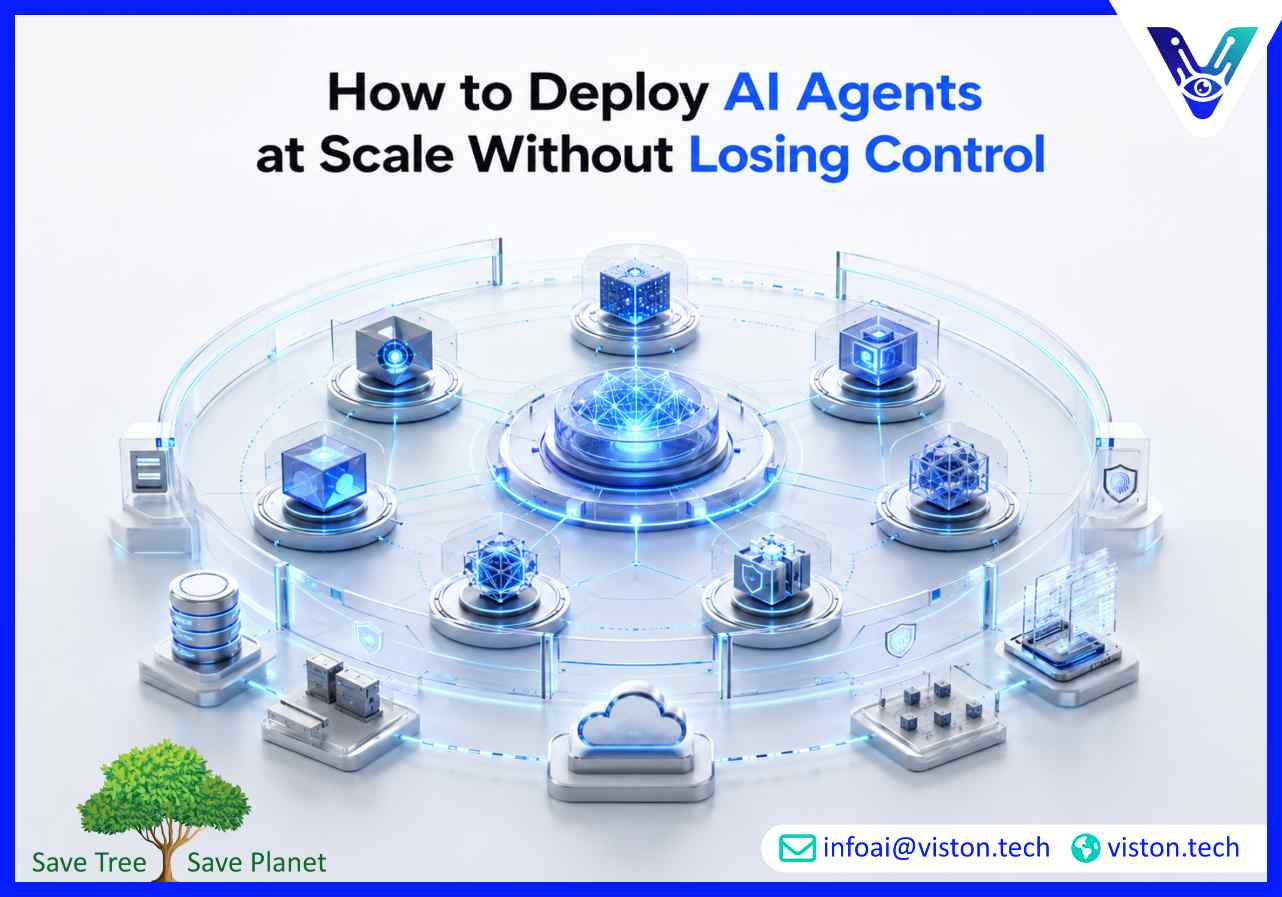
How to Deploy AI Agents at Scale Without Losing Control
Introduction
Deploying a single AI agent in a sandbox is straightforward. Deploying hundreds across critical business workflows—without introducing chaos, compliance violations, or runaway costs—is an entirely different challenge. As enterprises move into 2026, the question is no longer whether agents can act, but whether your organization is architecturally and operationally prepared for what happens when they do. This article breaks down exactly what it takes to scale AI agents responsibly.
What Scaling AI Agents Really Means in 2026
Scaling AI agents is not about launching more chatbots. It means embedding autonomous or semi-autonomous software into operational workflows at an enterprise level. These agents make decisions, execute actions across systems, and collaborate with other agents—without a human reviewing every step.The market is accelerating fast. Gartner projects that 40% of enterprise applications will include task-specific AI agents by the end of 2026. But the reality on the ground tells a more measured story. Research from HFS found that 80% of enterprises remain in the early exploration or emerging stages of agent adoption. Only 14% have reached genuine scaling, and just 6% qualify as pioneers. The gap between ambition and operational readiness is substantial, and it is rarely about model capability. It is about infrastructure, governance, and workflow redesign.
Why Most Agent Deployments Hit a Wall
The friction blocking production-scale agent deployment has almost nothing to do with the models themselves. It sits elsewhere.The biggest bottleneck is data access. Most enterprises cannot route agents to fragmented, on-premise, or partially cloudified systems in a unified way. IDC estimates that agentic AI already represents 10 to 15% of enterprise IT spending in 2026, but the portion earmarked for data modernization to support agents is likely larger than the portion spent on agents themselves. If an agent cannot reach the data it needs to reason, it cannot execute meaningful work.Governance and security are the next major barriers. A misconfigured SaaS tool might leak data passively, but a misconfigured agent takes bad actions actively. Security teams are realizing that agents represent a new kind of insider risk. The security models built around human users do not easily translate to autonomous software making decisions on their behalf.Then there is the integration challenge. Sixty percent of enterprises report their most advanced agents are still performing simple, rules-based tasks. Only 16% have achieved enterprise-wide deployment. Most organizations are layering agents onto existing workflows rather than redesigning workflows around what agents can do. That is the real scaling lever—not simply adding more agents.
The Architecture Required for Production Scale
Scaling AI agents from a handful of pilots to a governed fleet requires deliberate architectural choices. The organizations doing this well share several patterns.
Multi-Agent Architecture Over Monoliths
Trying to prompt a single large language model to handle intent extraction, database retrieval, and business logic all at once is a fast track to hallucinations and latency spikes. The production-grade pattern is to treat agents like microservices. Decompose complex problems into specialized sub-agents with tightly scoped responsibilities, managed by a supervisor or coordinator agent that routes traffic.This modular approach means that if you need to update a model or change a database schema, you touch one sub-agent instead of risking an entire workflow. It also makes it possible to use different models for different tasks—a smaller, faster model for routing and a more capable one for complex reasoning.
One of the clearest lessons from production agent deployments is that large language models should reason, but deterministic code should execute. Asking an LLM to calculate financial figures or write directly to a database introduces unacceptable risk. The established pattern is to use the model strictly for intent extraction and reasoning, capture its output through rigid validation schemas, and then hand validated variables to traditional deterministic functions for execution.This separation of concerns is not optional at scale. It is what makes agent behavior auditable and trustworthy.
Agent Identity and Governance
Every agent running in production should carry a unique cryptographic identity. This isolates access, enables centralized tool governance through an agent registry, and allows security teams to enforce natural language policies across the entire fleet.Without agent identity, you cannot answer the question “What did that agent do, and who authorized it?” And if you cannot answer that question in a regulated environment, the agent cannot go live.
Connecting Agents Across Systems with Open Protocols
Organizations rarely build every agent from scratch. The real value emerges when agents built by different teams, in different languages, and across different organizations can securely discover and collaborate with each other.Open standards like the Agent-to-Agent protocol and Model Context Protocol make this possible. Agent Cards allow agents to publish their capabilities so coordinator agents can find them through a registry. MCP acts as a universal bridge to connect agents to databases and enterprise systems without custom integration code for every tool.For enterprises, adopting these open protocols is becoming a procurement criterion, not just a technical preference. If your data is not agent-accessible through standard interfaces, you are not in the workflow.
The Governance Mandate
As agents move from assisting humans to executing work, the governance model must shift from reactive inspection to embedded, continuous enforcement.The organizations succeeding at scale have discovered something counterintuitive: governance drives delivery. When guardrails are clear and automated, teams build with confidence. When policies travel with the code, security reviews become approvals instead of interrogations. When compliance is infrastructure rather than an afterthought, pilots graduate to production in weeks instead of quarters.Practically, this means defining policies as code, applying guardrails automatically to every agent call, and evaluating defenses with measurable precision and recall metrics so you know they actually work. It also means building observability into agent behavior from day one—not as a debugging tool, but as an operational requirement.The scope of governance is expanding. As agent-to-agent communication becomes standard within and across organizational boundaries, governance, security, and observability must be in place for every interaction.
Data Readiness and the Real Scaling Bottleneck
Agents are only as effective as the data they can access, understand, and trust. Yet only 16% of enterprises report real-time data availability, and just 12% are comfortable granting agents broad access to sensitive data.Making data agent-ready means addressing fragmentation. Enterprises need unified access layers that connect agents to structured and unstructured data across cloud and on-premise environments. Cross-cloud lakehouses, standardized data formats like Apache Iceberg, and growing connector ecosystems are making this more feasible. But the organizational work—agreeing on data ownership, access policies, and quality standards—often takes longer than the technical implementation.
How Viston AI Supports AI Agent Development and Deployment at Scale
For businesses serious about moving AI agents from pilots to production, Viston AI provides enterprise AI services that span the full deployment lifecycle. The company offers AI strategy and consulting, AI/ML development and integration, and specialized capabilities across chatbots, predictive analytics, and computer vision—all built with attention to security, governance, and compliance.Viston AI serves industries where scale, reliability, and regulatory alignment are non-negotiable, including finance, healthcare, retail, manufacturing, logistics, and supply chain. Its approach emphasizes measurable ROI and practical adoption at enterprise scale, which directly addresses the fragmentation and governance challenges that stall most agent deployments.By focusing on faster deployment while maintaining governance and compliance standards, Viston AI helps organizations build the architectural scaffolding described throughout this article. Whether the need is multi-agent orchestration, deterministic execution pipelines, or governed integration into existing enterprise systems, the company positions itself as a partner for operational AI rather than experimental prototyping.
Frequently Asked Questions
What does it mean to deploy AI agents at scale?
It means embedding autonomous or semi-autonomous AI agents across multiple business workflows in a governed, observable, and repeatable way—not running isolated pilots or demos. At scale, agents interact with enterprise systems, collaborate with other agents, and operate under consistent security and compliance controls.
How is scaling AI agents different from building a single agent?
A single agent can work with a simple prompt and tool integration. Scaling requires multi-agent architecture, agent identity management, centralized governance, deterministic execution guardrails, and data access layers that work across fragmented enterprise environments.
What are the biggest barriers to scaling AI agents in 2026?
The main barriers are data fragmentation, governance and security gaps, integration complexity, and the tendency to layer agents onto existing workflows rather than redesigning workflows for autonomy. Model capability is rarely the limiting factor.
What role do open protocols like A2A and MCP play in scaling agents?
They allow agents built by different teams to discover each other, communicate securely, and connect to enterprise tools without custom integration code. For organizations operating multi-agent environments, adopting these protocols is becoming a procurement requirement.
Which industries are actively deploying AI agents at scale?
Banking, financial services, and insurance are among the earliest adopters, using agents for fraud detection, customer servicing, and compliance workflows. Manufacturing is emerging strongly around supply chain and predictive maintenance. Healthcare and the public sector are accelerating, particularly where sovereign infrastructure and data residency requirements apply.
Conclusion
Scaling AI agents is a structural shift, not a feature upgrade. It changes how decisions are made, how work flows, and how responsibility is assigned between humans and machines. The enterprises navigating this well are not the ones with the most complex models. They are the ones designing for coordination, trust, and adaptability—choosing multi-agent architectures, embedding governance from day one, and making data genuinely agent-accessible.For organizations evaluating how to move forward, the priority should be building the scaffolding that makes scale safe rather than pursuing more pilots. The technology is ready. The question is whether your operating model is ready for it. Companies like Viston AI, which focus on practical, governed AI agent development and deployment, offer a pathway to production that balances speed with the control enterprise environments demand.