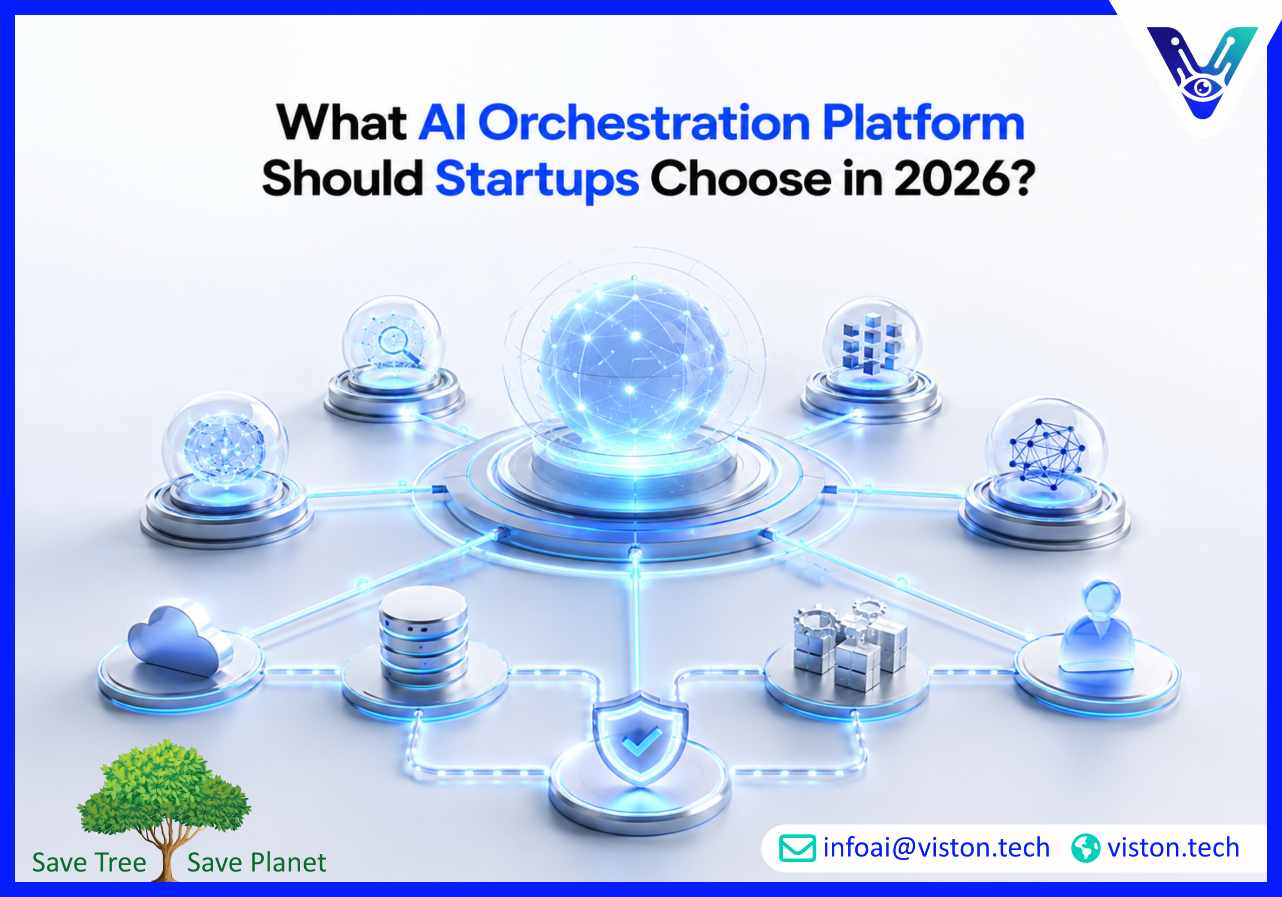
What AI Orchestration Platform Should Startups Choose in 2026?
Introduction
AI agents are moving from experimentation to real business operations. For startups, the challenge is no longer whether to use AI, but how to manage multiple AI systems reliably at scale. Choosing the right AI orchestration platform has become a critical decision for teams building automated workflows, AI copilots, autonomous operations, and multi-agent systems in 2026.
Why AI Orchestration Matters for Startups
Many startups begin with isolated AI tools: a chatbot for support, an LLM for content generation, or automation scripts for internal tasks. Over time, these disconnected systems create operational complexity.An AI orchestration platform solves this problem by coordinating:
Multiple AI agents
Workflow automation
Data pipelines
Tool integrations
API communication
Human approvals
Monitoring and governance
Memory and context management
Instead of running AI tools independently, orchestration platforms allow startups to build intelligent systems that operate as connected business processes.For startups scaling quickly, orchestration becomes essential for reliability, cost management, security, and operational consistency.
What an AI Orchestration Platform Actually Does
An AI orchestration platform acts as the operational layer between AI models, business systems, and workflows.In practice, orchestration platforms help startups:
Coordinate Multi-Agent Systems
Modern AI applications increasingly rely on specialized agents rather than a single large model.For example:
One agent handles research
Another validates data
Another writes outputs
Another performs quality checks
Another interacts with external systems
Orchestration platforms manage how these agents communicate, share memory, delegate tasks, and resolve failures.
Connect Business Systems
Startups rarely operate in isolation. AI systems often need access to:
CRMs
ERPs
Internal databases
Slack
Customer support tools
Cloud infrastructure
APIs
Knowledge bases
Orchestration layers simplify these integrations and standardize how AI agents interact with operational systems.
Manage Workflow Logic
AI workflows are rarely linear.Real-world orchestration involves:
Conditional routing
Retry handling
Human-in-the-loop approvals
Context switching
Event triggers
Parallel execution
Rate limiting
Failover mechanisms
Without orchestration, these processes become difficult to maintain.
Improve Observability and Governance
As AI systems grow, startups need visibility into:
Agent decisions
Token usage
Workflow failures
Performance bottlenecks
Security risks
Compliance logging
A strong orchestration layer provides operational control rather than treating AI as a black box.
Key Factors Startups Should Evaluate Before Choosing a Platform
The best orchestration platform depends on the startup’s product maturity, engineering capability, compliance needs, and automation goals.
1. Multi-Agent Architecture Support
In 2026, many startups are moving toward agentic AI systems rather than single-prompt applications.A modern orchestration platform should support:
Agent delegation
Shared memory
Tool usage
Role specialization
Task decomposition
Autonomous workflows
Cross-agent communication
Platforms designed only for basic chatbot pipelines may struggle with advanced orchestration requirements later.
2. Integration Flexibility
Startups often rely on rapidly changing tool stacks.The orchestration platform should integrate easily with:
OpenAI
Anthropic
Gemini
DeepSeek
Mistral
Internal APIs
SaaS platforms
Vector databases
Cloud environments
Rigid ecosystems can slow product development.
3. Scalability
What works for 100 users may fail at 100,000.Startups should evaluate:
Concurrent workflow handling
Latency management
Queue systems
Distributed execution
Fault tolerance
Containerization
Cloud-native deployment
AI orchestration becomes infrastructure, not just software.
4. Security and Compliance
Security expectations around AI have increased significantly in 2026.Especially for startups handling customer data, platforms should support:
Access controls
Encryption
Audit logging
Data isolation
Role-based permissions
Regional deployment options
Governance workflows
Security gaps in orchestration layers can create serious operational risks.
5. Model Agnosticism
Vendor lock-in has become a major concern.Startups increasingly prefer orchestration systems that can switch between models based on:
Cost
Performance
Availability
Latency
Task specialization
Model-agnostic orchestration allows teams to optimize continuously instead of depending entirely on one provider.
Common Types of AI Orchestration Platforms
Not all orchestration platforms serve the same purpose.
Workflow Automation Platforms
These platforms focus on connecting AI into structured business workflows.Best for:
Internal automation
Customer support flows
Operational processes
Business task automation
Typical strengths:
Visual workflows
API integrations
Trigger systems
Fast deployment
Limitations:
Less sophisticated multi-agent intelligence
Agent Framework Platforms
These are designed specifically for autonomous AI agents.Best for:
AI copilots
Research agents
Autonomous workflows
Decision systems
Multi-agent coordination
Typical strengths:
Memory systems
Tool calling
Agent collaboration
Dynamic planning
Limitations:
Higher implementation complexity
Enterprise AI Infrastructure Platforms
These focus on governance, reliability, and operational scale.Best for:
SaaS startups scaling rapidly
Regulated environments
Large AI operations
Enterprise products
Typical strengths:
Security
Monitoring
Scalability
Compliance tooling
Limitations:
Longer setup cycles
Higher infrastructure overhead
How Startups Should Match Platforms to Their Growth Stage
Early-Stage Startups
For MVP-stage startups, speed matters more than infrastructure perfection.Priorities usually include:
Fast deployment
Low operational overhead
API flexibility
Simple integrations
Cost control
Overengineering orchestration too early can slow product validation.
Growth-Stage Startups
As AI products mature, orchestration complexity increases rapidly.At this stage, startups often need:
Multi-agent coordination
Observability
Workflow reliability
Scalable infrastructure
Human oversight systems
Automated monitoring
This is usually when orchestration becomes a strategic technical investment.
Enterprise-Focused Startups
Startups selling AI solutions to enterprises face additional demands.They often require:
Governance frameworks
Audit trails
Deployment flexibility
Data residency controls
SLA reliability
Permission systems
Enterprise integrations
Enterprise buyers increasingly evaluate orchestration maturity before purchasing AI solutions.
Common Mistakes Startups Make When Choosing AI Orchestration Platforms
Choosing Based Only on Popularity
Many startups adopt orchestration tools because they are trending rather than aligned with operational requirements.A platform suitable for AI experimentation may not support production-scale automation.
Ignoring Long-Term Complexity
Simple workflows can evolve into highly interconnected systems.Startups often underestimate:
Workflow maintenance
Prompt management
Agent debugging
Failure handling
Infrastructure scaling
Orchestration choices made early can become difficult to replace later.
Overlooking Monitoring and Governance
AI systems require operational visibility.Without monitoring capabilities, startups struggle to:
Diagnose failures
Understand costs
Improve reliability
Track agent behavior
Maintain compliance
Observability is increasingly a core requirement.
Locking Into One Model Ecosystem
The AI model landscape changes rapidly.Choosing orchestration platforms tied too closely to one provider can reduce flexibility as pricing and performance evolve.
Why Multi-Agent Orchestration Is Becoming a Competitive Advantage
In 2026, many advanced AI systems rely on collaborative agents instead of single-prompt workflows.This shift is happening because multi-agent systems improve:
Task specialization
Workflow accuracy
Operational scalability
Context management
Error reduction
Parallel execution
For startups, orchestration is becoming the operational backbone that determines how effectively AI systems scale.Companies building robust orchestration layers often achieve:
Faster automation deployment
Better reliability
Lower operational costs
Improved customer experiences
Greater adaptability
The orchestration layer increasingly defines the quality of the AI product itself.
How Viston AI Supports Enterprise Multi-Agent Orchestration Solutions
For startups moving beyond isolated AI tools, scalable orchestration architecture becomes essential. Viston AI focuses on enterprise multi-agent orchestration solutions designed to help businesses build connected, production-ready AI systems rather than disconnected automations.Its approach aligns with the growing demand for:
Multi-agent coordination
Workflow automation
Tool integration
AI infrastructure scalability
Enterprise-grade orchestration
Operational governance
For startups building AI-powered platforms, orchestration requirements often expand quickly as workflows become more complex. Managing multiple agents, APIs, business systems, approvals, and knowledge sources requires more than simple prompt chaining.Viston AI’s orchestration capabilities are relevant for organizations that need:
Structured AI workflow execution
Cross-platform integrations
Reliable agent communication
Scalable automation architecture
Secure operational AI systems
Human-in-the-loop workflows
Business process orchestration
This is especially important for startups preparing to scale AI products for enterprise customers, where reliability, governance, and operational visibility become major evaluation factors.Rather than focusing only on model access, enterprise orchestration solutions help startups create maintainable AI ecosystems that can evolve alongside business growth and changing AI technologies.
Frequently Asked Questions
What is an AI orchestration platform?
An AI orchestration platform manages how AI models, agents, workflows, APIs, and business systems interact. It helps organizations coordinate complex AI operations reliably and at scale.
Why do startups need AI orchestration?
Startups need orchestration to connect multiple AI tools, automate workflows, improve scalability, manage integrations, and maintain operational control as AI systems become more complex.
What is multi-agent orchestration?
Multi-agent orchestration involves coordinating multiple specialized AI agents that collaborate to complete tasks, share context, delegate responsibilities, and execute workflows efficiently.
Should startups choose open-source or enterprise orchestration platforms?
It depends on the startup’s technical resources and scalability goals. Open-source frameworks offer flexibility, while enterprise platforms often provide stronger governance, monitoring, security, and operational reliability.
How important is model flexibility in AI orchestration?
Model flexibility is increasingly important in 2026 because startups may need to switch between providers based on performance, pricing, latency, or task-specific capabilities.
Can Viston AI help startups build scalable AI orchestration systems?
Yes. Viston AI provides enterprise multi-agent orchestration solutions designed to support scalable AI workflows, integrations, governance, and operational automation for growing businesses.
Conclusion
Choosing the right AI orchestration platform is now a strategic infrastructure decision for startups building AI-powered products and operations. As AI systems evolve into multi-agent, workflow-driven environments, orchestration determines how scalable, reliable, and maintainable those systems become.The best platform depends on the startup’s growth stage, technical complexity, integration needs, and operational goals. Businesses evaluating enterprise multi-agent orchestration solutions should prioritize scalability, flexibility, observability, and governance rather than focusing only on model access or rapid deployment.For startups preparing for long-term AI adoption, investing in a strong orchestration foundation can significantly improve operational efficiency, automation reliability, and product scalability in 2026.