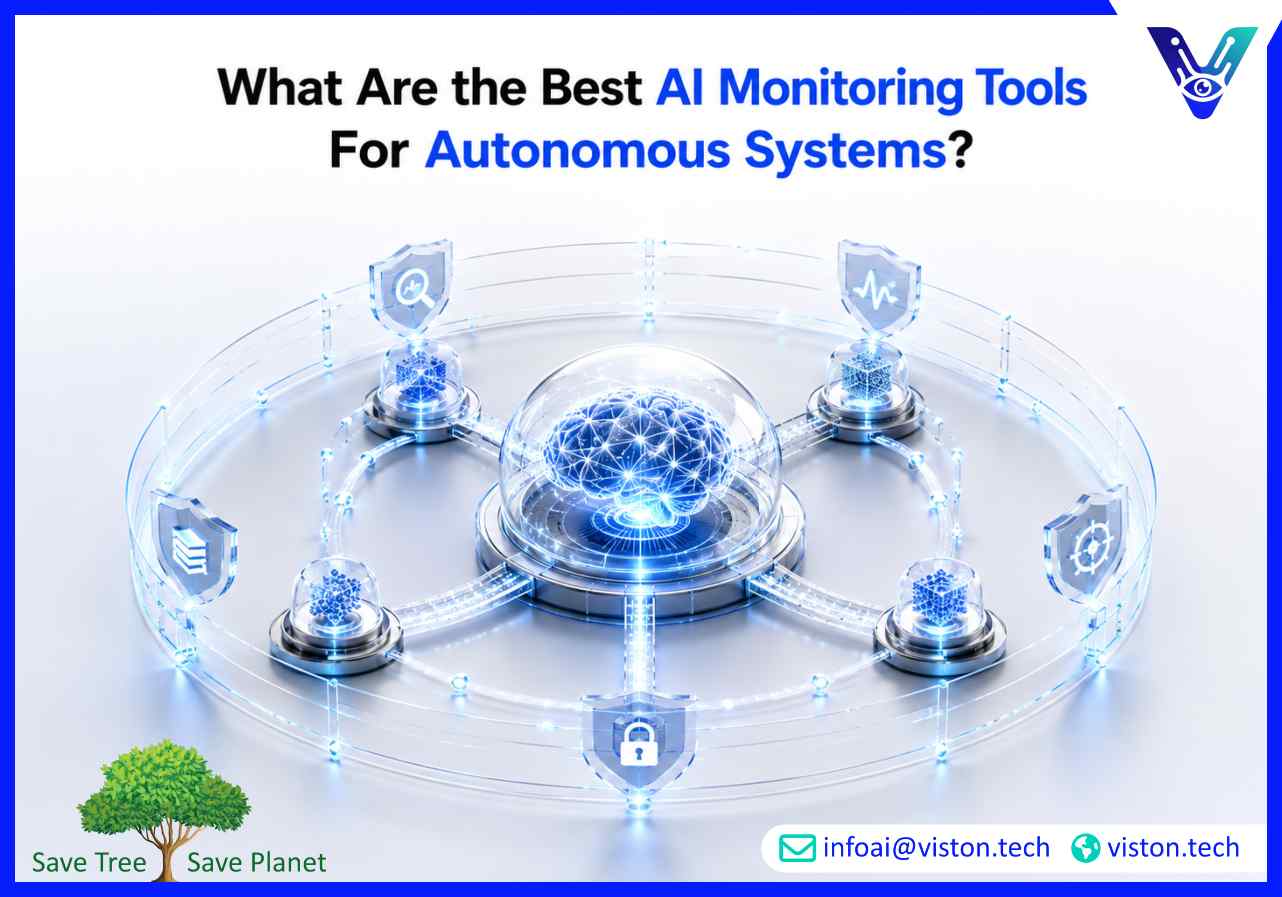
What Are the Best AI Monitoring Tools for Autonomous Systems?
Introduction
Autonomous systems—from self-driving vehicles to agentic AI workflows—are transforming business operations. But as these systems gain independence, the question shifts from “what can they do” to “how can we trust what they’re doing.” For organizations deploying autonomous capabilities, AI monitoring has become an operational necessity, not a technical luxury.
Understanding AI Monitoring for Autonomous Systems
The shift from simple automation to true autonomy has broken traditional monitoring approaches. Autonomous systems fail in ways that look like success: actions that are syntactically valid but semantically wrong, unnecessary tool calls that waste resources, or decisions that achieve stated goals but violate unstated business rules.AI monitoring for autonomous systems is fundamentally different from conventional observability. Traditional tools track metrics like CPU usage and response times. Autonomous monitoring must track reasoning—the branching paths of multi-step decision loops, the quality of context retrieval, and the coherence of goal completion across extended operations.In 2026, the market has matured significantly. Enterprise spending on AI agent monitoring is projected to grow at a 45% compound annual rate, driven by requirements for security, cost control, and regulatory compliance. Organizations can no longer afford to treat autonomous systems as black boxes.
Why Traditional Observability Falls Short
Conventional observability platforms were designed for deterministic systems. They excel at answering “what happened” but struggle with “why did the agent decide that.” Autonomous systems introduce several monitoring challenges that legacy tools cannot address:Decision transparency is the first hurdle. When an autonomous agent makes a tool call or takes an action, understanding the reasoning chain requires tracing through context windows, retrieval outputs, and internal state changes—information most platforms discard after debugging.Cost attribution presents another challenge. Autonomous systems can consume tokens unpredictably, making budget forecasting difficult. Without granular monitoring, organizations face unexpected bills from recursive loops or inefficient agent behaviors.Security and compliance requirements add further complexity. Autonomous agents access data and execute actions across systems. Monitoring must track behavioral drift, detect anomalous patterns, and maintain auditable records for regulatory review.
The Architecture of Modern AI Monitoring Tools
Understanding the underlying architecture of monitoring tools helps organizations make informed procurement decisions. Most solutions fall into one of two categories:Proxy-based tools sit between your application and model providers. They offer zero-instrumentation setup and automatic capture of all traffic. However, they introduce a potential single point of failure and raise security concerns about credential exposure.SDK-based tools instrument your code directly. There is no middleman, meaning deeper visibility into agent reasoning and no external dependency for continued operation. The trade-off is higher implementation effort.For production autonomous systems, industry experts increasingly recommend SDK-based approaches. The ability to function during observability backend outages and maintain data within your security perimeter outweighs the convenience of proxy solutions.
Essential Capabilities for Production Monitoring
When evaluating AI monitoring tools for autonomous systems, several capabilities have emerged as non-negotiable for enterprise deployments.
Trace-Level LLM Evaluations
Standard metrics cannot capture whether an agent made the right decision. Trace-level evaluations verify end-to-end reliability by scoring each step against business criteria—not just technical correctness.
Context Graph Management
The persistent record of why an agent made each decision—including the reasoning it considered, the context it retrieved, and the tools it called—becomes a business asset. The best platforms retain this data, make it queryable, and enable feedback loops where past decisions inform future behavior.
Session-Level Analysis
Autonomous systems operate across multi-turn interactions. Monitoring must measure coherence and goal achievement across entire sessions, not just isolated responses.
Behavioral Drift Detection
Agents can gradually deviate from expected behavior patterns due to model updates, data shifts, or gradual compromise. Automated drift detection flags these changes before they impact operations.
Implementation Considerations for Enterprises
Deploying AI monitoring requires more than selecting a tool. Organizations must address several practical considerations to achieve production-ready observability.Data architecture decisions have long-term implications. Whether monitoring data lives in your warehouse or the vendor’s platform affects query performance, analysis flexibility, and migration complexity. Some enterprises prioritize data portability through OpenTelemetry standards, while others accept vendor coupling for real-time query capabilities.Guardrail implementation defines what actions AI can take automatically. Organizations progressing toward autonomous operations typically start with supervised models—AI recommends actions, humans approve—before moving to conditional automation for low-risk scenarios.Integration with existing stacks determines adoption success. Monitoring tools that require complete instrumentation rewrites face internal resistance. Solutions supporting standard protocols and existing framework integrations reduce friction.
The Role of AI-Powered Research Tools in Autonomous Monitoring
This is where specialized research capabilities become relevant. AI-powered research tools enable organizations to analyze monitoring data at scale—transforming raw telemetry into actionable intelligence about system behavior, failure patterns, and optimization opportunities.For businesses deploying autonomous systems, the volume of monitoring data quickly overwhelms manual analysis. AI research tools automate pattern detection, correlate seemingly unrelated failures, and generate hypotheses about root causes. They turn observability from a reactive debugging exercise into a proactive improvement engine.Viston AI provides AI-powered research tools that help organizations extract meaning from complex monitoring datasets. By applying advanced pattern recognition and contextual analysis to agent traces and system logs, Viston AI enables teams to identify failure precursors, optimize agent performance, and validate compliance with operational guardrails. For enterprises scaling autonomous deployments, this research capability transforms monitoring data from a compliance burden into a strategic asset.
Making an Informed Decision
Selecting AI monitoring tools requires matching capabilities to your specific autonomy maturity level. Organizations just beginning their autonomous journey may prioritize visibility and basic tracing. Those operating agentic systems in production need advanced evaluation frameworks and behavioral analysis.Key questions to ask potential vendors include:
How does the platform capture and store reasoning context?
What evaluation frameworks exist for measuring decision quality?
How is cost attributed to specific agent actions or workflows?
What guardrails exist for automated remediation?
How does the platform support compliance auditing?
The answers reveal whether a tool treats monitoring as telemetry collection or as an integrated system for understanding and improving autonomous behavior.
Frequently Asked Questions
What is the difference between AI monitoring and traditional observability?
Traditional observability tracks system health metrics like latency, errors, and resource usage. AI monitoring for autonomous systems focuses on decision quality, reasoning paths, goal completion, and behavioral consistency—capturing why an agent acted as it did, not just what happened.
Do autonomous systems require specialized monitoring tools?
Yes. Standard observability platforms cannot adequately capture agent decision trees, context retrieval quality, or multi-step reasoning coherence. Specialized tools provide trace-level evaluations, context graph management, and session-level analysis essential for production autonomous deployments.
How do AI-powered research tools support autonomous system monitoring?
Research tools analyze monitoring data to detect patterns, correlate failures, and generate optimization insights. They transform raw telemetry from a debugging resource into strategic intelligence about system behavior and improvement opportunities.
What are the key risks of insufficient AI monitoring?
Inadequate monitoring leads to undetected behavioral drift, unexpected cost overruns from inefficient agent actions, compliance violations from untracked decisions, and inability to diagnose failures when they occur. Organizations may face regulatory fines or operational disruptions.
How should organizations approach the transition to autonomous operations?
A phased approach is recommended: start with AI-assisted detection and human approval for actions, progress to supervised automation with guardrails, and only move toward conditional autonomy after validating reliability. Trust mechanisms and explainability are essential at every stage.
Conclusion
AI monitoring for autonomous systems has evolved from a technical nicety to an operational imperative in 2026. As organizations deploy increasingly independent agents, the ability to observe, understand, and optimize their behavior directly impacts reliability, cost, and compliance.The best tools provide decision-level visibility, maintain durable context graphs, and support evaluation frameworks that measure business outcomes—not just technical metrics. For enterprises serious about autonomous systems, monitoring is not an afterthought but the foundation of responsible deployment.AI-powered research tools play a critical enabling role in this ecosystem, turning raw monitoring data into actionable intelligence. Viston AI’s research capabilities help organizations extract maximum value from their observability investments, supporting the pattern detection and analysis needed to scale autonomous operations with confidence.