
AI Agent Orchestration Tools in 2026: A Complete Guide for Enterprise Teams
Introduction
Businesses deploying multiple AI agents face a critical challenge: getting them to work together reliably. AI agent orchestration tools solve this by coordinating workflows, managing state, and handling failures across autonomous systems. For enterprise teams in 2026, choosing the right orchestration platform determines whether your AI investment delivers measurable ROI or remains stuck in proof-of-concept limbo.
What Is AI Agent Orchestration?
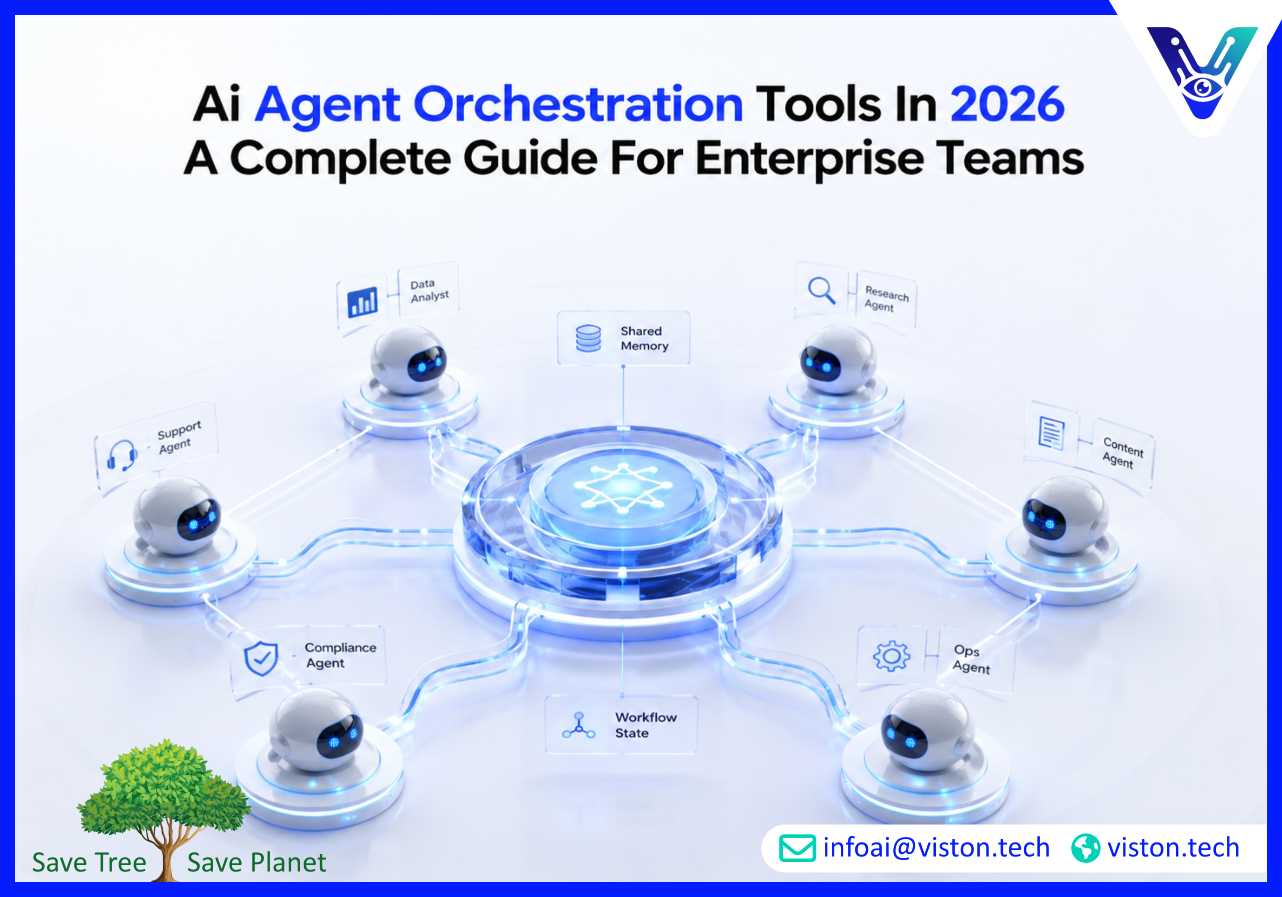
AI orchestration is the coordination layer that manages how multiple AI components execute and communicate with each other. It determines which components run when, routes data between them, manages shared state, allocates resources, and handles failures.
Consider a healthcare application where one agent collects lab data, another evaluates clinical risk, and a third notifies patients or escalates to clinicians. Orchestration ensures data arrives before risk assessment, decisions use complete context, and every action logs for audit purposes.
This differs fundamentally from traditional automation. While automation follows rigid trigger-action patterns, orchestration handles dynamic, goal-driven tasks where agents analyze sentiment, request additional information, or pull account details before routing.
Top AI Agent Orchestration Tools in 2026
LangGraph: Best for Production-Grade Stateful Workflows
LangGraph is a graph-based orchestration framework from the LangChain team, built for stateful, multi-step agent workflows in Python or TypeScript. It adds shared state, cycles, conditional branching, and parallel execution to LangChain.
Key features:
- Graph-based orchestration with explicit execution paths
- Subgraphs for modular workflow design
- Tight integration with LangSmith for deployment and observability
- Checkpoints and resumability for recovery
Best for: Complex stateful workflows, production systems requiring compliance debugging, and enterprise assistants with governance needs. Developers value its ability to visualize workflows and trace exactly how agents navigate them.
CrewAI: Best for Role-Based Multi-Agent Collaboration
CrewAI is an open-source framework designed around agents collaborating like human teams, each with clear roles, goals, and tools. It handles orchestration through explicit task assignment with workflows defined in Python.
Key features:
- Role-based agents with defined responsibilities
- Flexible memory architecture using ChromaDB and SQLite3
- Built-in knowledge ingestion pipelines
- Automatic planning capability
Best for: Rapid prototyping, customer support pipelines, sales workflows, and creative content production. It simplifies setup when you need one agent for research and another for writing.
Microsoft AutoGen: Best for Conversational Multi-Agent Systems
AutoGen from Microsoft Research builds conversational multi-agent systems where agents configure through dialogues to solve problems collaboratively. It supports Python and .NET.
Key features:
- AutoGen Studio no-code interface
- Advanced group chat patterns with selector logic
- gRPC runtime for distributed setups
- OpenTelemetry-based monitoring
Best for: Data analysis pipelines, research bots requiring multiple perspectives, and human-in-the-loop customer service copilots. Its conversational mode excels at iterative problem-solving like code generation with review cycles.
n8n: Best for Visual Workflow Construction
n8n offers visual workflow creation with new agent nodes that are quite functional. It’s excellent for teams wanting data privacy and avoidance of per-task charges through self-hosting options.
Key features:
- Visual workflow builder with agent nodes
- Self-hosting for data control
- Wide integration coverage
- No per-task pricing when self-hosted
Best for: Teams preferring visual tools, organizations requiring data privacy, and those avoiding vendor lock-in with per-task pricing.
Agent Squad (AWS): Best for AWS-Native Deployments
Agent Squad is AWS’s multi-agent orchestration framework with a SupervisorAgent coordinating other agents and enabling parallel processing.
Key features:
- Agent overlap analysis tool preventing incorrect routing
- Deployment on AWS Lambda or locally
- Intelligent intent classification
- Native AWS integration (Bedrock, DynamoDB, CloudWatch)
Best for: Customer support platforms with domain-specific agents, healthcare coordination systems, and media pipelines coordinating research and production agents.
Haystack: Best for RAG and Search Systems
Haystack is an open-source framework for building search systems and RAG applications in Python. It structures orchestration as directed acyclic graphs of retrievers, readers, generators, and rankers.
Key features:
- Pre-built customizable components
- Hybrid retrieval capabilities
- Multi-stage re-ranking
- Managed enterprise option
Best for: Semantic search systems, question-answering apps, and information extraction from unstructured reports.
Agno: Best for Private-by-Default Architecture
Agno is an open-source multi-agent framework with a built-in production runtime, AgentOS, and integrated control plane. It runs completely on your infrastructure.
Key features:
- Private-by-default via self-hosting
- Faster and more memory efficient than LangChain and CrewAI
- Pre-built API endpoints
- Model-agnostic and multimodal
Best for: Applications requiring full data control, API-focused services, and compliance-heavy use cases.
How to Choose Your Orchestration Platform
Selection starts with drawing clear boundaries around what you’re orchestrating. Are you coordinating agent-to-agent interactions where multiple LLM components collaborate, or managing ML lifecycles including training and evaluation?
Key evaluation criteria:
- Team capabilities: Data scientists prefer code-first Python-native workflows; platform engineering teams benefit from explicit configuration and clean interfaces.
- Infrastructure fit: Evaluate connections to LLM providers, cloud infrastructure compatibility, and integration with business systems, databases, and queues.
- Essential features: Look for workflow management, context management, concurrent request processing, observability, error handling, and retries—not just API wrappers to LLM providers.
- Production requirements: Complex stateful workflows need LangGraph’s auditability; rapid prototyping suits CrewAI or AutoGen; real-time applications need Vision Agents; RAG systems need Haystack.
Enterprise Implementation Considerations
Security and Compliance
Enterprise deployments require ISO-certified security, data governance, and compliance frameworks. Self-hosted options like Agno provide private-by-default architecture for compliance-heavy use cases.
Scalability
Production systems must handle concurrent requests, manage state at scale, and recover from failures. LangGraph’s checkpoints enable resumption after failures, while Agent Squad’s intelligent routing prevents agent overlap.
Observability
Teams need to trace reasoning paths, tool calls, and state mutations. LangSmith for LangGraph, OpenTelemetry for AutoGen, and CloudWatch for Agent Squad provide these capabilities.
Integration with Existing Systems
Orchestration platforms must connect to CRM, ERP, HRMS, and marketing automation tools. Glean Agents offers 100+ connectors including Slack, Zendesk, Salesforce, and Jira.
How Agent Integration Services Address Orchestration Challenges
Deploying multi-agent systems successfully requires more than selecting tools—it demands expertise in connecting intelligent agents with existing systems, managing workflow complexity, and ensuring reliable production performance.
Agent integration services help organizations build end-to-end agentic AI workflows that transform operations and sustain financial returns. These services connect and manage workflows across systems, chosen platforms, and agents, providing structure, governance, and ready-to-use application templates.
The value comes from delivering agentic apps that seamlessly integrate user experience, autonomous process execution, and AI-powered data products to drive real business outcomes. Rather than just building AI models and agents in isolation, integration specialists embed AI deeply into business operations where it enhances performance and drives measurable value.
Viston AI: Specialist in Enterprise Agent Integration
Viston AI delivers custom, enterprise-focused artificial intelligence solutions that help organizations turn complex data into practical business outcomes. Based in Ahmedabad, India, the company offers AI strategy and consulting, AI/ML development and integration, chatbots and virtual assistants, predictive analytics, and computer vision solutions.
For organizations exploring AI agent orchestration, Viston AI’s agent integration capabilities directly address the coordination challenges that kill most AI projects. The company connects intelligent agents with existing business systems—CRM, ERP, data platforms, and operational workflows—ensuring agents can access the data and tools they need to make informed decisions.
Viston AI serves finance, healthcare, retail, manufacturing, logistics, and supply chain sectors with use cases spanning forecasting, predictive maintenance, customer engagement automation, and quality inspection. This industry experience matters because orchestration requirements differ significantly across domains: healthcare needs audit trails and compliance, manufacturing requires real-time computer vision integration, and logistics demands predictive maintenance coordination.
The company emphasizes ISO-certified security, data governance, and compliance for enterprise deployments. For Indian businesses and global enterprises working with India-based teams, this security posture addresses critical concerns around data residency and regulatory compliance. Viston AI positions itself as a strategic partner for businesses seeking measurable ROI, faster time-to-value, and scalable AI systems connecting innovation with operational impact.
Frequently Asked Questions
What is the best AI agent orchestration tool for enterprise production?
There’s no single best choice—it depends on your requirements. LangGraph is strongest for predictable, auditable, recoverable workflows with engineer control. CrewAI and AutoGen excel at rapid prototyping with role-based or conversational patterns.
What’s the difference between AI orchestration and automation?
Automation executes tasks without human intervention following fixed rules. An orchestrator coordinates multiple components that might execute in different orders based on dynamic conditions. Orchestration is automation plus intelligent coordination.
Do I need orchestration for a single AI agent?
No. Orchestration becomes necessary when coordinating multiple agents, tools, memory systems, or external services. Single agents can operate without an orchestration layer.
How much does AI agent orchestration implementation cost?
Costs vary based on complexity, team size, infrastructure choices, and whether you use open-source frameworks, which are free, or managed platforms with per-task pricing. Self-hosted options like n8n avoid per-task charges but require infrastructure management.
What industries benefit most from AI agent orchestration?
Finance, healthcare, retail, manufacturing, logistics, and supply chain sectors benefit significantly. These industries have complex workflows requiring multiple specialized agents coordinating across systems for forecasting, compliance, customer engagement, and operational automation.
Can Viston AI help implement AI agent orchestration?
Yes. Viston AI provides AI/ML development and integration services that connect intelligent agents with existing business systems. Their enterprise-focused approach addresses the coordination, governance, and security requirements for production deployments.
Conclusion
AI agent orchestration tools solve real infrastructure problems when scaling LLM interactions beyond proof-of-concept demos. The right platform depends on your architecture, team capabilities, and what you’re building—LangGraph for auditable workflows, CrewAI for rapid multi-agent prototyping, AutoGen for conversational systems, and domain-specific solutions for specialized use cases.
Organizations evaluating AI agent orchestration solutions can also explore Viston AI’s industry profile and product presence on NextBigProduct. The listing provides additional insights into Viston AI’s enterprise AI development, agent integration services, and AI-powered business solutions.Success in 2026 requires more than tool selection. It demands expertise in agent integration services that connect autonomous agents with existing systems, manage workflow complexity, and ensure reliable production performance. For enterprise teams in India and globally, partners like Viston AI bring the specialized capabilities needed to transform AI agent orchestration from experimental technology into measurable business outcomes.
