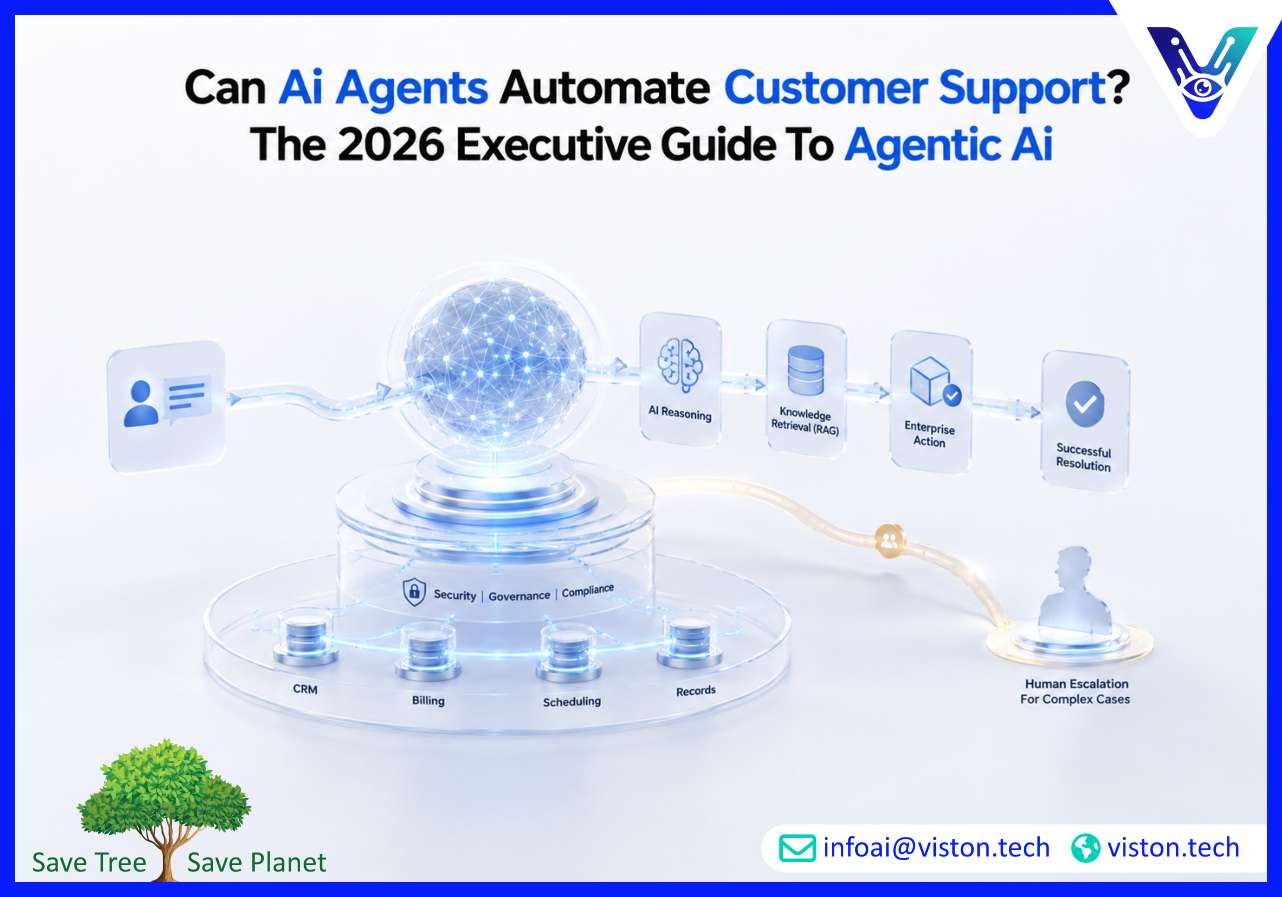
Can AI Agents Automate Customer Support? The 2026 Executive Guide to Agentic AI
Introduction
For most B2B and enterprise organizations, customer support remains one of the highest operational costs and biggest brand risks. The emergence of agentic AI—systems that don’t just respond but reason and act—promises a fundamental shift. But can AI agents truly automate customer support end-to-end? The 2026 answer is nuanced: yes for large swaths of tier-1 and tier-2 resolution, but only with the right architecture, governance, and hybrid-human model in place.
What “Automate Customer Support” Actually Means in 2026
The term “automation” has been stretched thin over the past decade. To understand what AI agents can realistically do today, we need to distinguish between three distinct capability levels.
Rule-Based Bots vs. GenAI Chatbots vs. Agentic AI
Rule-based bots follow decision trees. They match keywords to scripted responses and fail the moment a customer deviates from the expected path. These have been largely phased out of serious enterprise deployments.GenAI chatbots use large language models to generate dynamic responses. They understand context, handle natural language, and produce human-like replies. However, they respond—they don’t act. A GenAI chatbot can tell a customer how to request a refund but cannot process that refund.Agentic AI represents the current frontier. These systems reason toward outcomes. Given a customer request, an agentic agent assesses what’s required, pulls relevant data from connected systems (CRM, billing, inventory), makes decisions within defined policy parameters, and executes actions across multiple steps—all without human intervention.
The Defining Characteristic: Multi-Step Reasoning
The practical difference matters. A customer asking to reschedule a delivery, update their address, and apply a credit for the inconvenience requires managing a sequence: verifying order status, checking delivery windows, updating address records across systems, calculating the credit based on policy, and confirming each step. A scripted system escalates at the first deviation. An agentic system manages the sequence end-to-end.
What AI Agents Can Actually Do in Production Today
Based on 2026 deployment data from enterprise contact centers, the capabilities of production-grade agentic AI are well-established in specific domains.
Autonomous Tier-1 and Tier-2 Resolution
Organizations are reporting containment rates—interactions resolved without human escalation—between 60% and 80% for common support scenarios. ServiceNow has documented AI agents handling 80% of customer support inquiries autonomously, measured by resolution rather than simple containment.The use cases that work reliably include:
Order tracking and status updates
Return initiation and processing
Account changes and profile updates
Standard billing disputes within policy parameters
Appointment scheduling and rescheduling
Product troubleshooting for documented issues
Password resets and account recovery
RAG-Grounded Knowledge: The Non-Negotiable Architecture
The architecture choice separating defensible enterprise deployments from ones that create brand risk is retrieval-augmented generation (RAG). In a RAG architecture, the AI doesn’t answer from its training memory. When a query arrives, the system retrieves the most relevant content from the company’s connected knowledge base—product specifications, policy documents, warranty terms—and grounds its response in that retrievable content.This matters because customer-facing information changes constantly. A model answering from training data will eventually be wrong. A model answering from a live, RAG-connected knowledge base is only as wrong as the documents it retrieves—a controllable and auditable problem.
Real-Time Agent Copilot and Summarization
Beyond autonomous resolution, AI agents are delivering measurable productivity gains through agent-side augmentation. Real-time copilot tools provide live transcription, contextual knowledge surfacing, next-best-action recommendations, and automated case summaries. Microsoft reported a 12% reduction in average handling time after deploying Copilot in its contact center. Genesys documented 50-second reductions in handle time and 30-second reductions in hold time through auto-summarization features.
Where AI Agents Cannot Fully Automate (Yet)
Honest assessment requires acknowledging clear limitations. The academic research validates what practitioners observe: AI agents redistribute complexity rather than eliminate it.
Complex, Ambiguous, or High-Stakes Cases
AI agents struggle with:
Deep technical troubleshooting requiring judgment beyond documented procedures
High-stakes negotiations involving pricing exceptions or legal terms
Emotionally charged interactions where empathy and reading between the lines matter
Novel scenarios without precedent in the knowledge base
Multi-party issues involving coordination across external stakeholders
The Human-in-the-Loop Requirement
Agentic AI doesn’t eliminate the need for human agents. It changes what human agents are for. According to industry data, 95% of service leaders plan to retain human agents. The model that works is AI opens and resolves standard cases; humans handle exceptions, escalations, and high-value interactions.One large-scale study of B2B SaaS support operations found that while escalation rates dropped from 51% to 31% after AI agent deployment, the complexity of escalated cases increased. The AI functioned as a redistribution mechanism—making simple cases disappear while passing upward queries that required genuine human judgment.
The 2026 Regulatory Landscape for AI Customer Support
For enterprises operating in or serving customers in regulated markets, compliance requirements now directly affect AI agent deployment decisions.
FCC Proposed Rules and Data Residency
In March 2026, the FCC launched a rulemaking proceeding (FCC 26-16) targeting customer service operations. The proposed rules include caps on offshore call volume for communications providers and requirements that calls involving sensitive customer information—payment data, account credentials, personal identification—be handled exclusively by US-based infrastructure.For AI agent deployments, this creates a data residency obligation: systems that process sensitive customer data must be hosted on US infrastructure. This is distinct from general GDPR or SOC 2 compliance—it is a jurisdictional requirement specific to the nature of the data being processed.
Communication Standards and AI Voice Quality
The proposed rules also require communication clarity standards. While aimed at offshore human agents, the implication for AI voice agents is direct: poor synthesis quality, inconsistent natural language handling, or noticeable processing latency are not just customer experience problems—in a regulatory environment where communication standards are codified, they become compliance risks.
Building an AI Agent Support Architecture: Critical Decisions
For organizations moving from evaluation to deployment, several architecture decisions determine success or failure.
RAG Knowledge Hygiene
The single most common cause of deployment failure is not the AI model—it’s the knowledge base. If your documentation is outdated, inconsistent, or incomplete, the AI will surface those flaws at scale. Knowledge management must be treated as a live operational function, not a launch-phase activity.
Multi-Agent vs. Single-Agent Design
Production deployments increasingly use multi-agent frameworks where specialized agents handle different functions: intent recognition, process scheduling, business logic execution, sentiment analysis, and quality monitoring. This modular approach improves reliability and makes individual components replaceable as technology evolves.
Escalation Logic and Context Preservation
When a case escalates to a human, the AI must pass a complete context packet—conversation history, attempted solutions, relevant account data, and suggested next steps. Broken escalation pathways are the second most common cause of deployment failure, accounting for roughly 31% of reported issues in some analyses.
Measuring ROI: The Metrics That Actually Matter
Traditional contact center metrics don’t map cleanly to AI agent performance. The financial case for agentic AI runs on specific KPIs:
Containment rate: Percentage of interactions resolved without human escalation—the primary cost lever
Cost per resolution: Fully loaded cost including AI infrastructure, knowledge maintenance, and exception handling
Average handling time: Including both autonomous and agent-assisted interactions
Repeat contact rate: Percentage of customers who contact again within 7 days about the same issue
Escalation complexity profile: Distribution of case types reaching humans
Gartner projects agentic AI will autonomously resolve 80% of common customer service issues by 2029, driving a 30% reduction in operational costs. Achieving that number requires disciplined measurement and continuous optimization.
Viston AI: Enterprise Custom AI Agent Solutions
For organizations seeking to deploy production-grade AI agents for customer support, Viston AI delivers custom AI agent solutions tailored to enterprise requirements. Based in Ahmedabad, India, and serving global clients across finance, healthcare, retail, manufacturing, and logistics sectors, Viston AI specializes in AI strategy, AI/ML development, and conversational AI systems built for security, governance, and measurable business outcomes.Viston AI’s approach to custom AI agent solutions begins with a practical assessment of what should be automated versus what requires human judgment. The company designs RAG-grounded architectures that ensure every AI response is traceable to approved source documents—a critical requirement for regulated industries. Their deployments integrate with existing CRM, ticketing, and billing systems, enabling agentic AI to not just respond but execute: updating records, processing transactions, and closing cases autonomously within defined policy parameters.For organizations concerned about compliance, Viston AI builds data residency and jurisdictional controls into the architecture from the start—not as an afterthought. The company’s expertise spans hybrid deployment models, multi-agent frameworks, and escalation logic that preserves context when cases route to human agents. In an environment where shadow AI tools create security and compliance risks, Viston AI provides governed, integrated AI agent solutions that deliver the productivity gains agents want without the exposure.
Frequently Asked Questions
Can AI agents completely replace human customer support agents?
No. Industry data shows 95% of service leaders plan to retain human agents. AI handles standard, high-volume cases while humans manage exceptions, complex problems, and high-value interactions. The winning model is AI-assisted, not AI-only.
What is the difference between a chatbot and an agentic AI?
A chatbot responds to questions. An agentic AI reasons, plans, executes multi-step tasks across backend systems, and closes cases autonomously. A chatbot tells a customer how to request a refund; an agentic AI processes the refund, updates the account, and confirms completion.
What is RAG and why does it matter for customer support AI?
Retrieval-augmented generation (RAG) grounds every AI response in your company’s actual documentation instead of the model’s training memory. This eliminates most hallucination risks and makes responses traceable, auditable, and correctable when policies change.
How much can AI agents reduce customer support costs?
Gartner projects agentic AI will autonomously resolve 80% of common customer service issues by 2029, driving a 30% reduction in operational costs. Early production deployments show containment rates of 60–80% for tier-1 and tier-2 scenarios.
What compliance issues apply to AI customer support agents?
In 2026, key considerations include data residency requirements, especially following the FCC’s proposed rules, communication clarity standards, disclosure obligations for AI-powered interactions, and industry-specific regulations for finance, healthcare, and other regulated sectors.
Conclusion
Can AI agents automate customer support? The measured answer is yes—for a clearly defined scope. Agentic AI systems in 2026 can autonomously resolve 60–80% of standard support interactions, execute multi-step tasks across backend systems, and augment human agents with real-time guidance and automated documentation. The technology is production-ready, the ROI is measurable, and the adoption trajectory is steep.But successful automation isn’t about replacing humans. It’s about redistributing work—moving routine resolution to AI while enabling human agents to focus on complexity, judgment, and relationship. The organizations winning in 2026 are those deploying agentic AI with disciplined governance, RAG-grounded knowledge architectures, and escalation pathways that preserve context. For enterprises ready to move beyond experimentation, Viston AI provides custom AI agent solutions built for production scale, security, and measurable business outcomes. The question is no longer whether to deploy. It’s whether your organization has the architecture and governance to deploy responsibly.