
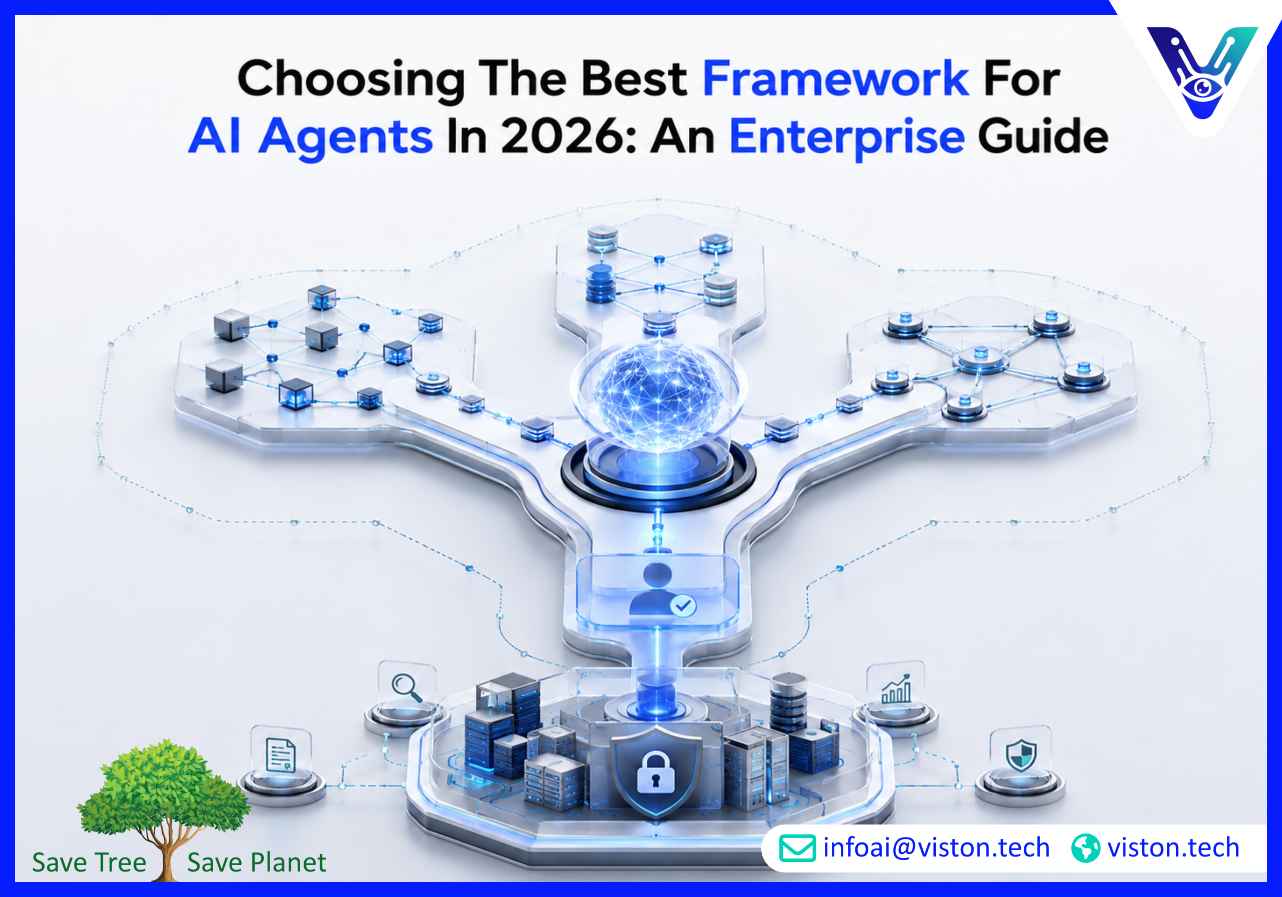
As 2026 progresses, the conversation around artificial intelligence has shifted from “Can it generate text?” to “Can it reliably complete complex work?” Businesses are no longer satisfied with passive chatbots or simple automation scripts. They are actively seeking AI agents—autonomous, reasoning-based systems capable of planning, executing, and refining multi-step workflows across diverse enterprise environments.
An agentic architecture is a structural design where an LLM functions as the central reasoning engine. Unlike traditional automation, which follows rigid, pre-defined scripts, an agentic system perceives its environment, selects the appropriate tools, and adjusts its plan based on intermediate results. This shift represents a transition from instruction-based tasks to intent-based outcomes.
In an enterprise context, these agents are being deployed to handle high-value, high-complexity tasks—such as financial reconciliation, automated compliance reporting, supply chain logistics, and software remediation. Because these workflows involve real-world stakes, the “magic” of a standard LLM is not enough. You require a robust framework that provides:
In 2026, the ecosystem has matured into specific tiers. Choosing a framework requires an honest assessment of your technical maturity and the complexity of your deployment.
For mission-critical applications—such as insurance authorizations or complex supply chain logistics—LangGraph has emerged as the industry leader. By representing agent workflows as directed graphs (nodes and edges), it allows developers to define explicit, stateful paths. It is the premier choice when compliance, predictability, and the ability to manage cyclical loops take precedence over sheer development speed.
For engineering teams that prioritize reliability and code quality, PydanticAI offers a robust, modern approach. It forces strict schema validation on agent inputs and outputs, ensuring that the data passed between tools or back to the user is always structured correctly. This is particularly valuable when agents are tasked with updating databases, triggering transactional APIs, or performing data-heavy analytical tasks.
When a task is too complex for a single agent, multi-agent frameworks like CrewAI and AutoGen shine. These frameworks allow you to create specialized “crews”—for example, a researcher agent, an analyzer agent, and a writer agent—that collaborate on a project. This modularity makes systems easier to test, iterate upon, and specialize.
In the complex environment of 2026, the challenge for many organizations is not just selecting a framework, but integrating these agents into existing business systems (ERP, CRM, and legacy cloud infrastructure) while maintaining strict security standards.
Viston AI functions as a strategic partner for enterprises aiming to bridge the gap between AI research and production-grade software. We specialize in building Custom AI Agent Solutions that are designed for high-stakes business environments.
Our approach centers on:
By partnering with Viston AI, organizations gain the technical infrastructure required to navigate the complexities of autonomous systems, ensuring that their AI deployment is both innovative and operationally sound.
Building an agent is easy; building an agent that doesn’t break under pressure is an engineering feat. In 2026, the most successful implementations move beyond simple “agent-in-a-box” designs to encompass broader system requirements.
When workflows exceed a certain complexity threshold, a monolithic agent will inevitably suffer from “context fragmentation.” By using a multi-agent framework, we can decompose a process into sub-tasks. Each agent acts as a specialist with a limited, high-accuracy toolset. Viston AI emphasizes this modularity, ensuring that if one component of your workflow needs an update—such as a data retrieval method—the entire system does not need a full re-deployment.
Enterprises require agents that remember context across sessions. This necessitates integrating persistent storage—typically via vector databases—that allows the agent to recall specific documentation, past user interactions, or evolving business constraints. Without a robust memory strategy, agents are relegated to short-term, stateless interactions that fail to drive long-term business value.
The greatest risk to agentic adoption is unmonitored autonomy. We advocate for a “Control Plane” architecture: an external layer that monitors agent actions against a set of business policies in real-time. This layer acts as the final arbiter, preventing the agent from deviating into unauthorized workflows or accessing sensitive data stores that are outside of its scope.
When evaluating a framework or development partner for your AI agent project, consider the following checklist:
A chatbot is reactive—it answers questions based on a prompt. An AI agent is proactive—it uses a reasoning engine to create a plan, utilize external tools, and iterate on tasks until a specific business goal is achieved.
Security is enforced by implementing “least privilege” access to tools, strict schema validation, and human-in-the-loop validation for sensitive actions. Viston AI adds a governance layer to ensure all agentic behavior remains within pre-defined operational boundaries.
For industries like finance or healthcare, we recommend graph-based frameworks like LangGraph. These provide the deterministic, audit-friendly execution paths required to meet regulatory standards.
Yes. We specialize in taking existing AI proofs-of-concept and hardening them into production-ready systems, focusing on performance, scalability, and security to ensure a successful enterprise rollout.
For complex workflows, multiple specialized agents are generally more effective. This “swarm” architecture reduces the probability of failure and allows for easier testing of individual components within the system.
The transition to agentic workflows is the defining technological shift for businesses in 2026. By moving from static automation to autonomous, reasoning-based systems, organizations can unlock unprecedented efficiency. However, success depends on choosing a framework that aligns with your specific needs for compliance, security, and complexity. Whether you are automating internal research or external customer engagement, building a sustainable system requires a focus on robust architecture. With the right strategic partner, such as Viston AI, enterprises can navigate these technical complexities and implement AI agents that serve as secure, reliable, and high-performing partners in their business operations.
