
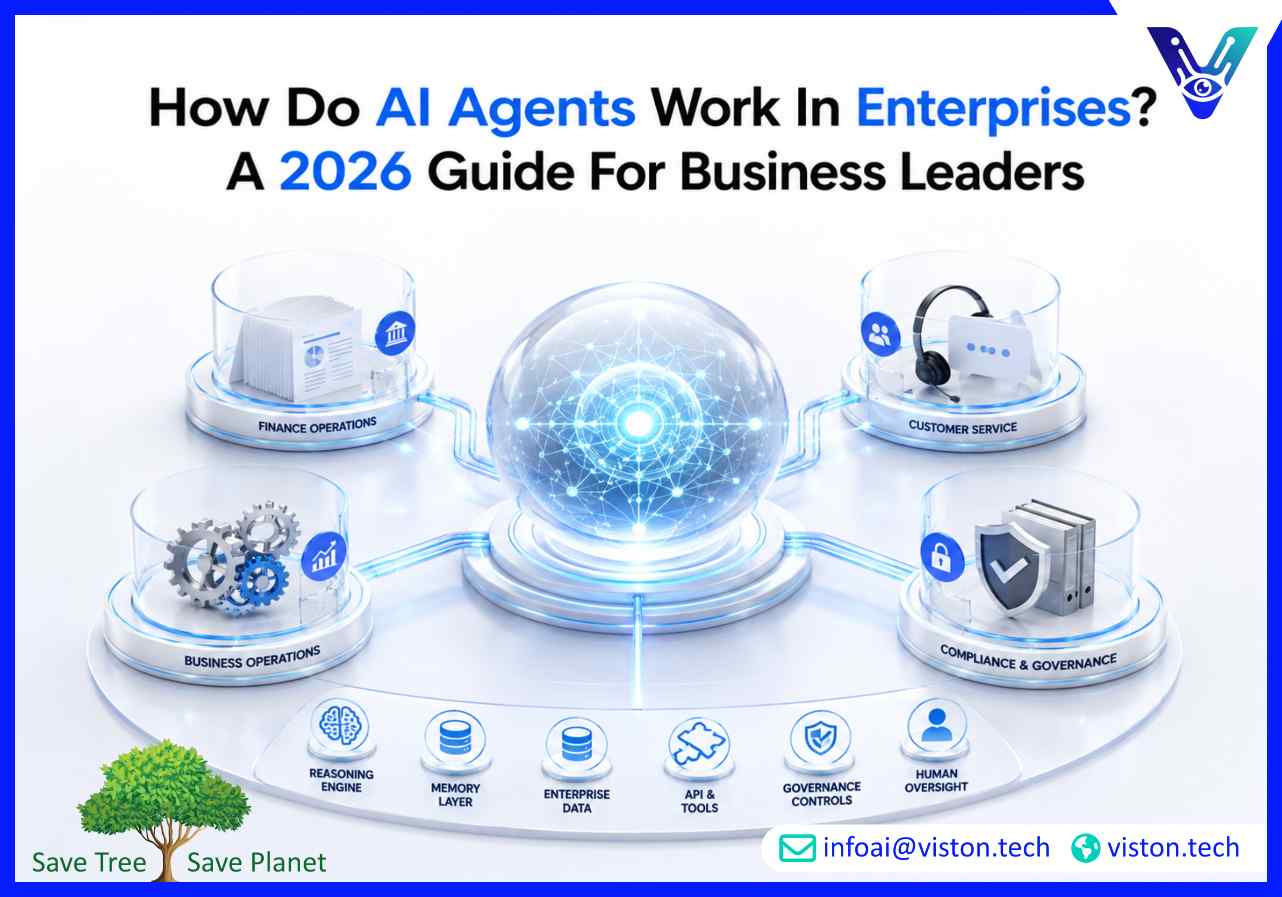
Enterprise leaders are no longer asking whether AI agents have a place in business operations. They are asking how to deploy them well. In 2026, AI agents are moving from controlled experiments into production environments across finance, operations, customer service, and beyond — and the organizations building the right infrastructure are already seeing measurable returns.
An AI agent is not a chatbot with extra features. It is an autonomous system capable of perceiving its environment, reasoning through a goal, selecting and using tools, executing tasks, and adapting based on outcomes — with minimal human intervention at every step.
Where a traditional automation tool follows fixed rules on a predictable input, an AI agent handles multi-step workflows that require dynamic decision-making. It can query a database, interpret the result, trigger an API call, update a record, and escalate an anomaly — all within a single task cycle — without waiting for a human to progress each stage.
At the architectural level, most enterprise-grade agents are built around a large language model acting as the reasoning core. That model is connected to memory systems, external tools and APIs, and an orchestration layer that governs how the agent plans and sequences actions.
The shift happening right now is structural. For most of the last decade, enterprises implemented AI as isolated tools — a predictive model here, a recommendation engine there.
Agentic AI changes that relationship. Instead of a tool that answers a question, you have a system that owns a process end to end.
Gartner forecasts that 40 percent of enterprise applications will contain task-specific AI agents by the end of 2026.
Consumer AI tools and enterprise AI agents are built for fundamentally different operating environments. In an enterprise context, an agent needs to:
Generic automation handles repetitive, rules-based tasks. Custom AI agents address something harder: workflows that require context, judgment, and the ability to act across disconnected systems.
Deployment readiness matters as much as the agent architecture itself.
Viston AI operates as a specialist in custom AI agent solutions, working with enterprises that need to move AI initiatives out of the lab and into production at scale.
Viston’s technical approach centers on leading agent frameworks including AutoGen Studio, CrewAI, and Vertex AI Agent Builder.
Their LLMOps in a Box platform provides infrastructure to deploy, monitor, govern, and scale agents responsibly — covering model performance, audit trails, compliance controls, and integration management across enterprise systems.
Traditional automation executes fixed, rules-based tasks on predictable inputs. An AI agent reasons through variable conditions, selects appropriate actions, uses external tools, and adapts based on outcomes.
Customer support, compliance and risk processing, finance operations, supply chain coordination, and IT service management are seeing the strongest early returns.
Effective deployment requires integration capability with existing systems, a governance and monitoring framework, clearly defined data access controls, and human oversight protocols.
Well-scoped pilots with clean data and existing API infrastructure can reach production in eight to sixteen weeks. Larger multi-agent systems typically require a longer phased rollout.
Viston builds task-focused autonomous agents using frameworks such as AutoGen Studio, CrewAI, and Vertex AI Agent Builder, supported by their LLMOps in a Box platform.
Enterprises need to address data privacy, audit trail requirements, model drift monitoring, access controls, and defined human escalation paths.
Understanding how AI agents work in enterprises is no longer a theoretical exercise — it is a practical requirement for any organization evaluating where autonomous systems fit within their operations. In 2026, the technical capability exists. The frameworks are mature. The business cases are proven across real deployments. Viston AI’s focus on end-to-end custom AI agent solutions positions them as a specialist worth engaging for enterprise teams ready to move beyond experimentation.
