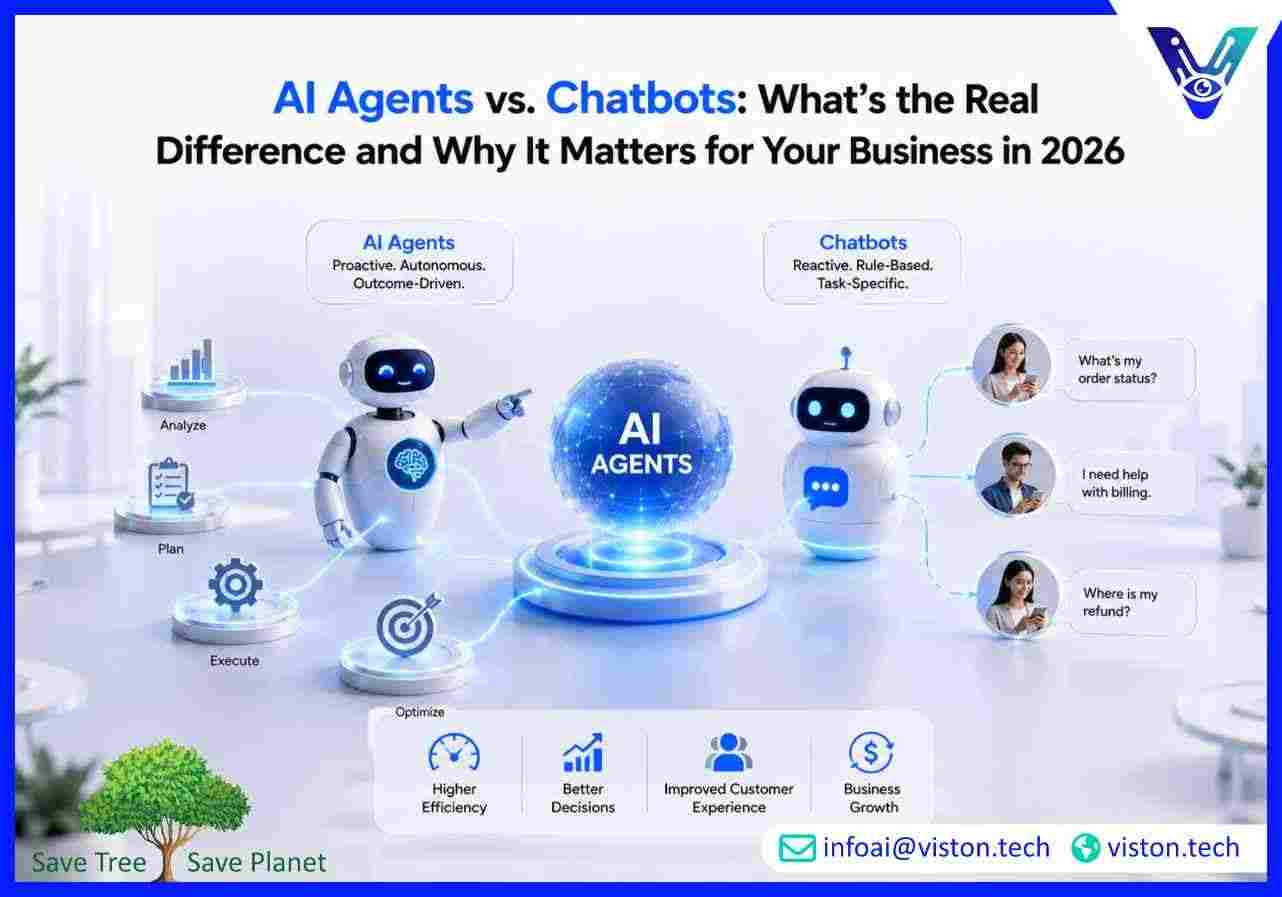
AI Agents vs. Chatbots: What’s the Real Difference and Why It Matters for Your Business in 2026
Businesses investing in conversational and autonomous AI today face a critical question: are they deploying a tool that answers questions, or one that actually gets work done? The distinction between AI agents and chatbots is no longer academic. It directly shapes your automation strategy, your operational outcomes, and the return you see on every pound, dollar, or euro spent on AI.
What Is an AI Chatbot?
A chatbot is a conversational interface designed to simulate dialogue. It receives a user input, processes it against a defined knowledge base or language model, and returns a response. That is largely where its role ends.Enterprise chatbots have improved significantly over recent years. Modern implementations powered by large language models like GPT-4o or Gemini can handle nuanced language, manage context across a conversation, and respond to a wide range of queries without rigid scripted flows. Customer service automation, HR query handling, lead qualification, and internal knowledge retrieval are all well-suited to chatbot deployment.However, a chatbot is fundamentally reactive. It responds when asked. It does not initiate actions, connect to live business systems to complete tasks, make independent decisions, or coordinate with other systems to produce an outcome. It is a highly capable conversational layer, but it remains a layer.
What Is an AI Agent?
An AI agent operates at a fundamentally different level. Rather than responding to a single query, an agent is given a goal and works autonomously to achieve it — breaking that goal into tasks, making decisions along the way, using available tools, querying APIs, writing and executing code, updating systems, and adjusting its approach based on what it encounters.Where a chatbot tells a customer their order has been delayed, an agent can identify the delay, check warehouse inventory, reroute the shipment, update the CRM record, notify the logistics provider, and send the customer a personalised resolution — all without human instruction at each step.In 2026, AI agents are being built on frameworks such as CrewAI, AutoGen, and LangGraph, and deployed across enterprise workflows spanning finance, healthcare, logistics, software development, and customer operations. They can operate as single autonomous agents or as part of coordinated multi-agent systems, where different agents handle different specialised functions in parallel.
The Core Differences: A Practical Breakdown
Understanding where these two technologies diverge helps businesses select the right tool for the right job.
Autonomy and Decision-Making
Chatbots follow conversational paths. Even sophisticated LLM-powered chatbots are designed to retrieve, summarise, or respond — they do not make decisions that alter business processes. AI agents are designed to reason, plan, and act. They evaluate available information, determine the best course of action, and execute across connected systems.
Tool Use and System Integration
Chatbots can be connected to knowledge bases and, in some implementations, basic integrations. AI agents are built around tool use. They can call APIs, query databases, run code, access file systems, trigger workflows in platforms like Salesforce or SAP, and interact with third-party services as part of achieving their assigned goal.
Task Scope
Chatbots handle single-turn or multi-turn conversations. An AI agent can manage an extended, multi-step workflow — spanning minutes, hours, or longer — coordinating information and actions across multiple systems to deliver a defined business outcome.
Human Involvement
Chatbots typically require a human at the end of any complex decision. Agents are designed to reduce or eliminate that dependency across defined task categories, escalating to humans only when genuinely required.
Memory and Context
Advanced chatbots maintain context within a conversation session. AI agents can maintain task memory across sessions, track progress toward long-running goals, and adapt based on outcomes from earlier actions.
When to Use a Chatbot vs. an AI Agent
Neither technology is universally superior. The right choice depends entirely on what the business actually needs to accomplish.Chatbots remain the right tool for high-volume, conversational use cases: answering customer FAQs, onboarding new users, handling first-line support, collecting structured data from leads, or delivering self-service information at scale. They are fast to deploy, cost-effective, and well understood by both users and IT teams.AI agents become the right investment when your business is facing workflow bottlenecks that require multi-step resolution, when repetitive knowledge-work processes are consuming skilled staff time, or when automation needs to span multiple systems and make context-driven decisions. Common enterprise agent use cases in 2026 include automated financial research and analysis, compliance monitoring, customer resolution workflows, document processing pipelines, and software development acceleration.Many organisations are finding that the two work best together — a chatbot provides the conversational front end, and an agent handles the back-end execution when a task requires it.
Why This Distinction Is Commercially Significant in 2026
Enterprise AI investment is maturing. Boards and executive teams are no longer satisfied with chatbots that deflect queries. They are asking for measurable operational impact: reduced processing time, lower cost per resolution, fewer manual handoffs, faster research cycles, and quantifiable workflow efficiency gains.AI agents deliver on those expectations in ways that chatbots alone cannot. But they also require more rigorous design, governance, and integration. Poorly scoped agents can introduce errors, create compliance exposure, or produce unpredictable behaviour in production environments. This is why the expertise behind the deployment matters as much as the technology itself.Responsible agent deployment in 2026 means establishing clear KPIs before build, defining the boundaries of agent autonomy, integrating human oversight at appropriate decision points, and monitoring performance through dedicated LLMOps infrastructure.
How Viston AI Approaches Custom AI Agent and Chatbot Solutions
Viston AI specialises in building both enterprise AI chatbots and custom AI agent solutions, recognising that most organisations need both capabilities, deployed intelligently and at the right level of complexity.On the chatbot side, Viston builds enterprise-grade conversational systems powered by models including ChatGPT, Gemini, and custom-trained variants — designed for customer service automation, lead generation, multilingual support, and internal knowledge management. These are not generic deployments. They are configured to align with specific business processes, brand tone, and integration requirements.On the agent side, Viston works with senior enterprise stakeholders — including Chief AI Officers and Heads of Digital Transformation — to design and deploy autonomous agents using frameworks including CrewAI and AutoGen Studio. Their multi-agent orchestration capability allows complex workflows to be managed across specialised agents operating in coordination.What distinguishes the Viston approach is its emphasis on responsible AI at scale. Every solution is built with governance guardrails, compliance considerations, and clear performance measurement built in from the start. This matters particularly for regulated sectors. KPIs are defined at the project outset, and performance is measured against business outcomes — task completion rate, cost savings, speed, and revenue impact — rather than technical metrics alone.Viston operates across the USA, Europe, and Australia, working with both enterprises that have established data science teams and organisations that need a complete end-to-end AI partner.
Frequently Asked Questions
Can a chatbot become an AI agent with the right integrations?
A chatbot with API connections can perform limited actions, but it does not become a true AI agent. Agents are architecturally different — they are designed around goal-directed reasoning, multi-step planning, and autonomous tool use. Bolting integrations onto a chatbot does not replicate that capability.
Are AI agents more expensive to implement than chatbots?
AI agents typically involve greater design, development, and governance investment than standard chatbots, reflecting their higher complexity and greater operational impact. However, the business case often justifies the difference. For workflows involving significant manual effort or multi-system coordination, the reduction in operational cost and processing time can produce strong ROI within months.
What industries benefit most from AI agent deployment?
Financial services, healthcare, logistics, retail, and software development are seeing the most substantial agent use cases in 2026. Any sector with repetitive knowledge work, multi-step approval processes, or high-volume data handling is a strong candidate.
How do businesses ensure AI agents operate safely in production environments?
Safe agent deployment requires defined task scope, clear escalation rules, LLMOps monitoring, audit trails, and human-in-the-loop checkpoints at appropriate decision boundaries. Governance is not optional for enterprise deployments — it is a core part of the design.
Can Viston AI build both chatbots and AI agents for the same organisation?
Yes. Viston AI provides both enterprise AI chatbot development and custom AI agent solutions, and can architect environments where the two work in conjunction — a chatbot handling the conversational layer while agents manage back-end workflow execution.
What is multi-agent orchestration?
Multi-agent orchestration involves deploying multiple specialised AI agents that work in coordination to complete a complex workflow. Rather than a single agent handling everything, each agent focuses on a defined task — one handles data retrieval, another analysis, another system updates — with an orchestration layer managing the overall process.
Conclusion
The difference between AI agents and chatbots comes down to scope, autonomy, and outcome. Chatbots excel at conversation. Agents get work done. For businesses in 2026 looking to move beyond surface-level automation, understanding this distinction is the starting point for building an AI strategy that delivers measurable operational impact.Selecting the right capability for each use case — and ensuring it is designed, governed, and deployed properly — is what separates successful AI investment from costly experimentation. Viston AI’s expertise across both custom AI agent solutions and enterprise chatbot development makes it a practical partner for organisations ready to build at that level.