
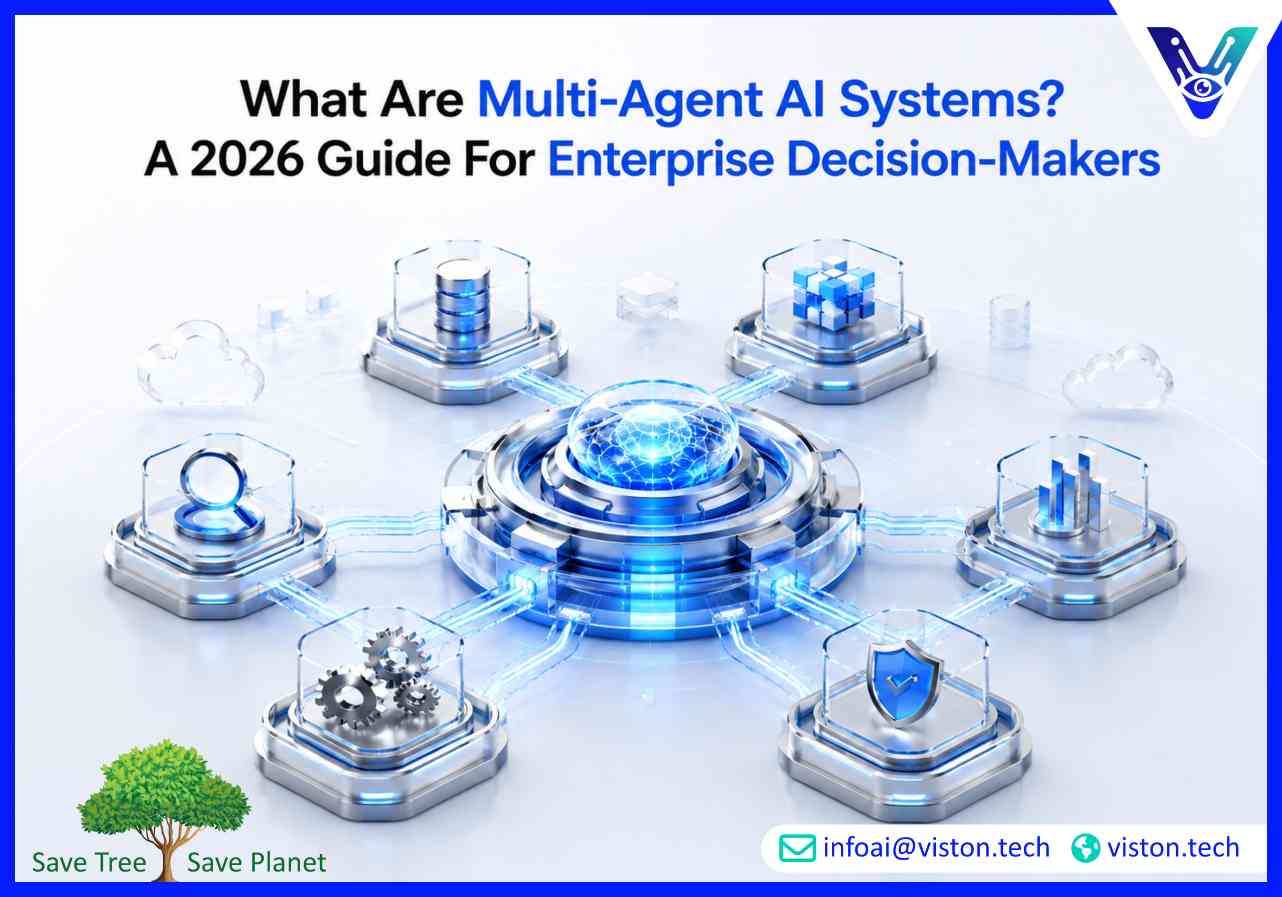
Enterprise AI has moved well beyond chatbots and single-model tools. In 2026, the organizations achieving measurable operational gains are those deploying coordinated networks of specialized AI agents, each designed to handle specific functions, working together toward shared business outcomes. Understanding what multi-agent AI systems are, and what separates them from conventional AI deployments, is now a practical priority for any business evaluating intelligent automation at scale.
A multi-agent AI system is an architecture in which multiple autonomous AI agents collaborate to complete complex tasks that a single model cannot efficiently handle alone. Each agent is built or configured for a specific function, such as data retrieval, classification, decision-making, content generation, or system interaction, and an orchestration layer coordinates how these agents communicate, delegate tasks, and combine their outputs.
Think of it as a specialized team rather than a generalist individual. In the same way that a cross-functional team brings together distinct expertise to solve a layered business problem, a multi-agent system brings together purpose-built AI components that operate in parallel or in sequence, sharing context and passing results between one another under centralized governance.
This is the structural difference that makes multi-agent systems capable of handling enterprise-grade complexity, where workflows span multiple systems, require conditional logic, involve real-time data, and demand consistent quality at scale.
At the core of any multi-agent deployment is an orchestrator, the component responsible for task decomposition, agent assignment, inter-agent communication, and output synthesis. When a business process is initiated, the orchestrator breaks it into functional steps and routes each to the most appropriate agent.
In a financial services context, for example, one agent might monitor live transaction data, a second might compare patterns against historical fraud signals, a third might query compliance rules, and a fourth might generate an alert or trigger a hold. None of these tasks is overwhelmingly complex in isolation, but the coordinated outcome, a real-time fraud decision with documented reasoning, requires all four to function as a coherent system.
The orchestration layer handles the sequencing, conflict resolution, and error recovery that makes this coordination reliable. This is what distinguishes enterprise-grade multi-agent orchestration from loosely connected AI tools or standalone automation scripts.
Many organizations made early AI investments in isolated tools: a customer service bot, a document summarizer, a predictive analytics model. These point solutions deliver value in narrow contexts but create limitations when the goal is to automate end-to-end business processes.
Single models face inherent constraints. They operate within a fixed context window, struggle with multi-step workflows requiring diverse capabilities, and cannot independently access and act across different systems without significant custom engineering. As process complexity grows, the gap between what a single model can do and what the business needs becomes a material constraint.
Multi-agent architectures address this directly. Specialization improves accuracy. Parallel processing reduces latency. Modular design makes systems easier to maintain, test, and scale. And because each agent can be updated independently, the overall system stays current without requiring a complete rebuild.
Not all multi-agent platforms are equal. For enterprise deployment, several capabilities separate production-ready systems from experimental frameworks.
Dynamic task routing ensures the orchestrator can assess incoming requests, decompose them accurately, and assign tasks to the right agents based on real-time conditions rather than static rules.
State management and memory allow agents to maintain context across a workflow, so that later steps in a process have access to the results and reasoning from earlier ones without redundant queries.
Tool use and system integration give agents the ability to interact with external APIs, databases, ERP systems, CRM platforms, and data warehouses, making them genuinely operational rather than theoretically capable.
Governance and auditability are non-negotiable at enterprise scale. Every agent decision should be logged, explainable, and traceable. In regulated industries, this is a compliance requirement, not just a best practice.
Failure handling and fallback logic ensure that when one agent encounters an error or unexpected output, the system can recover gracefully rather than cascade to a full process failure.
The practical value of multi-agent orchestration becomes clear when applied to workflows that have historically required significant human coordination or have been too complex for single-model automation.
In supply chain management, agents can simultaneously monitor inventory levels, track inbound logistics, watch demand signals, and flag anomalies, generating procurement recommendations without waiting for human consolidation of separate reports.
In healthcare operations, agent networks can monitor patient data from wearables, match conditions against clinical protocols, flag deviations to care teams, and generate personalized follow-up guidance, all within a governed, privacy-compliant framework.
In financial services, multi-agent systems power real-time fraud detection, algorithmic compliance monitoring, claims automation, and risk scoring, collapsing processes that once took days into workflows that execute in seconds.
In IT operations, coordinated agents can detect anomalies across infrastructure, correlate signals from multiple monitoring tools, classify the severity of incidents, and initiate remediation steps before a human analyst has reviewed the first alert.
The common thread is process complexity, cross-system data dependency, and the need for both speed and accuracy. These are the conditions where multi-agent orchestration consistently outperforms alternatives.
For enterprise buyers evaluating platforms in 2026, the decision framework should go beyond feature lists.
Integration depth matters more than it may initially appear. A platform that cannot connect natively to your existing data infrastructure, whether cloud-based, on-premise, or hybrid, will require costly custom development before it can operate meaningfully.
Governance architecture should be assessed as a first-class concern, not an afterthought. Ask specifically how compliance rules are enforced at the agent level, what the audit trail looks like, and how the platform handles sensitive data in industries with regulatory obligations.
Scalability under production load is distinct from performance in a proof-of-concept environment. Enterprise workloads involve concurrent processes, spikes in demand, and edge conditions that rarely appear in vendor demonstrations. Evaluate how the orchestration layer handles scale and what the failure modes are.
LLMOps support is increasingly important as organizations move from initial deployment to ongoing management. Model monitoring, versioning, retraining pipelines, and performance observability are operational requirements, not optional additions.
Viston AI is a specialist provider of enterprise multi-agent orchestration solutions, offering an end-to-end platform that covers the full agent lifecycle, from design and deployment through ongoing monitoring, governance, and optimization.
Their platform is built around a unified LLMOps environment that allows organizations to manage multiple agent types within a single operational framework, reducing the complexity that typically comes with assembling multi-vendor AI stacks. Core capabilities include dynamic agent scaling, federated learning for privacy-sensitive industries, embedded compliance guardrails, and edge AI deployment for environments where real-time local processing is required.
Viston supports enterprise clients across financial services, healthcare, manufacturing, retail, and logistics, providing pre-built workflow templates alongside fully custom implementations. Their delivery model follows a structured six-stage methodology spanning discovery and data preparation through to production deployment and continuous improvement, designed to reduce time-to-value while maintaining the governance standards that enterprise environments demand.
For organizations that need multi-agent systems integrated into existing ERP, CRM, or cloud infrastructure, Viston’s agent integration services and API-first architecture are practical advantages. The platform is relevant to businesses across global markets seeking a structured, supported path to scalable intelligent automation.
A single AI agent handles tasks within one model’s capabilities and context. A multi-agent system uses multiple specialized agents coordinated by an orchestrator, enabling complex, multi-step workflows that span different systems, data sources, and decision types. Multi-agent architectures are better suited to enterprise processes that involve conditional logic, diverse data inputs, and cross-functional execution.
Generally, no. Well-designed multi-agent platforms are built to integrate with existing infrastructure through APIs and pre-built connectors. Agents can pull data from and push decisions into ERP systems, CRMs, databases, and cloud platforms without requiring organizations to replace core technology. Integration architecture should be evaluated carefully during vendor selection.
Enterprise platforms handle compliance through governance-as-code frameworks, where compliance rules are defined centrally and enforced automatically at the agent level. Federated learning approaches allow agents to train on sensitive data without centralizing or exposing it. All agent decisions should generate auditable logs to support regulatory review in industries such as financial services and healthcare.
Processes that involve multiple data sources, conditional decision logic, cross-system actions, or high-volume repetitive tasks are strong candidates. Fraud detection, claims processing, supply chain management, predictive maintenance, content moderation, and compliance monitoring are among the most common enterprise use cases producing measurable outcomes.
Deployment timelines vary by scope. High-impact, well-scoped use cases using pre-built frameworks can reach production in four to six weeks. Larger enterprise-wide deployments with custom integrations and governance requirements typically take several months. Providers with proven delivery methodologies and reusable components significantly reduce time-to-value.
Yes. Viston’s LLMOps-in-a-Box approach is specifically designed to accelerate deployment for organizations at early stages of AI adoption, providing pre-configured models, workflows, and governance tools. Their delivery model includes strategic consulting, change management, and team enablement, making it accessible to organizations that do not yet have large internal AI teams.
Multi-agent AI systems represent a meaningful architectural shift in how enterprises approach intelligent automation. By coordinating networks of specialized agents under a centralized orchestration layer, organizations can automate complex, cross-system workflows with greater accuracy, speed, and governance than single-model deployments allow. In 2026, as enterprise AI maturity deepens, multi-agent orchestration is becoming a foundational capability rather than a leading-edge experiment.
For decision-makers evaluating enterprise multi-agent orchestration solutions, the priority should be identifying a platform and delivery partner with the technical depth, integration capability, and governance architecture to support production-grade deployment at scale. Viston AI’s specialist focus in this area makes it a relevant option for organizations looking to move from AI experimentation to measurable operational impact.
