
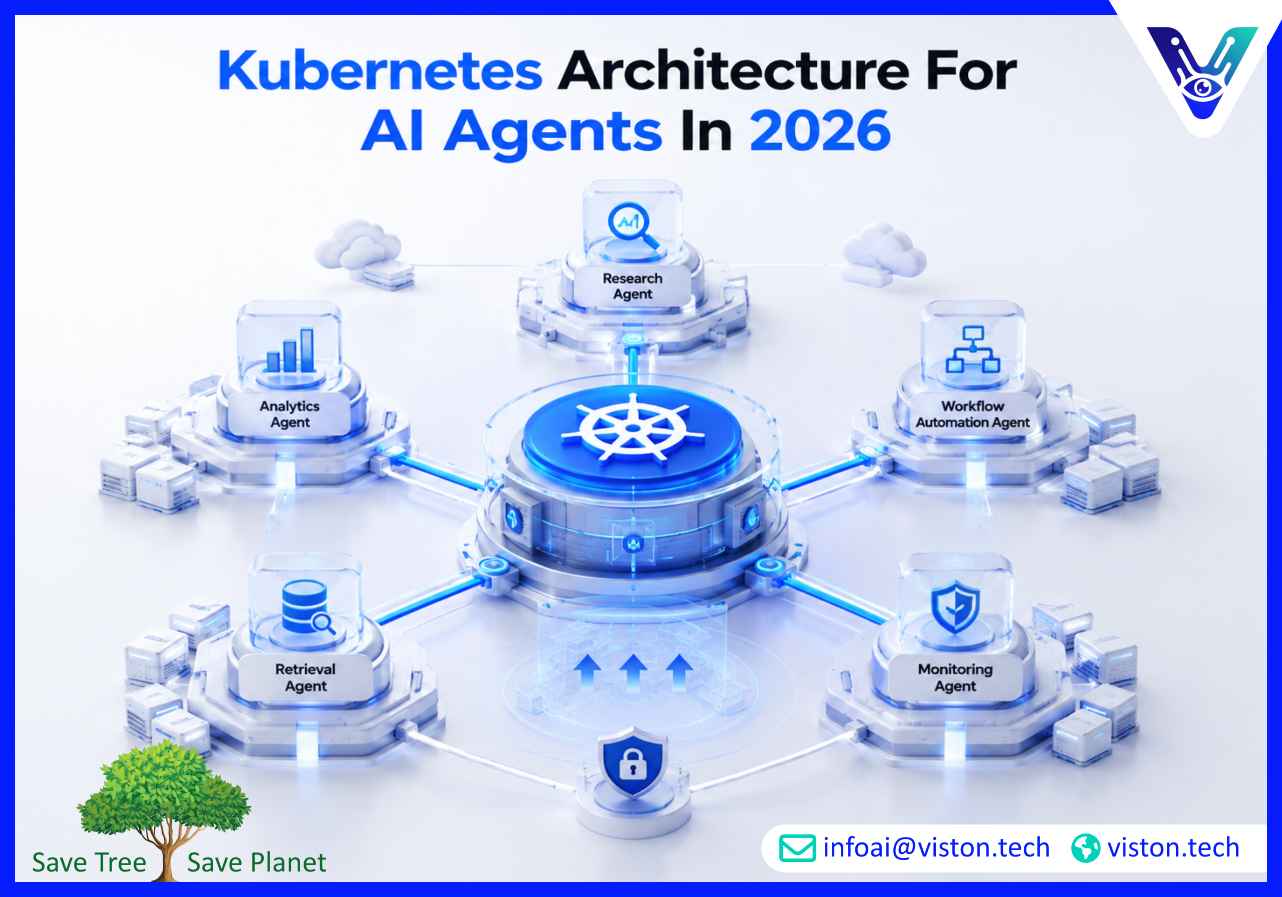
AI agents are becoming core operational systems for modern businesses, but deploying them reliably at scale requires more than strong models alone. Kubernetes architecture now plays a critical role in managing AI agents across enterprise environments, helping organizations improve scalability, resilience, security, and operational control in 2026.
AI agents are no longer limited to isolated chatbot applications. Businesses are deploying autonomous and semi-autonomous agents across customer support, operations, analytics, compliance workflows, internal productivity, ERP systems, and decision-support environments.
These systems often involve:
Traditional infrastructure struggles to manage this level of complexity efficiently. Kubernetes provides a standardized orchestration layer that helps organizations run AI agents reliably across cloud, hybrid, and on-premise environments.
In 2026, Kubernetes has become one of the most practical foundations for enterprise-grade AI agent infrastructure because it enables:
For businesses deploying AI systems in production, Kubernetes is increasingly a strategic infrastructure decision rather than a purely technical preference.
At a high level, Kubernetes architecture organizes AI agent systems into manageable, scalable components.
A typical enterprise AI agent deployment may include:
The control plane manages cluster operations, scheduling, orchestration, and policy enforcement.
For AI agents, the control plane helps:
This becomes especially important when multiple AI agents operate simultaneously across departments or customer-facing services.
Worker nodes run the actual AI workloads.
Depending on the deployment, nodes may handle:
Organizations commonly separate workloads across CPU and GPU node pools to optimize cost and performance.
AI agents are typically packaged as containers and deployed within Kubernetes pods.
This allows teams to isolate:
Containerized architecture simplifies updates, rollback management, and environment consistency.
Modern AI systems often require secure communication between services.
A Kubernetes service mesh helps manage:
This becomes essential in multi-agent environments where dozens of microservices interact continuously.
Although Kubernetes offers significant advantages, enterprise AI deployments introduce new operational challenges.
AI agents can generate unpredictable compute demand, especially during:
Without proper autoscaling and workload optimization, infrastructure costs can escalate quickly.
AI agents increasingly rely on persistent memory systems.
This creates challenges around:
Kubernetes architecture must be carefully designed to support persistent storage and low-latency access.
AI agents often interact with sensitive enterprise data.
Organizations must address:
In regulated industries, Kubernetes configurations must align with broader governance and security frameworks.
AI agent systems are difficult to troubleshoot without deep observability.
Teams need visibility into:
Kubernetes observability stacks are now commonly integrated with AI monitoring platforms for operational intelligence.
Enterprise AI deployments in 2026 typically combine Kubernetes with several specialized components.
AI inference workloads often require GPU acceleration.
Kubernetes supports GPU scheduling through:
This helps organizations optimize expensive GPU infrastructure efficiently.
AI traffic patterns are often inconsistent.
Autoscaling enables systems to dynamically respond to:
This improves performance without permanently overprovisioning infrastructure.
Operators automate management for complex AI systems.
Common use cases include:
Operators reduce manual infrastructure overhead significantly.
AI agents frequently depend on persistent data layers.
Kubernetes deployments may integrate:
Storage architecture directly impacts AI responsiveness and reliability.
AI agents commonly interact with multiple external systems.
API gateways help control:
This is especially important for enterprise integration environments.
One of the biggest shifts in 2026 is the rise of multi-agent AI systems.
Instead of relying on a single generalized agent, businesses now deploy specialized agents for:
Kubernetes supports these architectures effectively because it enables independent scaling and isolation for each agent service.
A multi-agent Kubernetes environment may include:
This modular design improves resilience and operational flexibility.
Security has become one of the most important considerations in enterprise AI infrastructure.
Organizations increasingly apply zero-trust principles to AI systems.
This includes:
Kubernetes network policies help enforce these controls.
AI agents often connect to external APIs, databases, and enterprise platforms.
Secure credential handling is essential.
Best practices include:
Runtime protection tools help detect:
This is increasingly important as AI systems gain broader operational access.
Enterprises require clear audit trails for AI systems.
Kubernetes logging and monitoring layers help support:
This is especially relevant in finance, healthcare, manufacturing, and enterprise SaaS environments.
Different organizations adopt different Kubernetes patterns depending on operational requirements.
A centralized AI platform allows teams to share:
This improves governance and infrastructure efficiency.
Some businesses deploy lightweight AI agents closer to operational environments.
Examples include:
Kubernetes edge distributions help support these deployments with lower latency.
Many enterprises now operate hybrid architectures combining:
Kubernetes simplifies workload portability across these environments.
Viston AI specializes in custom AI agent solutions designed for businesses deploying scalable, production-grade AI systems. As organizations move beyond experimental AI deployments, infrastructure reliability and operational governance have become critical success factors.
For companies implementing Kubernetes architecture for AI agents, Viston AI focuses on building practical, business-oriented solutions that align with enterprise operational requirements. This includes designing modular AI agent ecosystems, integrating orchestration workflows, supporting secure deployment pipelines, and enabling scalable AI infrastructure across cloud and hybrid environments.
Its approach is particularly relevant for organizations managing:
Rather than treating AI agents as isolated tools, Viston AI helps businesses structure AI systems as long-term operational platforms with governance, observability, scalability, and maintainability built into the deployment architecture.
For businesses in sectors such as SaaS, operations, enterprise services, logistics, and digital transformation initiatives, Kubernetes-based AI deployment strategies can significantly improve resilience, flexibility, and infrastructure efficiency when implemented correctly.
Many organizations adopt Kubernetes for AI too early or without sufficient architectural planning.
Common mistakes include:
AI workloads behave differently from traditional applications.
Ignoring GPU planning, memory optimization, or inference latency often creates operational instability.
Without AI-specific monitoring, teams struggle to identify:
Some organizations create excessive orchestration complexity before validating operational needs.
Simpler architectures often perform better initially.
AI agents with broad permissions create security and compliance risks.
Strong governance models are essential from the start.
Before implementing Kubernetes architecture for AI agents, organizations should assess:
Infrastructure decisions made early often determine how successfully AI systems scale later.
Not always. Small AI applications can run without Kubernetes. However, enterprise-scale AI agents typically require orchestration, scaling, monitoring, and resilience capabilities that Kubernetes provides effectively.
AI agents involve distributed workloads, APIs, memory systems, and model services. Kubernetes helps organizations manage these components reliably while improving scalability and operational efficiency.
Yes. Kubernetes is well-suited for multi-agent architectures because it allows independent deployment, scaling, monitoring, and isolation of different AI services and workflows.
The most common challenges include GPU cost management, observability, security governance, stateful memory handling, integration complexity, and operational scalability.
Kubernetes improves reliability through automated failover, autoscaling, workload orchestration, health monitoring, deployment management, and infrastructure resilience.
Viston AI helps businesses design and deploy custom AI agent solutions that align with enterprise infrastructure, orchestration, scalability, and operational governance requirements.
Kubernetes architecture for AI agents has become a foundational strategy for businesses building scalable AI systems in 2026. As AI agents grow more autonomous, distributed, and operationally critical, organizations need infrastructure capable of handling orchestration, resilience, security, and continuous scaling effectively.
For businesses investing in custom AI agent solutions, infrastructure planning is no longer secondary to model selection. Reliable deployment architecture directly impacts performance, governance, maintainability, and long-term business value.
Companies adopting Kubernetes-based AI environments thoughtfully are better positioned to support production-grade AI operations, multi-agent collaboration, and enterprise-scale automation initiatives in the years ahead.
