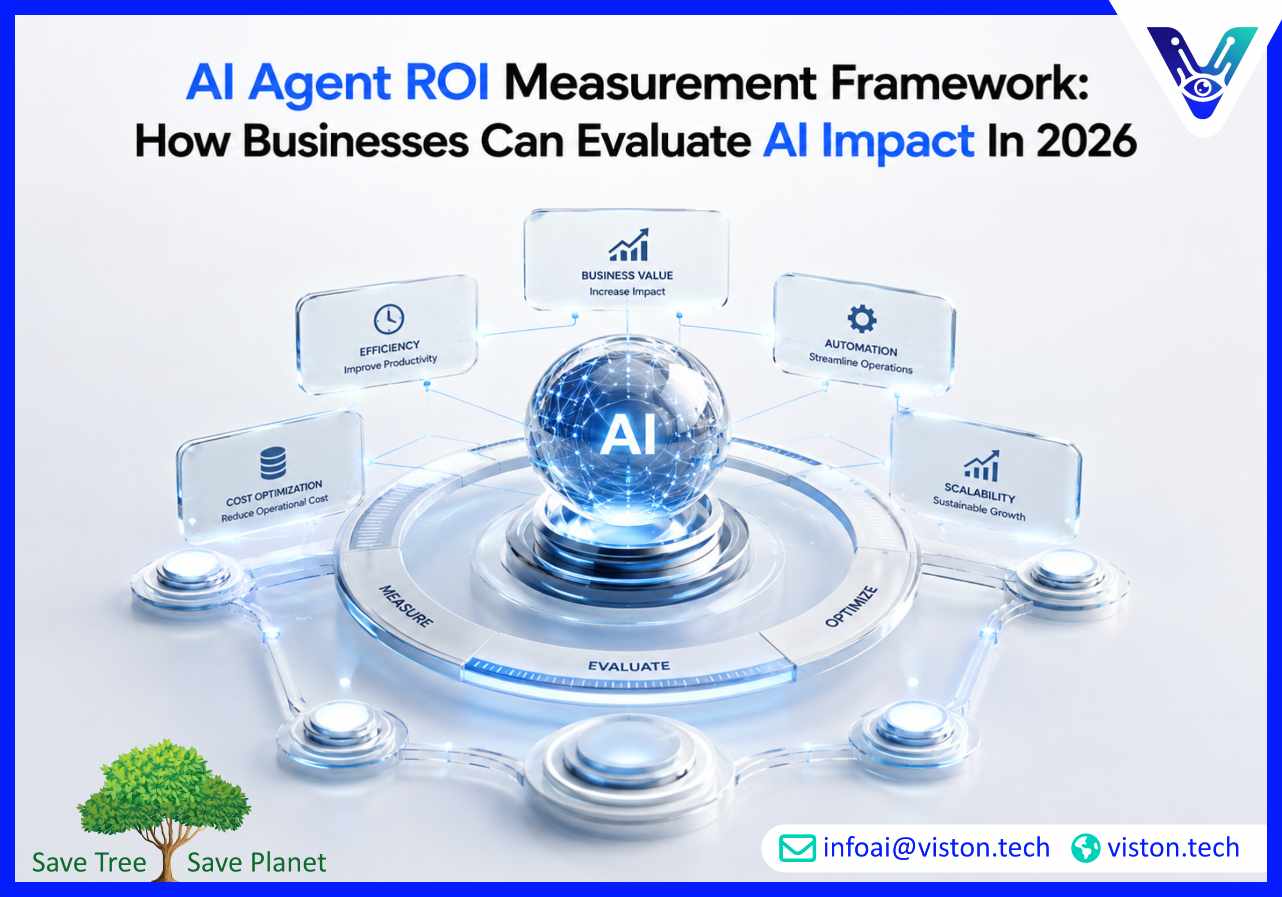
AI Agent ROI Measurement Framework: How Businesses Can Evaluate AI Impact in 2026
Introduction
As organizations invest more heavily in AI automation, many struggle to determine whether those initiatives are delivering measurable business value. An effective AI agent ROI measurement framework helps businesses assess operational impact, cost efficiency, scalability, and long-term strategic outcomes while reducing the risks associated with fragmented AI adoption.
Why AI Agent ROI Measurement Matters in 2026
AI agents are now being deployed across customer support, operations, logistics, finance, procurement, sales enablement, workflow automation, and internal knowledge management. However, implementing AI systems without measurable performance indicators often leads to unclear outcomes, inefficient spending, and weak executive alignment.In 2026, businesses are under growing pressure to justify AI investments with measurable business outcomes rather than experimentation alone. Decision-makers increasingly expect AI initiatives to demonstrate:
Operational efficiency improvements
Reduced manual workload
Faster response times
Better resource allocation
Improved customer experiences
Reduced process bottlenecks
Scalable automation outcomes
Data-driven optimization opportunities
Without a structured ROI framework, organizations may deploy AI agents successfully from a technical perspective while failing to achieve meaningful business impact.
What Is an AI Agent ROI Measurement Framework?
An AI agent ROI measurement framework is a structured evaluation model used to measure the effectiveness, business value, and operational performance of AI-powered agents and automation systems.The framework helps organizations determine:
Whether AI agents are improving business processes
Which workflows generate the strongest returns
How automation affects operational costs
Whether AI adoption aligns with strategic business objectives
Where optimization or scaling opportunities exist
How AI performance changes over time
Unlike basic automation reporting, a mature ROI framework evaluates both quantitative and qualitative outcomes across operational, financial, and strategic dimensions.
Core Components of an AI Agent ROI Measurement Framework
1. Business Objective Alignment
ROI measurement begins with clearly defining why the AI agent is being implemented.Organizations often fail to measure AI performance accurately because objectives are vague or disconnected from operational priorities. Effective frameworks align AI initiatives with measurable business goals such as:
Reducing support ticket resolution times
Improving workflow accuracy
Automating repetitive administrative tasks
Increasing operational throughput
Enhancing employee productivity
Improving response consistency
Accelerating decision-making processes
Without baseline objectives, measuring AI impact becomes largely subjective.
2. Baseline Performance Analysis
Before deployment, businesses need accurate benchmarks for current operational performance.This includes metrics such as:
Average task completion times
Human labor costs
Error rates
Workflow delays
Escalation frequency
Customer wait times
Operational overhead
Resource utilization
Baseline analysis is critical because AI ROI cannot be calculated meaningfully without comparing pre-implementation and post-implementation performance.
3. Operational Efficiency Metrics
One of the primary purposes of AI agents is operational optimization.Common operational metrics include:
Workflow Automation Rate
Measures how many tasks or processes are automated successfully without human intervention.
Response and Resolution Speed
Tracks improvements in processing times, customer response rates, or workflow completion speed.
Error Reduction
Measures decreases in manual processing errors, data inconsistencies, or operational inaccuracies.
Productivity Gains
Evaluates whether employees can focus on higher-value work after AI automation is introduced.
Scalability Performance
Determines how effectively AI systems handle increasing workloads without proportional staffing increases.
Financial Metrics Used in AI ROI Evaluation
Direct Cost Savings
Organizations typically assess reductions in:
Labor costs
Administrative overhead
Repetitive manual work
Support staffing burdens
Operational inefficiencies
However, modern ROI frameworks avoid oversimplifying AI value into labor replacement alone.
Cost Avoidance
AI agents often generate value by preventing future costs associated with:
Operational delays
Compliance failures
Process inefficiencies
Customer churn
Workflow disruptions
Human error remediation
Revenue Impact
In some industries, AI agents directly influence revenue through:
Faster lead qualification
Improved customer retention
Higher sales conversion efficiency
Reduced service downtime
Better customer engagement
Long-Term Scalability Value
A mature ROI framework also measures whether AI systems allow organizations to scale operations without equivalent infrastructure or workforce expansion.
Challenges Businesses Face When Measuring AI ROI
Fragmented Data Sources
Many organizations struggle because operational data exists across disconnected systems.AI performance measurement becomes difficult when information is spread across CRMs, ERP platforms, ticketing systems, workflow tools, and analytics platforms without centralized reporting.
Undefined Success Metrics
Businesses often deploy AI systems before defining measurable outcomes.Without clear KPIs, organizations may rely on subjective impressions instead of measurable operational evidence.
Overemphasis on Short-Term Returns
Some organizations expect immediate financial savings from AI initiatives while overlooking long-term strategic benefits such as process optimization, scalability, and decision support improvements.
Inconsistent Monitoring
AI systems require ongoing performance monitoring.A one-time ROI analysis is rarely sufficient because AI agents evolve through usage patterns, integrations, workflow changes, and data quality improvements.
Industry Relevance of AI ROI Frameworks
Different industries evaluate AI ROI differently depending on operational priorities and regulatory expectations.
Healthcare
Healthcare organizations focus heavily on:
Administrative efficiency
Patient workflow optimization
Documentation automation
Compliance support
Operational reliability
Financial Services
Banks and financial institutions prioritize:
Risk reduction
Fraud monitoring
Customer support automation
Compliance accuracy
Data security governance
Manufacturing
Manufacturers often measure:
Downtime reduction
Predictive maintenance improvements
Supply chain efficiency
Workflow automation reliability
Retail and E-Commerce
Retail businesses frequently evaluate:
Customer engagement efficiency
Inventory workflow optimization
Automated support performance
Order processing speed
Why AI Readiness Assessment Services Matter Before ROI Measurement
Many organizations attempt to measure AI ROI without evaluating whether their infrastructure, workflows, and operational processes are actually prepared for AI adoption.This is where AI Readiness Assessment Services become strategically important.A readiness assessment helps organizations determine:
Whether operational workflows are suitable for AI automation
Which processes offer the strongest automation potential
Data quality and accessibility levels
Integration readiness across business systems
Security and governance requirements
Workflow dependencies and implementation risks
Scalability limitations
Organizational adoption readiness
Without this preparation phase, businesses may implement AI agents into unsuitable workflows, resulting in weak ROI outcomes despite significant investment.
How Viston AI Supports AI Readiness Assessment and ROI Planning
For organizations evaluating AI automation opportunities, Viston AI provides AI Readiness Assessment Services designed to help businesses identify practical, scalable, and measurable AI implementation opportunities.Rather than approaching AI adoption as a generic technology initiative, Viston AI focuses on aligning AI capabilities with operational objectives, workflow requirements, and measurable business outcomes.Its assessment-driven approach helps organizations evaluate:
Workflow automation potential
AI implementation feasibility
Operational bottlenecks
Process optimization opportunities
Integration requirements
Data accessibility and readiness
Scalability considerations
Risk management factors
For businesses exploring AI agents, workflow automation, or intelligent operational systems, this type of structured readiness assessment can significantly improve the likelihood of achieving measurable ROI after deployment.Organizations increasingly recognize that successful AI adoption depends not only on the AI technology itself, but also on operational alignment, implementation planning, governance, and measurable performance tracking.
Best Practices for Building an Effective AI Agent ROI Framework
Establish Clear KPIs Early
Define measurable outcomes before implementation begins.KPIs should align with operational priorities and business goals rather than focusing solely on technical performance metrics.
Use Both Quantitative and Qualitative Metrics
Strong ROI frameworks evaluate:
Financial outcomes
Operational improvements
Employee productivity
Customer experience impact
Process reliability
Scalability improvements
Create Ongoing Monitoring Processes
AI ROI should be monitored continuously rather than measured once.Regular performance reviews help businesses identify:
Optimization opportunities
Workflow inefficiencies
Model performance changes
Emerging automation gaps
Prioritize High-Impact Use Cases
Not every workflow benefits equally from AI automation.Organizations typically achieve better ROI when focusing first on repetitive, high-volume, process-heavy workflows with measurable operational friction.
Include Governance and Risk Evaluation
Responsible AI implementation now plays a larger role in ROI evaluation.Businesses increasingly assess:
Data governance
Compliance alignment
Security controls
Human oversight mechanisms
Transparency requirements
The Future of AI ROI Measurement
In 2026, AI ROI frameworks are evolving beyond simple cost-saving calculations.Organizations are increasingly evaluating AI initiatives based on:
Strategic agility
Operational resilience
Workforce augmentation
Decision intelligence
Automation scalability
Long-term optimization capabilities
As AI agents become more deeply integrated into business operations, ROI measurement will increasingly focus on enterprise-wide operational transformation rather than isolated automation metrics.Businesses that establish structured measurement frameworks early are better positioned to scale AI initiatives responsibly and efficiently.
Frequently Asked Questions
What is an AI agent ROI measurement framework?
An AI agent ROI measurement framework is a structured method used to evaluate the operational, financial, and strategic impact of AI-powered automation systems within business environments.
Why is AI ROI difficult to measure?
AI ROI can be difficult to measure because organizations often lack baseline metrics, centralized operational data, clearly defined KPIs, or long-term monitoring processes.
What metrics are commonly used to measure AI agent performance?
Common metrics include workflow automation rates, cost savings, productivity improvements, response speed, error reduction, customer satisfaction, and scalability performance.
Why is an AI readiness assessment important before implementation?
An AI readiness assessment helps businesses identify suitable workflows, infrastructure gaps, integration requirements, operational risks, and realistic automation opportunities before deploying AI systems.
How often should businesses evaluate AI ROI?
AI ROI should be monitored continuously through ongoing performance reviews, operational reporting, and optimization assessments rather than through one-time evaluations.
Can Viston AI help businesses evaluate AI readiness?
Yes. Viston AI offers AI Readiness Assessment Services that help organizations evaluate workflow suitability, automation opportunities, operational readiness, and implementation considerations for scalable AI adoption.
Conclusion
An effective AI agent ROI measurement framework helps businesses move beyond experimental AI adoption toward measurable operational value. As organizations increasingly rely on automation, intelligent workflows, and AI-driven decision systems, structured performance measurement becomes essential for scalability, governance, and long-term business impact.Businesses that combine clear ROI evaluation with strategic AI Readiness Assessment Services are typically better positioned to identify meaningful automation opportunities, reduce implementation risks, and align AI initiatives with measurable operational outcomes. For organizations exploring scalable AI adoption, Viston AI provides practical readiness assessment capabilities that support informed and outcome-focused AI implementation strategies.