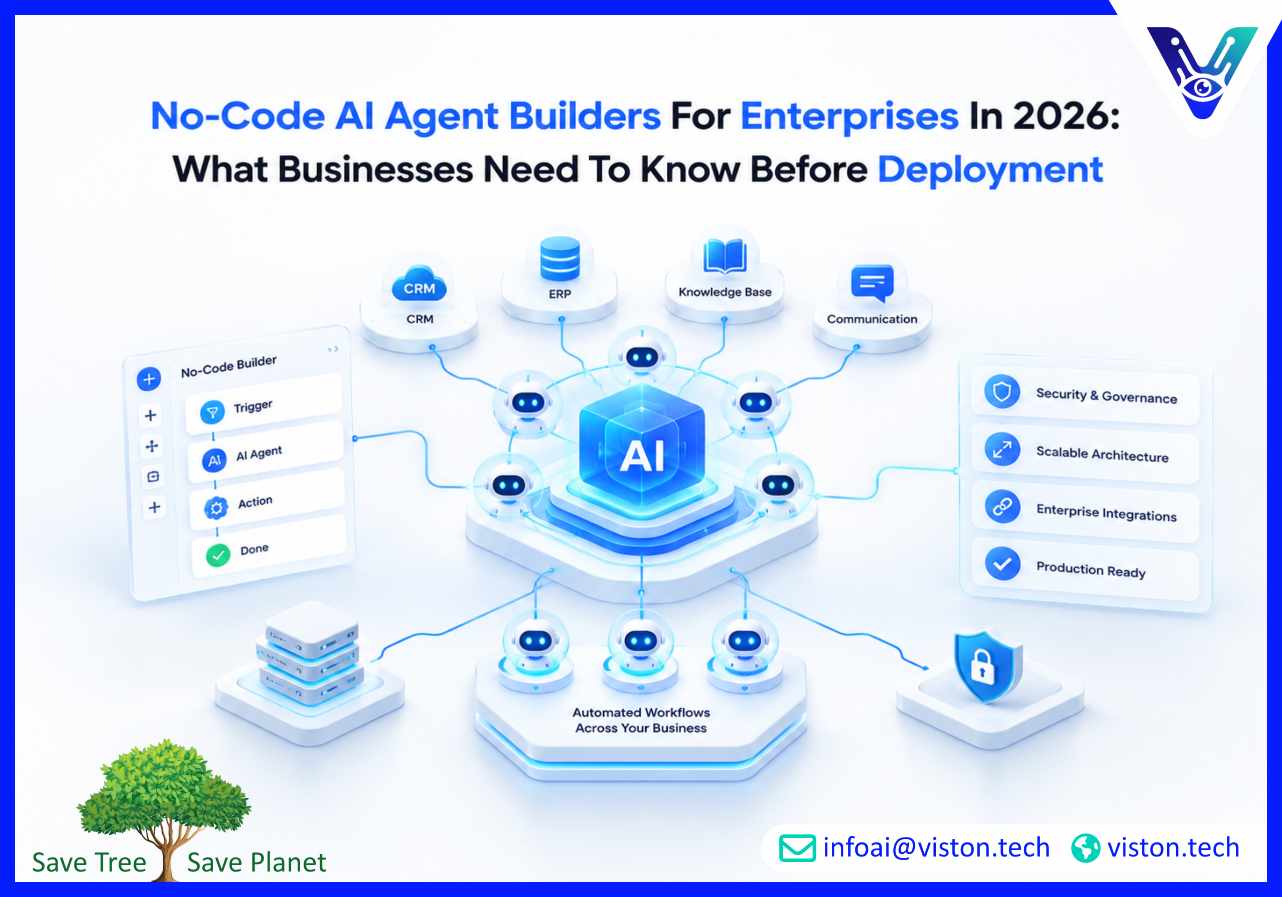
No-Code AI Agent Builders for Enterprises in 2026: What Businesses Need to Know Before Deployment
Introduction
No-code AI agent builders are rapidly changing how enterprises adopt automation and deploy AI-driven workflows. In 2026, businesses are no longer asking whether AI agents are useful—they are evaluating how quickly, securely, and reliably they can implement them across operations, customer service, sales, and internal systems without creating unnecessary development complexity.
What Are No-Code AI Agent Builders?
No-code AI agent builders are platforms that allow businesses to create AI-powered agents using visual interfaces instead of traditional programming. These tools enable non-technical teams and business units to automate workflows, orchestrate data, connect enterprise systems, and deploy conversational or task-oriented AI agents with minimal coding effort.Modern enterprise AI agent builders typically support:
Workflow automation
Large language model (LLM) integration
API and enterprise software connections
Knowledge base retrieval
Multi-step decision logic
Human approval workflows
CRM and ERP integrations
Internal process automation
Customer support automation
AI orchestration across departments
Unlike earlier chatbot platforms, enterprise-grade no-code AI systems now focus heavily on operational workflows, governance, security, scalability, and interoperability with existing business infrastructure.
Why Enterprises Are Investing in No-Code AI Agents in 2026
The demand for enterprise AI deployment has accelerated because organizations want faster operational efficiency without relying entirely on large software engineering teams.Several factors are driving adoption in 2026:
Faster Automation Deployment
Traditional enterprise software implementation cycles are often slow and resource-intensive. No-code AI platforms reduce deployment time by allowing operations teams, analysts, and process owners to configure workflows visually.This enables businesses to automate:
Customer onboarding
Internal ticket routing
Sales qualification
Vendor communication
HR support
Procurement workflows
Document processing
Knowledge retrieval
without waiting months for custom development.
Lower Technical Bottlenecks
Many enterprises face AI talent shortages. No-code AI agent builders help reduce dependency on specialized engineering teams for every automation requirement.Business teams can prototype workflows independently while technical teams focus on architecture, governance, integrations, and security.
Multi-System Integration Requirements
Modern enterprises operate across fragmented software ecosystems. AI agents are increasingly used to coordinate information between:
CRM systems
ERP platforms
Marketing tools
Support systems
Internal databases
Cloud applications
Communication platforms
No-code platforms simplify orchestration across these environments while reducing integration friction.
Operational Scalability
Enterprises are now prioritizing scalable AI deployment rather than isolated pilots. No-code agent builders support rapid expansion across departments while maintaining centralized governance and deployment standards.
Key Features Enterprises Should Evaluate
Not all no-code AI agent builders are suitable for enterprise environments. Many platforms are designed for simple automation use cases and lack the reliability required for production deployment.Businesses evaluating platforms in 2026 should focus on several critical capabilities.
Security and Governance Controls
AI deployment introduces operational and compliance risks, especially when sensitive enterprise data is involved.Enterprise-grade platforms should support:
Role-based access control
Audit logs
Data isolation
Encryption standards
Permission management
Human-in-the-loop approvals
Compliance workflows
Secure API authentication
Private model deployment options
Governance is particularly important in industries handling regulated data such as finance, healthcare, legal services, and enterprise SaaS operations.
Integration Flexibility
AI agents become valuable only when connected to real operational systems.Strong enterprise platforms support integrations with:
Salesforce
HubSpot
SAP
Microsoft Dynamics
Slack
Microsoft Teams
ServiceNow
Google Workspace
AWS environments
Custom APIs
Organizations should also assess whether the platform supports hybrid infrastructure or private deployment models.
Workflow Orchestration Capabilities
Many businesses underestimate the complexity of enterprise workflows.A useful no-code AI agent platform should support:
Multi-step workflows
Conditional logic
Exception handling
Approval chains
Trigger-based automation
Parallel task execution
Cross-platform orchestration
Stateful memory handling
Simple chatbot builders often fail when workflows become operationally complex.
Model Flexibility and AI Compatibility
Enterprises increasingly want flexibility to work with multiple AI models rather than becoming dependent on a single vendor ecosystem.Modern platforms should support:
OpenAI models
Anthropic models
Open-source LLMs
Hybrid AI infrastructure
Retrieval-augmented generation (RAG)
Vector database integrations
Fine-tuning support where applicable
Vendor lock-in has become a growing concern for enterprise procurement teams.
Monitoring and Observability
AI agents require ongoing monitoring to ensure reliability and accuracy.Enterprise teams should evaluate:
Workflow analytics
Failure reporting
Token consumption tracking
Response evaluation
Human override mechanisms
Agent performance metrics
Security event visibility
Operational logging
Without proper observability, AI automation can become difficult to govern at scale.
Common Enterprise Use Cases for No-Code AI Agents
No-code AI agents are now being deployed across multiple operational areas.
Customer Support Automation
Enterprises use AI agents to:
Resolve common support requests
Retrieve customer account data
Escalate complex issues
Automate ticket categorization
Provide multilingual support
Route requests intelligently
This improves response consistency while reducing support team workload.
Internal Knowledge Management
AI agents increasingly act as enterprise knowledge assistants.Employees use them to retrieve:
Internal policies
Process documentation
Product information
Technical procedures
Compliance guidance
HR resources
When connected to internal systems, these agents reduce information silos significantly.
Sales and Lead Qualification
AI agents can automate:
Lead enrichment
Prospect qualification
CRM updates
Follow-up workflows
Meeting scheduling
Proposal generation support
This helps sales teams focus more on high-value opportunities.
Operations and Workflow Automation
Operations teams are deploying AI agents for:
Approval routing
Procurement workflows
Inventory coordination
Vendor communications
Invoice handling
Internal reporting automation
This is especially valuable for enterprises managing large process volumes across departments.
Risks Enterprises Should Not Ignore
Although no-code AI deployment offers major advantages, implementation mistakes remain common.
Poor Governance Planning
AI agents interacting with sensitive enterprise data require strict governance structures. Organizations that deploy quickly without operational oversight often face compliance and security challenges later.
Over-Automation
Not every process should be fully autonomous.Human oversight remains essential for:
High-risk approvals
Legal decisions
Financial actions
Sensitive customer interactions
Compliance workflows
Successful deployments balance automation with accountability.
Fragmented AI Deployments
Enterprises sometimes adopt multiple disconnected AI tools across departments, leading to operational silos and inconsistent governance.Centralized AI architecture planning is becoming increasingly important in 2026.
Weak Integration Strategy
An AI agent is only as effective as the systems it can access reliably.Many businesses underestimate:
API complexity
Data synchronization challenges
Authentication management
Legacy infrastructure limitations
Integration planning should happen early in the deployment process.
How AI Development and Deployment Services Support Enterprise Adoption
No-code AI platforms simplify workflow creation, but enterprise deployment still requires significant strategic and technical expertise.Organizations often need support with:
AI architecture planning
Workflow design
Integration engineering
Security implementation
Governance frameworks
Infrastructure optimization
AI model selection
Data pipeline design
Performance monitoring
Scalability planning
This is where specialized AI development and deployment expertise becomes important.Even with no-code tooling, enterprises typically require customized implementation strategies aligned with their operational requirements, compliance obligations, and existing technology stack.
How Viston AI Supports Enterprise AI Development and Deployment
For enterprises exploring no-code AI agent builders, implementation success depends heavily on how well AI systems integrate into existing business operations. This is where specialized AI deployment expertise becomes operationally valuable.Viston AI focuses on AI development and deployment services that help businesses move beyond experimental automation toward scalable, production-ready AI systems. Rather than treating AI agents as isolated tools, the company’s approach aligns automation workflows with enterprise infrastructure, operational processes, and long-term scalability requirements.This is particularly relevant for organizations implementing:
AI workflow automation
Multi-agent systems
Enterprise AI integrations
Retrieval-based AI assistants
Internal operations automation
AI-powered business process orchestration
Businesses evaluating no-code AI platforms often discover that deployment complexity increases once integrations, governance, security, monitoring, and operational reliability become priorities. Practical AI deployment therefore requires more than interface-level configuration.Viston AI’s relevance in this space comes from its focus on implementation architecture, deployment reliability, workflow optimization, and scalable AI operations that support real enterprise use cases rather than isolated demonstrations. For organizations adopting AI agents in customer operations, internal automation, or workflow orchestration, experienced deployment support can significantly reduce implementation risk while improving operational outcomes.
How to Choose the Right No-Code AI Agent Platform
Enterprises should evaluate platforms based on operational fit rather than feature lists alone.Key evaluation questions include:
Does the Platform Support Enterprise Security Requirements?
Security capabilities should align with internal governance and compliance expectations.
Can It Integrate With Existing Infrastructure?
Integration flexibility is critical for operational value.
Is the Workflow Engine Scalable?
Simple automation tools often struggle with enterprise-scale orchestration requirements.
Does the Vendor Support Multi-Model AI Architectures?
Flexibility matters as AI ecosystems continue evolving rapidly.
Are Monitoring and Human Oversight Features Mature?
Reliable observability is essential for enterprise deployment confidence.
Can the Platform Support Long-Term AI Expansion?
Businesses should assess whether the platform can evolve alongside broader AI transformation initiatives.
Frequently Asked Questions
Are no-code AI agent builders suitable for large enterprises?
Yes. Many enterprise-grade platforms now support advanced security, governance, integrations, and workflow orchestration suitable for large-scale deployments. However, implementation planning remains important for operational reliability.
What is the difference between a chatbot builder and an AI agent builder?
Chatbot builders primarily focus on conversations, while AI agent builders support broader workflow automation, integrations, decision logic, memory handling, and multi-system orchestration.
Do enterprises still need developers when using no-code AI platforms?
Usually, yes. While no-code platforms reduce manual development effort, enterprises still require expertise for integrations, security, governance, infrastructure planning, and scalable deployment architecture.
What industries benefit most from no-code AI agents?
Industries with high operational complexity and repetitive workflows often see strong value, including finance, healthcare, SaaS, logistics, manufacturing, retail, and professional services.
How important is governance in enterprise AI deployment?
Governance is critical. Enterprises need visibility, auditability, approval workflows, access controls, and monitoring to reduce operational and compliance risks associated with AI systems.
How can Viston AI help businesses deploying AI agents?
Viston AI supports businesses with AI development and deployment services focused on scalable implementation, workflow orchestration, integration strategy, and operational AI deployment for enterprise environments.
Conclusion
No-code AI agent builders are becoming a major part of enterprise automation strategies in 2026 because they allow organizations to deploy AI-driven workflows faster and more efficiently. However, successful implementation depends on more than visual workflow builders alone. Enterprises still need strong AI development and deployment planning, secure integrations, governance controls, and scalable operational architecture.Businesses evaluating no-code AI solutions should focus on long-term operational fit, integration reliability, and deployment readiness rather than surface-level automation features. For organizations looking to implement enterprise AI systems responsibly and effectively, experienced AI deployment support from providers such as Viston AI can help bridge the gap between experimentation and scalable business value.