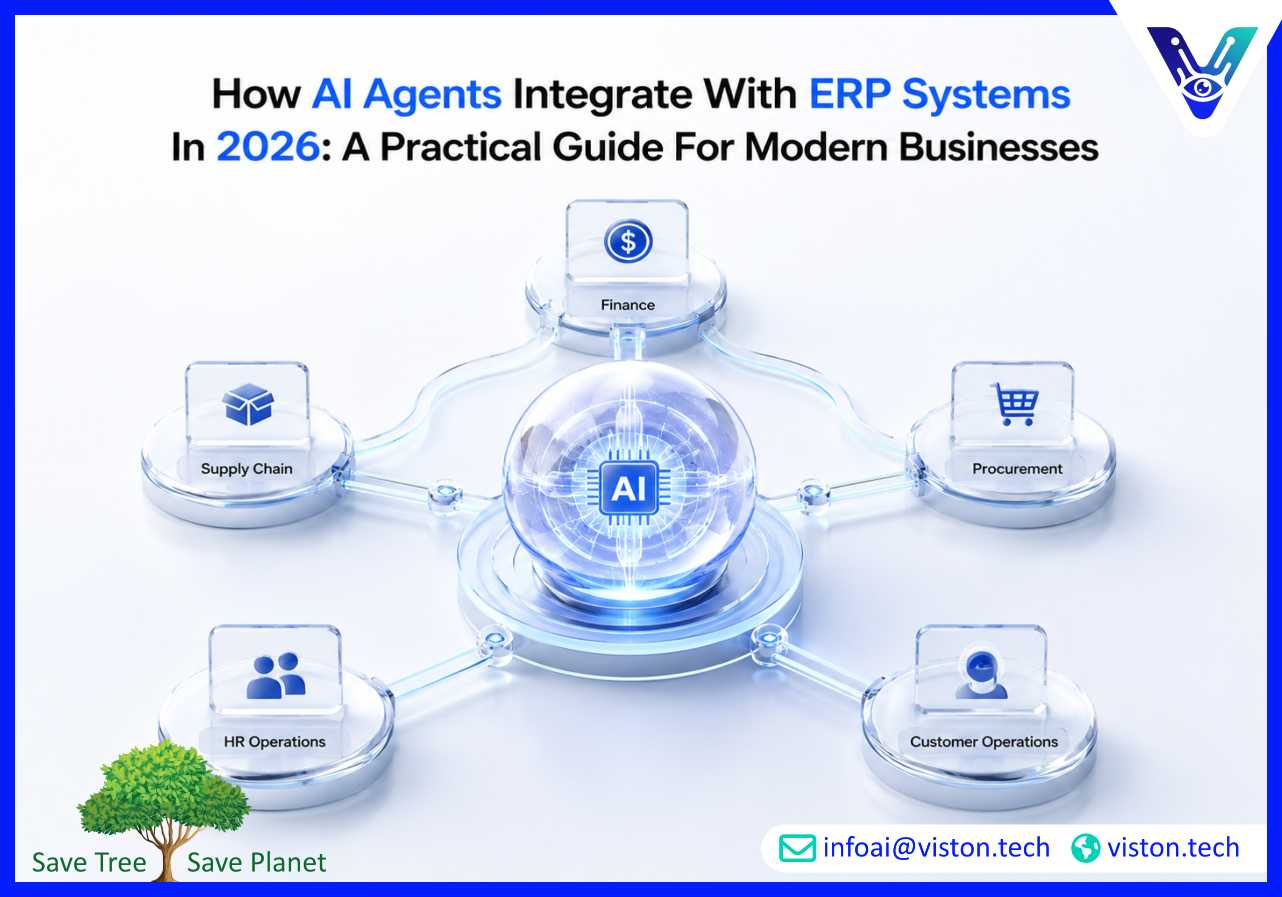
How AI Agents Integrate With ERP Systems in 2026: A Practical Guide for Modern Businesses
Introduction
ERP systems remain the operational backbone of modern businesses, but many organizations still struggle with slow workflows, fragmented data, and manual decision-making. In 2026, AI agents are changing how businesses interact with ERP platforms by automating processes, improving visibility, and enabling faster operational execution across finance, supply chain, procurement, HR, and customer operations.
What AI Agents Mean for ERP Systems
AI agents are autonomous or semi-autonomous software systems capable of interpreting data, executing tasks, coordinating workflows, and interacting with enterprise applications with minimal human intervention.When integrated with ERP systems, AI agents can:
Retrieve and process operational data
Trigger automated workflows
Monitor business events in real time
Generate reports and insights
Handle repetitive operational tasks
Coordinate actions across multiple business systems
Assist employees through conversational interfaces
Unlike traditional ERP automation, AI agents are context-aware and capable of adapting to changing operational conditions. They can interpret requests, learn from historical workflows, and interact across systems rather than following rigid predefined rules alone.This shift is becoming increasingly important as organizations face rising operational complexity, higher customer expectations, and growing pressure to improve efficiency without continuously increasing headcount.
Why Businesses Are Integrating AI Agents With ERP Platforms in 2026
Many ERP environments still depend heavily on manual coordination between teams, spreadsheets, email approvals, and disconnected systems.Common operational challenges include:
Slow procurement approvals
Delayed reporting cycles
Inventory forecasting inaccuracies
Manual invoice processing
Data duplication across departments
Inefficient customer support workflows
Limited visibility into operational bottlenecks
Human dependency for routine decisions
AI agents help reduce these inefficiencies by acting directly within ERP-driven workflows.
Finance Operations
AI agents can:
Match invoices against purchase orders
Detect anomalies in expenses
Trigger payment approvals
Generate financial summaries
Monitor compliance workflows
Supply Chain and Inventory
AI-driven ERP workflows can:
Predict inventory shortages
Automate replenishment recommendations
Coordinate supplier communications
Detect shipping disruptions
Optimize warehouse operations
HR and Employee Operations
Organizations are increasingly using AI agents inside ERP HR modules to:
Automate onboarding workflows
Handle leave and payroll queries
Generate employee reports
Assist with policy compliance tasks
Customer and Service Operations
AI agents connected to ERP and CRM systems can:
Update order statuses
Coordinate fulfillment workflows
Respond to customer inquiries
Escalate operational exceptions
Improve response times across service teams
The result is faster operational execution with fewer manual dependencies.
How AI Agents Integrate With ERP Systems
ERP integration is not simply about connecting a chatbot to enterprise software. Effective AI agent integration requires structured architecture, governance, workflow design, security controls, and operational reliability.Most enterprise integrations involve several layers.
API and Middleware Integration
Modern ERP systems such as SAP S/4HANA, Oracle NetSuite, Microsoft Dynamics 365, and Odoo provide APIs that allow AI agents to securely interact with operational data and workflows.Integration layers commonly include:
REST APIs
GraphQL APIs
Event-driven architectures
Enterprise service buses
Workflow orchestration platforms
Secure middleware environments
This architecture enables AI agents to read, analyze, and act on ERP data without disrupting core ERP stability.
Workflow Orchestration
AI agents are typically embedded into operational workflows rather than deployed as standalone tools.Examples include:
Procurement approval chains
Inventory escalation processes
Financial reconciliation workflows
Customer order management
Service ticket routing
Vendor onboarding
Workflow orchestration ensures the AI agent understands:
Business rules
Approval hierarchies
Role permissions
Escalation logic
Compliance requirements
Without orchestration, AI automation often becomes unreliable and difficult to govern.
Data Synchronization and Context Management
ERP environments contain highly sensitive operational data.AI agents must maintain:
Accurate data synchronization
Permission-aware access
Role-based context
Audit logging
Transaction consistency
In enterprise environments, context management is critical. An AI agent handling procurement approvals should not access HR payroll records or unrelated financial information.This is why modern ERP AI deployments increasingly use:
Secure vector databases
Enterprise identity systems
Retrieval-augmented generation (RAG)
Policy-based access controls
Real-time observability tools
Human-in-the-Loop Controls
Despite advances in AI autonomy, most ERP workflows still require controlled human oversight.Businesses typically use human approvals for:
Financial transactions
Contract modifications
Supplier onboarding
Pricing decisions
Compliance-sensitive workflows
Human-in-the-loop design helps organizations maintain accountability while still benefiting from operational automation.
Key Benefits of AI Agent ERP Integration
Organizations investing in AI-enabled ERP operations are typically focused on measurable operational outcomes rather than experimental AI deployments.Key benefits include:
Faster Operational Execution
AI agents reduce delays caused by repetitive manual coordination.Tasks that previously required hours of internal communication can often be completed automatically in minutes.
Improved Data Utilization
ERP systems contain large volumes of operational data that are often underutilized.AI agents help organizations extract practical value from this data through:
Automated reporting
Predictive analysis
Operational recommendations
Real-time alerts
Reduced Manual Workloads
Teams can focus more on strategic operations when repetitive tasks are automated.This is particularly valuable in:
Finance teams
Procurement departments
Shared service operations
Customer operations
Supply chain management
Better Cross-System Coordination
Many businesses operate with disconnected enterprise systems.AI agents can coordinate workflows across:
ERP platforms
CRM systems
Inventory systems
Support platforms
BI tools
Procurement software
Data warehouses
This reduces fragmentation and improves operational consistency.
Improved Decision Support
AI agents can surface operational insights faster than traditional reporting workflows.Examples include:
Supplier performance anomalies
Inventory risk alerts
Delayed receivables
Demand forecasting signals
Operational bottlenecks
This allows business leaders to make faster, more informed decisions.
Common ERP Integration Challenges Businesses Face
AI agent integration projects can fail when organizations underestimate enterprise complexity.Some of the most common challenges include:
Legacy ERP Environments
Older ERP systems may lack modern APIs or integration readiness.Businesses often require:
Middleware modernization
Data mapping
Workflow restructuring
API enablement layers
Poor Data Quality
AI agents rely heavily on structured and reliable data.Incomplete or inconsistent ERP data can lead to:
Incorrect automations
Faulty reporting
Workflow failures
Compliance risks
Security and Compliance Concerns
ERP systems contain sensitive operational and financial data.Organizations must carefully manage:
Access permissions
Data residency
Audit requirements
Encryption standards
Regulatory compliance
Vendor security reviews
Over-Automation Risks
Not every ERP process should be fully autonomous.Organizations that aggressively automate without governance often encounter:
Approval failures
Operational confusion
Compliance issues
Reduced accountability
Successful deployments balance automation with operational oversight.
Industry Use Cases for AI Agent ERP Integration
Different industries are adopting ERP-integrated AI agents based on their operational priorities.
Manufacturing
Manufacturers use AI agents for:
Production scheduling
Inventory optimization
Vendor coordination
Predictive maintenance workflows
Procurement automation
Retail and Ecommerce
Retail organizations integrate AI agents into ERP environments to support:
Demand forecasting
Omnichannel inventory management
Automated fulfillment coordination
Supplier management
Healthcare
Healthcare organizations increasingly use ERP-connected AI workflows for:
Procurement operations
Inventory management
Billing coordination
Compliance documentation
Logistics and Supply Chain
AI agents help logistics providers manage:
Shipment coordination
Warehouse workflows
Vendor communication
Route planning
Exception management
What Businesses Should Evaluate Before Implementation
Before integrating AI agents into ERP systems, organizations should evaluate operational readiness carefully.Key evaluation areas include:
ERP Architecture Readiness
Businesses should assess:
API maturity
Integration capabilities
Data accessibility
Workflow flexibility
Governance and Security
AI agent deployment requires clear governance around:
Access controls
Data usage policies
Approval rules
Audit logging
Compliance monitoring
Operational Priorities
Organizations should prioritize workflows that offer:
High manual workload reduction
Clear operational bottlenecks
Measurable ROI potential
Repeatable processes
Scalability Requirements
Enterprise AI integration should support:
Multi-department operations
Cross-system orchestration
Future workflow expansion
Long-term operational monitoring
How Viston AI Supports AI Agent Integration Services
Viston AI helps businesses implement practical AI agent integration strategies that align with real operational workflows rather than isolated AI experimentation.For organizations integrating AI agents with ERP systems, the challenge is rarely just technical connectivity. Businesses also need workflow orchestration, secure data handling, operational governance, scalable infrastructure, and reliable automation logic that works within existing enterprise environments.Viston AI’s Agent Integration Services focus on helping businesses connect AI agents with enterprise systems such as ERP, CRM, operational databases, and workflow platforms in a structured and business-focused way. This includes designing integration architectures, implementing automation workflows, enabling cross-system coordination, and supporting enterprise-grade observability and operational control.For companies operating in manufacturing, operations-heavy industries, SaaS environments, logistics, and enterprise services, this approach helps reduce fragmented workflows while improving operational efficiency and decision-making.As ERP environments become more connected with AI-driven automation in 2026, businesses increasingly need integration partners that understand both enterprise operations and modern AI orchestration frameworks. Viston AI positions its services around this intersection of operational practicality, scalability, and AI-enabled workflow automation.
Best Practices for Successful ERP AI Integration
Organizations achieving the best outcomes from ERP AI integration projects typically follow several operational best practices.
Start With High-Impact Workflows
Begin with workflows that:
Consume significant manual effort
Have measurable inefficiencies
Operate with structured data
Deliver clear ROI potential
Maintain Strong Governance
AI agents should operate within clearly defined operational boundaries.This includes:
Role-based permissions
Approval thresholds
Audit logging
Exception handling
Prioritize Integration Reliability
Operational automation depends on system reliability.Businesses should invest in:
Monitoring
Observability
Error handling
Workflow resilience
Performance tracking
Keep Human Oversight Where Necessary
Enterprise AI should augment operational teams, not eliminate accountability.Human review remains essential for sensitive or high-risk workflows.
Frequently Asked Questions
How do AI agents connect with ERP systems?
AI agents typically connect to ERP systems through APIs, middleware platforms, workflow orchestration tools, and event-driven architectures. These integrations allow AI agents to retrieve data, automate tasks, and coordinate operational workflows securely.
Which ERP systems support AI agent integration?
Most modern ERP platforms support AI integrations, including SAP S/4HANA, Oracle NetSuite, Microsoft Dynamics 365, and Odoo. Integration complexity depends on API maturity, customization levels, and existing infrastructure.
Are AI agents secure enough for ERP environments?
AI agents can be deployed securely when organizations implement proper governance controls, role-based access management, encryption, audit logging, and compliance monitoring. Enterprise-grade security architecture is essential for sensitive ERP data.
What business processes benefit most from ERP AI integration?
High-volume and repetitive operational workflows often benefit the most, including procurement approvals, invoice processing, inventory management, reporting, customer operations, and supply chain coordination.
What are the biggest risks of AI ERP integration?
Common risks include poor data quality, weak governance, over-automation, integration instability, and insufficient security controls. Businesses should approach implementation with clear operational oversight and phased deployment strategies.
How can Viston AI help businesses with AI agent integration?
Viston AI provides Agent Integration Services focused on connecting AI agents with enterprise systems, operational workflows, and business applications while supporting scalability, governance, automation reliability, and cross-system orchestration.
Conclusion
AI agents are rapidly transforming how businesses interact with ERP systems in 2026. Instead of relying on slow, manually coordinated workflows, organizations are increasingly using AI-driven automation to improve operational efficiency, decision-making, and cross-functional execution.Successful ERP AI integration requires more than basic automation. Businesses need secure architectures, workflow orchestration, governance controls, scalable integration strategies, and operational reliability to achieve meaningful outcomes.For organizations exploring AI-enabled enterprise operations, Agent Integration Services can play a critical role in connecting AI capabilities with real business workflows. Companies such as Viston AI are helping businesses approach this transition with a more structured, scalable, and operationally practical integration strategy.