
AI Deployment for Mid-Sized Businesses in 2026: A Practical Guide to Scalable AI Agent Implementation
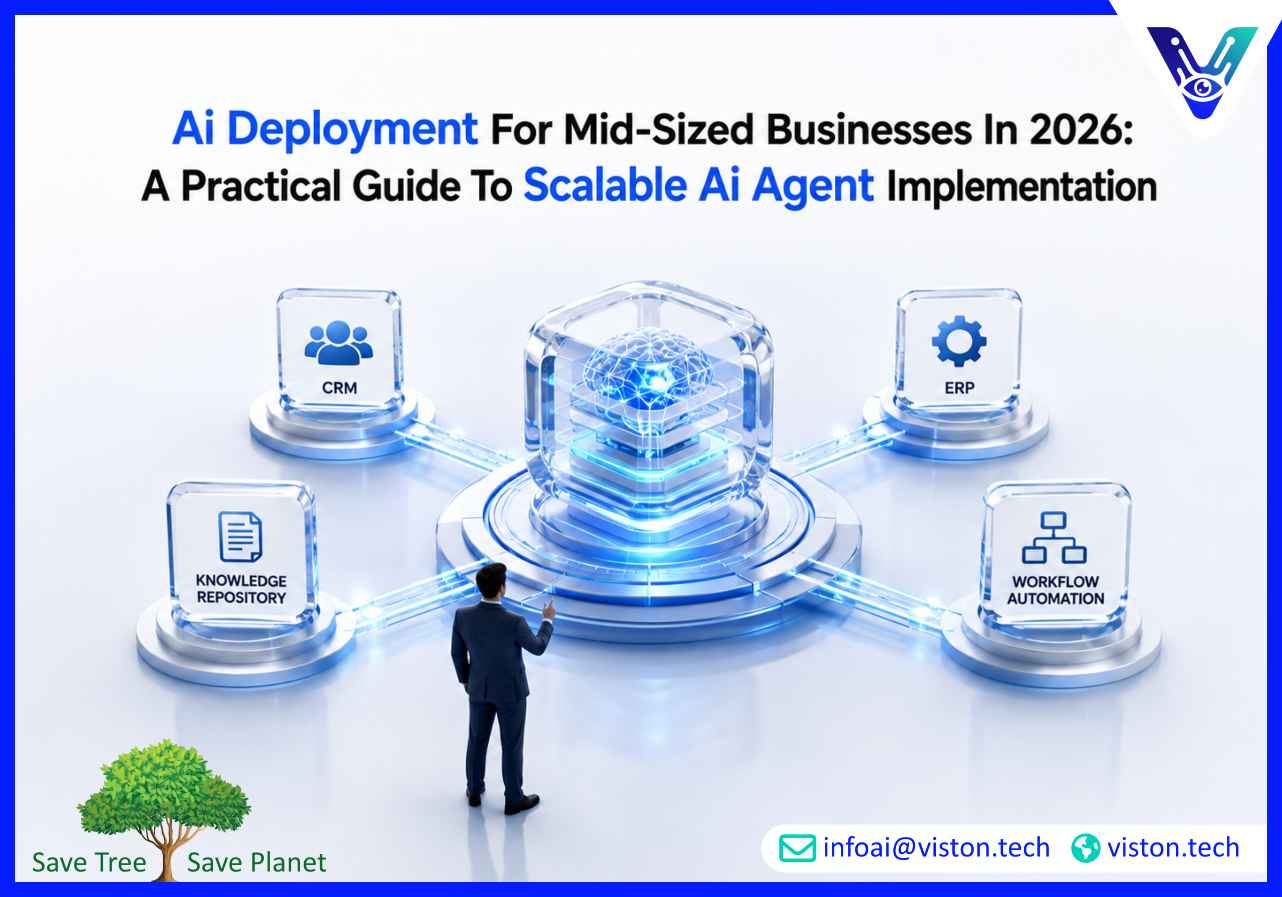
Introduction
AI adoption has moved beyond experimentation. For mid-sized businesses in 2026, the challenge is no longer whether to use AI, but how to deploy it in a way that creates measurable business value without introducing operational complexity, security risks, or disconnected systems. Effective deployment increasingly depends on practical AI agent strategies rather than isolated AI tools.
Why AI Deployment for Mid-Sized Businesses Matters in 2026
Mid-sized organizations sit in a unique position. They often need enterprise-grade efficiency and automation but typically operate without the large budgets, internal AI research teams, or extensive infrastructure available to large enterprises.
This creates a common problem: businesses want AI-driven outcomes such as faster operations, improved customer experience, and better decision-making, but many deployments fail because they start with technology instead of business processes.
In 2026, successful AI deployment increasingly focuses on:
- Intelligent workflow automation
- AI agents connected to business systems
- Secure data access and governance
- Cross-platform integrations
- Human oversight mechanisms
- Performance monitoring and optimization
- Scalable deployment architecture
Organizations are shifting from standalone chatbots toward AI systems capable of executing tasks, interacting with applications, and supporting real operational workflows. Modern AI agents combine language models, business rules, memory, tools, and system integrations into a coordinated operational layer.
What AI Deployment Means for Mid-Sized Businesses
AI deployment is the process of moving AI solutions from experimentation into real business operations.
Deployment is not simply connecting an API to a chatbot. For mid-sized companies, it usually involves:
Identifying business objectives
Examples include:
- Reducing support workload
- Automating internal operations
- Improving lead qualification
- Enhancing analytics workflows
- Streamlining customer onboarding
- Improving employee productivity
Integrating business systems
AI solutions often need connections to:
- CRM platforms
- ERP systems
- Internal databases
- Knowledge bases
- Communication platforms
- Analytics systems
- Customer support tools
Creating operational workflows
Instead of answering questions alone, modern AI agents may:
- Retrieve information
- Analyze context
- Make recommendations
- Trigger actions
- Escalate issues
- Generate reports
- Coordinate across systems
The objective is business execution rather than isolated AI interaction.
Common Challenges Mid-Sized Businesses Face During AI Deployment
Many organizations underestimate deployment complexity.
Data quality issues
AI systems depend heavily on accessible and reliable data.
Common problems include:
- Data silos
- Inconsistent formats
- Duplicate records
- Outdated information
- Missing documentation
Poor data frequently leads to unreliable outputs.
Integration difficulties
Businesses often operate multiple systems that were never designed to work together.
Examples include:
- Legacy applications
- Custom databases
- Department-specific software
- Multiple cloud environments
Without strong integration planning, AI becomes another disconnected tool.
Security and governance concerns
As AI agents gain access to internal systems, organizations increasingly require:
- Role-based permissions
- Encryption
- Audit trails
- Human approval workflows
- Data privacy controls
- Compliance alignment
Enterprise deployment platforms increasingly emphasize security, governance, and controlled access mechanisms for production AI environments.
Scalability challenges
A pilot project supporting one department may fail when expanded across the organization.
Common scalability issues include:
- API cost growth
- Infrastructure limitations
- Latency problems
- Inconsistent performance
- Monitoring gaps
How AI Agent Development Improves Deployment Success
AI agents are becoming a practical deployment model because they bridge the gap between AI intelligence and business execution.
Unlike traditional automation systems that follow fixed rules, AI agents can understand context and adapt to changing situations.
Capabilities often include:
Workflow orchestration
AI agents can coordinate multiple steps across systems:
Example:
A sales inquiry arrives:
- Extract customer information
- Check CRM records
- Assess lead quality
- Generate recommendations
- Notify the sales team
- Schedule follow-up actions
Context-aware decision support
Agents can process information from:
- Customer histories
- Documents
- Operational data
- Knowledge bases
- External systems
Continuous learning and optimization
Modern deployment strategies increasingly include:
- Feedback loops
- Monitoring systems
- Prompt optimization
- Workflow refinement
- Performance analytics
Agent-based deployment approaches are increasingly designed around planning, reasoning, and controlled task execution rather than simple scripted responses.
AI Deployment Use Cases for Mid-Sized Businesses
Practical use cases vary by industry, but several patterns are becoming common.
Customer support operations
AI agents can:
- Answer repetitive questions
- Retrieve account information
- Create support tickets
- Escalate complex issues
Benefits include:
- Reduced response times
- Improved service availability
- Lower operational workload
Sales and marketing workflows
AI deployment may support:
- Lead qualification
- Customer segmentation
- Campaign recommendations
- Personalized outreach
Internal operations
Businesses increasingly deploy AI for:
- HR onboarding
- Document processing
- Procurement workflows
- Reporting automation
Knowledge management
Organizations often struggle with information spread across multiple systems.
AI agents can:
- Search internal repositories
- Summarize information
- Retrieve documentation
- Assist employees with operational questions
A Practical AI Deployment Process for Mid-Sized Organizations
Successful deployment generally follows a structured process.
Step 1: Identify operational bottlenecks
Start with repetitive, measurable processes.
Questions to ask:
- Which tasks consume the most time?
- Where do delays occur?
- Which activities depend heavily on manual effort?
Step 2: Prioritize use cases
Choose initiatives that balance:
- Business impact
- Technical feasibility
- Implementation complexity
Step 3: Prepare data and systems
This stage typically includes:
- Data cleaning
- Integration planning
- Access controls
- Architecture design
Step 4: Build and test AI agents
Testing should evaluate:
- Response quality
- Workflow accuracy
- Security requirements
- Exception handling
- Performance under load
Step 5: Deploy and monitor
Deployment should include:
- Usage tracking
- Performance measurement
- Governance controls
- Continuous optimization
How Viston AI Supports AI Deployment for Mid-Sized Businesses
As AI deployment becomes more operationally complex, businesses increasingly need practical expertise around AI agent development and implementation rather than isolated AI experiments.
Viston AI focuses on AI agent development and deployment with an emphasis on turning business processes into scalable operational systems. For mid-sized businesses, this type of approach is often important because deployment challenges rarely involve models alone. More commonly, organizations struggle with integration complexity, fragmented workflows, security concerns, and long-term scalability.
AI agent implementation often requires multiple components working together:
- Workflow design
- System integration
- Orchestration logic
- Model selection
- Data handling
- Monitoring
- Governance controls
For businesses seeking deployment support, specialized delivery matters because an AI solution that performs well in testing can still fail under production conditions if operational requirements are overlooked.
A business-focused deployment approach generally prioritizes practical outcomes such as:
- Reducing repetitive work
- Improving operational efficiency
- Supporting internal teams
- Enabling scalable automation
- Maintaining reliability across systems
For organizations moving from AI exploration toward production adoption, structured AI agent deployment can help reduce implementation risk while supporting sustainable growth.
Frequently Asked Questions
What is AI deployment for mid-sized businesses?
AI deployment for mid-sized businesses involves implementing AI systems into operational workflows, applications, and business processes to create measurable business outcomes.
How are AI agents different from chatbots?
Traditional chatbots mainly answer questions. AI agents can understand context, make decisions, access tools, and execute multi-step workflows across business systems.
How long does AI deployment usually take?
The timeline depends on complexity. Focused deployments for individual workflows may take weeks, while larger cross-functional implementations involving integrations and governance can take several months.
What are the biggest deployment risks?
Common risks include:
- Poor data quality
- Security gaps
- Weak integrations
- Unclear business goals
- Lack of monitoring
- Insufficient change management
Can mid-sized businesses afford AI deployment?
Yes. Many organizations begin with targeted use cases rather than organization-wide initiatives. Deployment costs often depend on infrastructure requirements, integrations, workflow complexity, and support needs.
How can Viston AI help with AI deployment?
Viston AI supports AI agent development and deployment by helping businesses design, build, integrate, and scale AI-driven workflows that align with operational goals.
Conclusion
AI deployment for mid-sized businesses in 2026 is increasingly about building systems that create operational value rather than experimenting with standalone AI tools. Organizations that approach deployment strategically can improve efficiency, reduce manual work, and create scalable workflows across departments.
AI agent development plays an important role because modern business environments require systems capable of understanding context, integrating with existing platforms, and supporting real business execution. For companies looking to move from isolated AI initiatives to production-ready implementations, specialist deployment expertise from providers such as Viston AI can help turn AI investment into practical business outcomes.
