
From Pilot to Production: The 2026 AI Agent Implementation Roadmap for Startups
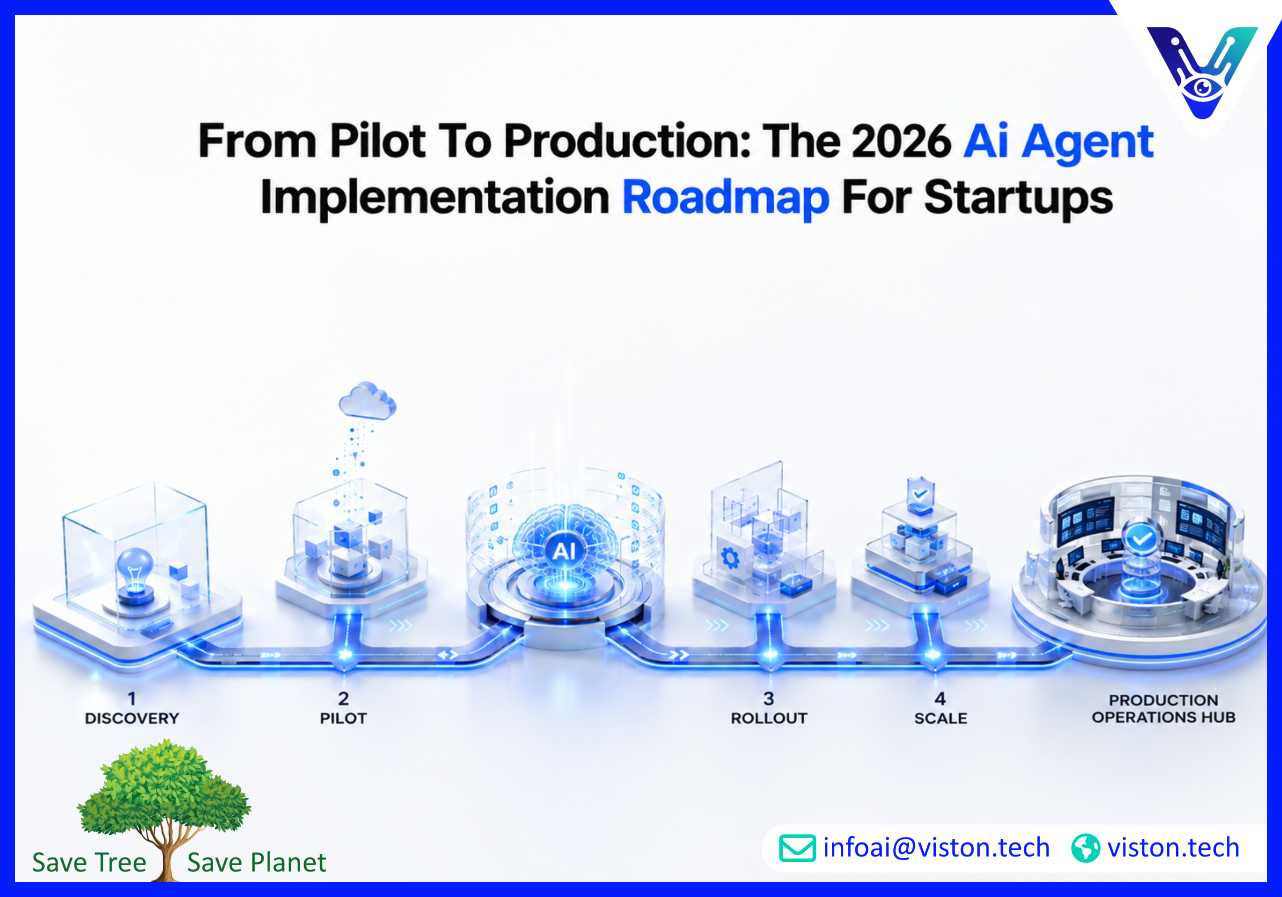
Introduction
The gap between generative AI enthusiasm and production-ready automation is wider than most startup founders realize. Industry data tells a stark story: while 79% of enterprises report adopting AI agents, only 11% have successfully deployed them in production environments. For startup decision-makers evaluating AI agent development & deployment, this disconnect represents both a significant opportunity and a considerable risk.
The question is no longer whether AI agents will transform business operations. It is how to implement them systematically—without becoming one of the 40% of agentic AI projects projected to be canceled by late 2027 due to escalating costs, unclear value, or inadequate governance. This roadmap provides a practical, phase-based framework for founders and technology leaders who need to move beyond experimentation and deliver measurable business outcomes through AI agent implementation.
Understanding AI Agents: What Startups Need to Know
Before committing resources to development, clarity on what AI agents actually are—and are not—is essential. Unlike chatbots that generate responses or traditional automation that follows rigid rules, AI agents operate as decision-making engines within defined systems. They plan multi-step tasks, use external tools, observe results, and work toward specific goals without step-by-step human guidance.
Consider the practical distinction: a chatbot tells you which invoices are overdue. An AI agent reviews those invoices, drafts follow-up correspondence, prepares CRM updates, and routes everything for approval before any action is taken. This shift from “decision support” to “assisted execution” is where real operational value emerges.
For startups, the appeal is obvious: AI agents can automate complex workflows that previously required multiple human touchpoints, compress cycle times, and scale operations without proportional headcount growth. But capturing that value requires a structured approach that prioritizes business problems over technology experimentation.
Phase 1: Discovery and Foundation (Months 1-3)
The most common failure point in agent implementation is skipping rigorous discovery. Startups eager to build often underestimate integration complexity, define metrics too loosely, or fail to involve operations and compliance stakeholders upfront.
Establishing Process Clarity
Begin by selecting a focused use case that addresses a real operational pain point—not the most technically interesting challenge. The ideal candidate processes exhibit three characteristics: they are highly digitized with standard data inputs and outputs, combine fixed procedures with some judgment requirements, and occur frequently enough that automation delivers meaningful time or cost savings.
Map the current-state process in detail. Interview the five to ten people who perform the work daily. Document baseline metrics including volume, accuracy, cycle time, and cost. Identify edge cases and exceptions before writing any code. This foundational work typically requires three to four weeks but prevents months of rework later.
Technical Readiness Assessment
Audit your data infrastructure honestly. According to industry estimates, 57% of organizations consider their data not AI-ready. An agent operating on ungoverned data does not produce bad outputs occasionally—it produces them systematically at scale.
Map all systems the agent needs to connect with. Assess API health, data freshness, and governance maturity. Identify integration risks early. The organizations that succeed treat integration as a core engineering challenge, not an afterthought.
Governance by Design
Build governance into the foundation rather than bolting it on after agents have proliferated across operations. Define what agents are authorized to do before deployment. Establish audit trails as a first-class requirement. The question “what happens when the agent is wrong?” should be a design specification, not an edge case.
Phase deliverables: A comprehensive discovery document covering process flows, integration architecture, baseline metrics, team RACI, and risk mitigation.
Phase 2: Pilot and Validation (Months 4-8)
The pilot phase validates assumptions before full commitment to deployment. This is where concepts become working prototypes, tested on live but low-risk transaction volumes.
Architecture and Tool Design
Production-grade agent architectures break monolithic prompts into specialized components. The winning pattern from Google Cloud’s Agent Bake-Off was clear: treat agents like microservices. Decompose complex problems into specialized sub-agents with tightly scoped prompts, managed by a supervisor agent that routes traffic.
Tool quality directly determines agent reliability. Each tool should have one explicit job, clear input schemas, and boundary conditions that prevent the agent from searching for information it already possesses. Bloating tool sets is a common failure mode—discipline in tool design pays dividends in production.
Pilot Deployment and Iteration
Deploy initially to 10-15% of live volume, starting with the lowest-risk transaction types. Monitor accuracy, speed, and cost daily. The typical accuracy curve shows approximately 60% at week one, progressing to 75% at week four, 85% at week eight, and 90% at week twelve.
Do not proceed to full rollout until accuracy consistently exceeds 85%. The tuning phase is where most startups try to cut corners—and where the disciplined separate from the struggling.
Phase deliverables: Integrated test environment, pilot deployment with monitoring dashboards, edge case documentation, and team training materials.
Phase 3: Staged Rollout and Governance (Months 9-14)
Scaling from pilot success to production volume requires systematic expansion and operational maturity.
Volume Expansion Protocol
Increase automation coverage in controlled increments: 20% of volume at week one, 30% at week three, 40% at week six, and 50% at week ten. Pause after each step to assess performance before proceeding. This staged approach prevents the cascade failures that occur when untested configurations handle unexpected edge cases at scale.
Operational Handoff
The project team should not own production agents permanently. Train two to three full-time equivalents as an AI operations function responsible for monitoring, tuning, and escalation handling. Define service-level agreements, document runbooks, and transition ownership methodically.
Monitoring and Feedback Loops
Implement dashboards tracking daily accuracy, speed, cost, and escalation metrics. Configure automated alerts for anomalies such as accuracy drops exceeding 5% or escalation spikes. Weekly performance reviews and monthly stakeholder reporting maintain visibility and accountability.
Phase deliverables: Governance framework with standard operating procedures, trained operations team, monitoring infrastructure, and weekly performance reporting.
Phase 4: Optimization and Scale (Months 15-18)
The final phase focuses on extracting maximum value from the initial deployment while building a repeatable playbook for subsequent use cases.
ROI Realization
With a structured approach, breakeven typically occurs around month 12, with cumulative positive value emerging by month 18. Organizations following this roadmap report approximately $350,000 or more in annual recurring benefit from their first production agent.
Playbook Development
Document every decision, architecture choice, and lesson learned. The first use case takes approximately 18 months. Subsequent use cases with the established playbook take roughly eight months. This repeatability is where competitive advantage compounds.
Building Your Internal Agentic Engineering Capability
Successful implementation requires more than following a roadmap—it demands building organizational capability. The skills gap between AI ambition and production reality is substantial. Founders should invest in three foundational areas before expanding their agent portfolio.
First, Python proficiency across the team is non-negotiable. Almost every agentic framework is Python-first. Second, LLM fundamentals including tokenization, context window management, and API usage patterns must be understood by everyone touching the system. Third, basic familiarity with vectors and embeddings is essential for designing effective memory architectures.
Frameworks have largely consolidated around LangGraph for production systems requiring precise state control and conditional branching, and CrewAI for simpler multi-agent coordination. Choose based on your specific use case complexity rather than feature checklists.
Security, Compliance, and Risk Management
For startups operating under data protection regulations, compliance exposure at the workflow level is a critical consideration. Every step an agent takes is a potential data processing event. When agents run on third-party infrastructure or external LLM APIs, compliance exposure multiplies rather than adds linearly.
The Viston AI Advantage in Agent Implementation
For startups seeking to accelerate their AI agent journey without building all capability internally, Viston AI provides specialized AI agent development & deployment services tailored to the unique constraints and opportunities of growth-stage companies. Unlike generalist consultancies, Viston focuses exclusively on agentic automation—bringing battle-tested implementation frameworks, pre-built integration patterns, and production monitoring systems that would take internal teams twelve to eighteen months to develop from scratch.
Viston’s approach prioritizes business outcomes over technical complexity. Their engagement model follows the proven roadmap phases outlined above but compresses timelines through reusable components and established governance templates. For European startups navigating data sovereignty requirements, Viston brings specific expertise in compliant deployment architectures that keep sensitive processing on owned infrastructure while leveraging best-in-class models through secure gateways. By partnering with Viston, technology leaders can focus on their core product differentiation while agent infrastructure is built, deployed, and optimized by specialists who have already solved the problems that derail internal initiatives.
Frequently Asked Questions
How long does it realistically take to deploy a production AI agent?
A first use case typically requires 12 to 18 months from initial discovery to full production rollout, including the pilot, staged deployment, and optimization phases.
What is the typical budget for AI agent implementation?
Initial investment across discovery, pilot, and rollout phases ranges from approximately $200,000 to $400,000 for a focused first use case, with positive ROI typically emerging around month 12.
What types of business processes are best suited for AI agents?
Ideal candidates are highly digitized, combine standard procedures with judgment, occur frequently, and have clear success metrics. Customer support triage, document processing, and workflow orchestration are common starting points.
How do AI agents differ from traditional RPA automation?
Traditional RPA follows rigid rules without adaptation. AI agents reason about context, use multiple tools, learn from outcomes, and handle exceptions within defined boundaries.
What are the biggest risks startups face with AI agent deployment?
Data quality gaps, inadequate governance, cost escalation from uncontrolled API usage, and insufficient human oversight for high-stakes decisions are the primary failure modes.
How do data sovereignty requirements affect agent implementation in Europe?
Under GDPR and national data protection laws, agent workflows must maintain data within compliant jurisdictions. This often requires hybrid architectures with local processing and encrypted gateway connections to external models.
Conclusion
The path from AI experimentation to operational advantage is neither short nor simple, but it is navigable with disciplined execution. The AI agent implementation roadmap for startups prioritizes process clarity over technical complexity, staged validation over rushed deployment, and governance by design over reactive controls.
Organizations following this structured approach typically achieve breakeven within 12 months and unlock significant annual value by month 18—while building a repeatable playbook for subsequent use cases that cuts implementation timelines in half. For technology leaders evaluating their AI agent development & deployment options, the decision is no longer whether to adopt agentic systems, but how to implement them without becoming a cautionary statistic.
The organizations that succeed will be those that treat agentic AI as a serious engineering discipline, not an experiment. Viston AI helps startups bridge this gap with specialized implementation expertise, proven frameworks, and production-ready infrastructure—turning roadmap phases into measurable business outcomes.
