AI Orchestration Frameworks Compared in 2026: What Businesses Should Know Before Building AI Agents
Introduction
AI systems have moved beyond single-model chatbots. Businesses now want AI agents that coordinate workflows, make decisions, interact with enterprise systems, and execute tasks autonomously. As adoption grows across industries in 2026, choosing the right orchestration framework has become a critical decision because it directly affects scalability, reliability, governance, and long-term deployment success.
Understanding AI Orchestration Frameworks
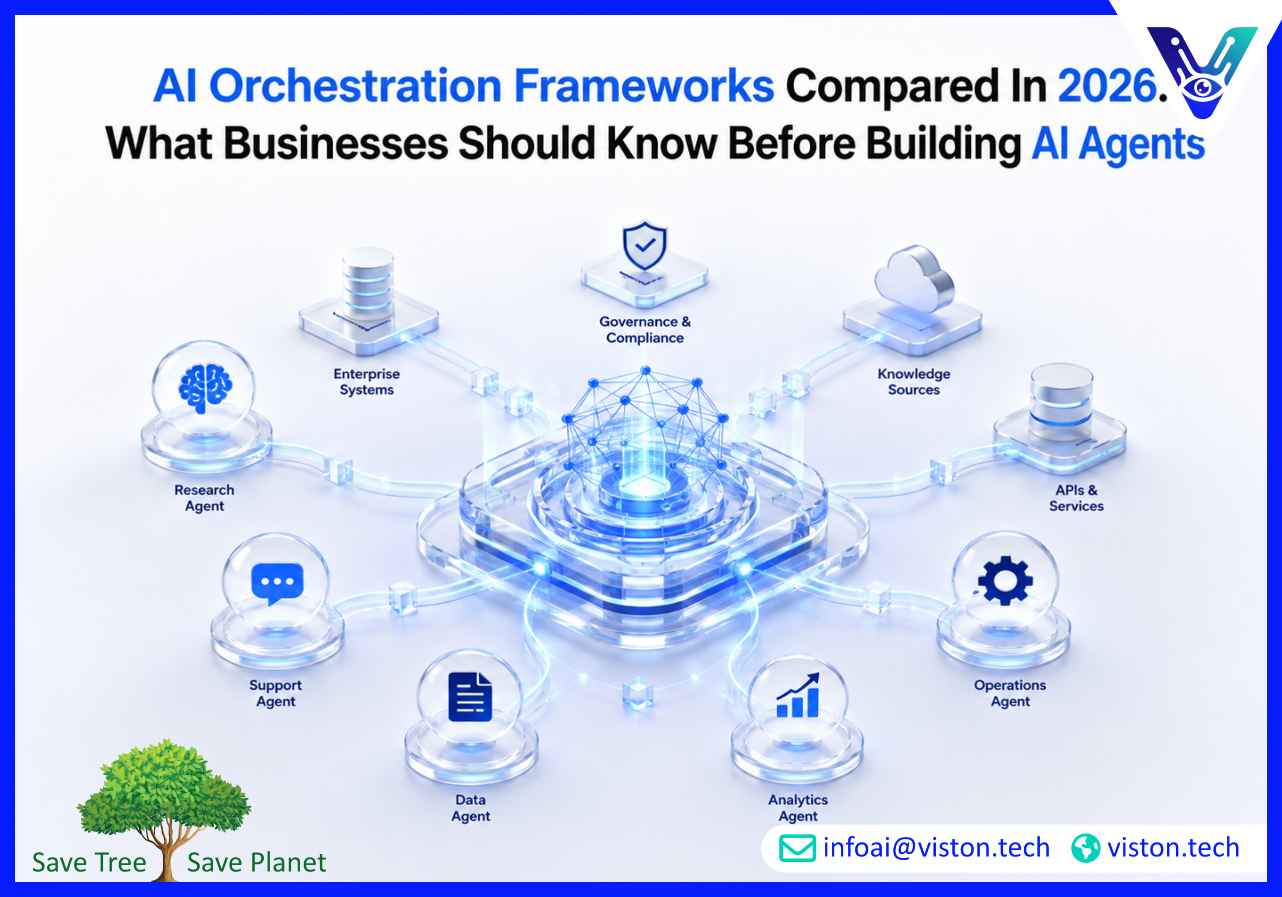
AI orchestration frameworks are software layers that manage how multiple AI components work together within an agent ecosystem. Instead of treating AI as a standalone model, orchestration frameworks coordinate prompts, memory, tools, APIs, workflows, retrieval systems, and multiple agents.Think of an orchestration framework as the operational layer that determines how AI agents behave once deployed.Modern enterprise AI environments rarely involve one isolated model. A customer service assistant may need to:
Retrieve information from internal knowledge bases
Access CRM platforms
Coordinate with external APIs
Route tasks between specialized agents
Maintain context across interactions
Apply security and compliance rules
Without orchestration, these systems quickly become difficult to manage.In 2026, orchestration is increasingly viewed as infrastructure rather than an optional enhancement.
Why AI Orchestration Frameworks Matter More in 2026
Early AI implementations often focused on proof-of-concept projects. Organizations are now deploying production-grade AI systems across operations, finance, healthcare, logistics, marketing, and customer support.Several factors are driving the need for orchestration:
Increasing Agent Complexity
Many businesses are moving toward multi-agent architectures where specialized agents perform distinct tasks.Examples include:
Research agents collecting information
Planning agents coordinating workflows
Execution agents performing actions
Validation agents checking outputs
Monitoring agents ensuring compliance
Without structured coordination, these systems create operational bottlenecks.
Enterprise Governance Requirements
Organizations increasingly require:
Audit trails
Access controls
Data privacy management
Model usage monitoring
Human approval checkpoints
Risk management controls
Orchestration frameworks provide mechanisms to enforce these requirements.
Multi-Model Environments
Many companies avoid dependence on a single AI provider.A business might use:
One model for reasoning
Another for image analysis
Specialized models for classification
Internal fine-tuned models for proprietary tasks
An orchestration layer allows these systems to work together efficiently.
AI Orchestration Frameworks Compared: Key Categories
Instead of viewing orchestration frameworks as simple tools, businesses should evaluate them based on architecture and deployment objectives.
Workflow-Centric Frameworks
Workflow-based orchestration systems focus on predefined processes.Strengths:
Predictable execution
Strong compliance support
Easier debugging
Better operational visibility
Challenges:
Reduced flexibility
Less adaptive behavior
Best suited for:
Insurance workflows
Financial processing
HR automation
Enterprise operations
Agent-Centric Frameworks
Agent-based systems emphasize autonomous decision-making.Strengths:
Dynamic task execution
Adaptive reasoning
Complex problem solving
Challenges:
Increased monitoring requirements
Greater operational complexity
Best suited for:
Research automation
Customer interactions
Knowledge management
Digital assistants
Multi-Agent Coordination Platforms
These environments coordinate multiple specialized agents.Strengths:
Parallel processing
Task specialization
Scalability
Challenges:
Agent synchronization complexity
Communication overhead
Best suited for:
Supply chain operations
Enterprise process automation
Large-scale data analysis
Retrieval-Integrated Frameworks
These combine orchestration with knowledge retrieval systems.Strengths:
Better factual accuracy
Access to business-specific information
Reduced hallucination risk
Challenges:
Requires strong data architecture
Governance becomes important
Best suited for:
Internal knowledge systems
Customer support
Legal research
Documentation management
Critical Evaluation Factors Before Selecting a Framework
Technology teams often focus heavily on features while overlooking operational requirements.The better approach is evaluating frameworks through business outcomes.
Integration Capabilities
AI agents rarely operate independently.Questions to ask:
Does it integrate with ERP systems?
Can it connect with CRM platforms?
Does it support APIs and event systems?
Can it work with internal databases?
Poor integrations often create deployment delays.
Observability and Monitoring
By 2026, organizations expect visibility into:
Agent actions
Token usage
Latency
Failures
Reasoning chains
Workflow performance
Without monitoring, diagnosing issues becomes difficult.
Security and Compliance
AI deployment increasingly involves regulated environments.Businesses should assess:
Access permissions
Encryption support
Identity management
Data retention controls
Audit capabilities
This becomes particularly important for healthcare, finance, and enterprise environments.
Scalability
An AI pilot handling hundreds of interactions differs significantly from production environments processing millions of transactions.Questions include:
Can workloads scale horizontally?
Does performance degrade under heavy demand?
Are deployment costs predictable?
Human-in-the-Loop Support
Many operational environments still require human oversight.Common examples include:
Contract approvals
Medical recommendations
Financial decisions
Customer escalation workflows
Frameworks increasingly include approval checkpoints and intervention mechanisms.
Common Business Risks When Choosing the Wrong Framework
AI deployment problems rarely start with the model itself. They often begin with orchestration decisions.Common risks include:
Vendor Lock-In
Some frameworks become tightly coupled with a single AI provider.This creates:
Limited flexibility
Cost risks
Migration challenges
Poor Debugging Capabilities
Complex agent workflows become difficult to troubleshoot without strong observability tools.Symptoms include:
Unexpected outputs
Workflow failures
Inconsistent performance
Hidden Operational Costs
Costs often emerge from:
API usage
Infrastructure requirements
Monitoring systems
Scaling overhead
Maintenance effort
Governance Gaps
Organizations frequently underestimate:
Compliance obligations
Access controls
Audit requirements
Security reviews
Addressing these late in deployment significantly increases implementation costs.
AI Agent Development and Deployment: Why Orchestration Cannot Be an Afterthought
AI agent development and deployment involves far more than selecting a language model.Successful implementations typically include:
Planning the Agent Architecture
Teams must define:
Agent responsibilities
Workflows
Data sources
Communication patterns
Escalation paths
Building Reliable Tool Integrations
Agents often require connections to:
Business applications
Internal databases
Search systems
APIs
Analytics platforms
Testing for Production Conditions
Testing increasingly includes:
Edge case handling
Failure recovery
Security validation
Load testing
Response quality measurement
Monitoring and Continuous Optimization
AI systems evolve after deployment.Organizations frequently optimize:
Prompt structures
Model selection
Memory systems
Workflow logic
Operational performance
The orchestration layer becomes the foundation supporting these improvements.
How Viston AI Supports Businesses Building Production AI Systems
For organizations investing in AI agent development and deployment, the challenge often extends beyond choosing a framework. The larger challenge is creating systems that work reliably under real business conditions.Viston AI focuses on practical AI implementation rather than isolated experimentation. AI orchestration frameworks directly affect how agents interact with business systems, manage workflows, maintain context, and scale across operational environments. Because of that connection, orchestration decisions become closely tied to deployment success.For businesses building enterprise AI systems, the process typically involves several layers:
Designing agent architecture
Connecting data sources and business tools
Establishing workflow logic
Implementing governance controls
Monitoring system behavior
Supporting scalability requirements
Organizations across industries increasingly require AI systems that fit existing operations rather than forcing operational redesign.A structured approach to AI agent development and deployment can help reduce common challenges such as fragmented workflows, integration complexity, inconsistent outputs, and operational risk. The objective is not simply deploying agents but creating systems that align with measurable business objectives while remaining adaptable as requirements evolve.As AI adoption expands globally, practical implementation capabilities increasingly matter as much as the underlying technology itself.
Frequently Asked Questions
What is an AI orchestration framework?
An AI orchestration framework coordinates multiple AI components, including models, workflows, tools, memory systems, and integrations, allowing AI agents to operate as connected systems rather than isolated applications.
Are AI orchestration frameworks necessary for small businesses?
Not always. Smaller deployments with simple workflows may operate without advanced orchestration. However, once multiple tools, integrations, or agents are involved, orchestration becomes increasingly valuable.
How do orchestration frameworks support AI agent development and deployment?
They provide structure for workflow management, tool coordination, memory handling, monitoring, and governance, making AI systems easier to deploy and maintain.
Can businesses switch orchestration frameworks later?
Yes, but migration complexity depends on system architecture and framework dependencies. Businesses should evaluate portability before implementation.
How should companies evaluate providers like Viston AI?
Organizations should assess implementation expertise, deployment capabilities, scalability approaches, integration experience, governance support, and practical understanding of business workflows rather than focusing only on technology claims.
Conclusion
AI orchestration frameworks compared in 2026 reveal an important reality: successful AI systems depend on far more than selecting the most advanced model. The orchestration layer determines how AI agents communicate, make decisions, integrate with enterprise systems, and operate at scale.For organizations pursuing AI agent development and deployment, the focus should be on long-term operational reliability rather than short-term experimentation. Framework selection affects security, performance, flexibility, and governance outcomes that continue long after deployment. Businesses investing in scalable AI capabilities increasingly benefit from working with specialists such as Viston AI that understand how architecture decisions translate into practical business performance.