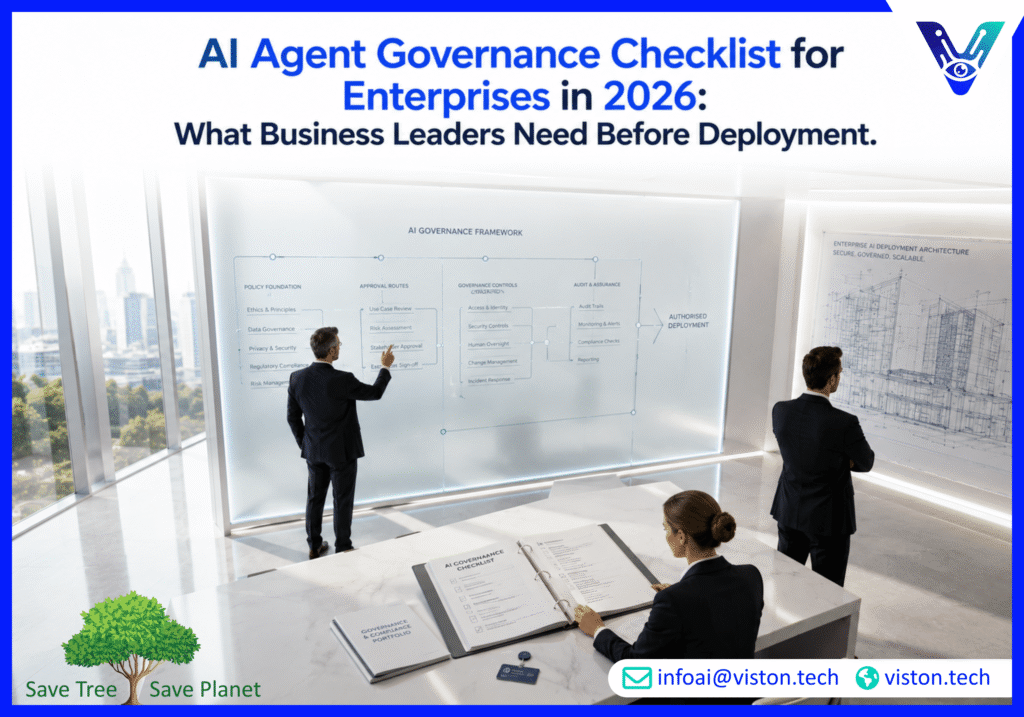
AI Agent Governance Checklist for Enterprises in 2026: What Business Leaders Need Before Deployment
Introduction
Enterprise AI adoption is shifting from experimentation to operational deployment. As organizations move autonomous AI agents into customer service, operations, analytics, and decision workflows, governance has become a business requirement rather than a compliance exercise. An effective AI agent governance checklist for enterprises helps reduce risk, maintain accountability, and support scalable AI deployment in 2026.
What AI Agent Governance Means for Enterprises
AI agent governance is the framework of policies, controls, processes, and technical safeguards that guide how AI agents are designed, deployed, monitored, and managed across an organization.Unlike traditional software systems, AI agents make decisions, interact with systems, process sensitive data, and sometimes trigger actions autonomously. This creates governance requirements beyond normal application management.Enterprise governance typically addresses:
Data access permissions
Human oversight requirements
Audit trails
Security controls
Regulatory compliance
Decision transparency
Performance monitoring
Risk management
Third-party integration oversight
Incident response procedures
The challenge in 2026 is not whether enterprises should govern AI agents. The challenge is governing them without slowing innovation.
Why AI Agent Governance Matters More in 2026
Many organizations initially deployed AI assistants for low-risk tasks like document summarization or internal knowledge retrieval. Today’s enterprise AI agents often:
Execute workflow automation
Access ERP and CRM systems
Trigger operational actions
Interact with customers
Support financial processes
Analyze sensitive datasets
Coordinate multiple systems
The more autonomy these systems gain, the greater the operational risk.Without structured governance, organizations can face issues such as:
Data exposure risks
AI agents may access confidential customer, financial, healthcare, or operational information without proper access boundaries.
Uncontrolled decision-making
Agents acting without escalation rules can create operational errors.
Compliance violations
Regulated industries must demonstrate how decisions were made and what data influenced them.
Security vulnerabilities
API integrations and external system connections expand the attack surface.
Lack of accountability
When an autonomous workflow fails, organizations need clear ownership and auditability.Governance creates predictable operating standards without preventing AI adoption.
The Enterprise AI Agent Governance Checklist for 2026
A practical AI agent governance checklist should combine operational, technical, and organizational controls.
1. Define the purpose and boundaries of every AI agent
Before deployment, identify:
What business process the agent supports
Expected outputs
Systems it can access
Actions it can perform
Restricted activities
Human escalation requirements
Avoid vague objectives.Weak definition:
“Customer support AI assistant”Better definition:
“AI agent handling order status inquiries, FAQ responses, and ticket categorization while escalating billing disputes to human teams.”Clear scope reduces unexpected behavior.
2. Establish role-based access controls
AI agents should not automatically receive broad organizational access.Consider:
Least-privilege access principles
Department-level permissions
Temporary access expiration
Sensitive data restrictions
Multi-factor authentication where applicable
An AI agent managing inventory does not require payroll system access.Access controls should align with organizational security architecture.
3. Create data governance rules
Data quality directly affects AI behavior.Organizations should document:
Approved data sources
Data ownership
Retention policies
Data classification categories
Personally identifiable information handling
Cross-border data requirements
This becomes particularly important for global enterprises operating across multiple regulatory environments.
4. Build human-in-the-loop controls
Not all decisions should be fully autonomous.High-risk activities should include:
Human approval checkpoints
Escalation workflows
Confidence thresholds
Exception handling rules
Examples include:
Financial approvals
Contract modifications
Legal decisions
Healthcare recommendations
Customer compensation actions
Human oversight does not reduce AI efficiency; it creates operational safeguards.
5. Maintain full audit trails
Enterprises should track:
User interactions
Input prompts
Agent outputs
Actions taken
System access history
Decision logic
Escalation records
Auditability supports:
Regulatory reviews
Internal investigations
Performance analysis
Security incident management
Many organizations now require AI logging standards comparable to traditional enterprise systems.
6. Implement security monitoring
AI agents interact with multiple endpoints, APIs, and databases.Security controls should include:
Continuous monitoring
API authentication policies
Threat detection
Prompt injection protections
Identity verification
Runtime monitoring
Security should be treated as an operational process rather than a one-time deployment task.
7. Define performance metrics
Governance is not only about controlling risk.Organizations also need measurable outcomes.Examples include:
Accuracy rates
Escalation frequency
Response times
Task completion rates
User satisfaction
Cost reduction impact
Error rates
Performance measurement identifies operational issues before they become larger problems.
8. Create incident response procedures
AI agents can fail.Governance frameworks should answer:
Who owns incident response?
How quickly should issues be addressed?
Which teams are notified?
How are deployments paused?
How are users informed?
Incident planning minimizes disruption when unexpected situations occur.
9. Review third-party AI dependencies
Many organizations deploy agents using external models, APIs, or platforms.Vendor assessments should examine:
Security standards
Data handling practices
Availability commitments
Compliance certifications
Service continuity plans
Model update policies
Third-party risk increasingly affects enterprise AI deployments.
10. Establish ongoing governance reviews
AI systems change over time.New datasets, model updates, business rules, and integrations can create unintended consequences.Organizations should schedule:
Quarterly governance reviews
Security assessments
Performance evaluations
Compliance audits
Risk reassessments
Governance should evolve with the AI environment.
Common Enterprise Mistakes When Governing AI Agents
Organizations often focus heavily on model performance while overlooking operational realities.Common mistakes include:
Treating AI agents like conventional software
Traditional applications follow predefined logic.AI agents operate probabilistically and require additional monitoring and validation.
Over-automating high-risk processes
Automation should match risk tolerance.Not every process benefits from complete autonomy.
Ignoring cross-functional ownership
Governance should involve:
Security teams
Operations teams
Legal departments
Compliance teams
Technology leaders
Business stakeholders
AI governance cannot be owned solely by engineering teams.
Delaying governance until after deployment
Adding governance later often creates higher costs and operational complexity.Controls should be incorporated from the beginning.
Supporting Governance Through AI Agent Development and Deployment
Governance becomes easier when it is integrated directly into AI agent development and deployment processes rather than layered on afterward.Organizations increasingly evaluate implementation partners based on their ability to support:
How Viston AI Supports Enterprise AI Agent Deployment with Governance in Mind
Organizations implementing AI agents often discover that technical deployment is only one part of the challenge. Sustainable deployment also requires operational controls, integration discipline, and governance-ready architecture.Viston AI focuses on AI agent development and deployment for organizations seeking practical, scalable AI solutions that align with real business processes. Governance considerations naturally intersect with this work because enterprise agents frequently interact with internal systems, operational workflows, and sensitive data environments.Rather than treating governance as a separate initiative, AI deployment practices increasingly benefit from structured planning around permissions, monitoring, workflow controls, and deployment standards from the start.For enterprises operating across industries and global markets, this becomes particularly relevant when AI systems need to scale beyond pilots into production environments. Businesses evaluating implementation partners often look for teams that understand not only model behavior but also operational realities such as integrations, security expectations, reliability requirements, and ongoing management needs.As enterprise AI environments mature in 2026, organizations are increasingly prioritizing deployment approaches that support both innovation and accountability.
Frequently Asked Questions
What is an AI agent governance checklist for enterprises?
An AI agent governance checklist is a structured framework that helps organizations manage AI deployment risks through policies, security controls, monitoring, compliance procedures, and operational standards.
Who should own AI governance inside an organization?
Governance usually requires shared ownership across technology leadership, security teams, compliance departments, operations teams, and business stakeholders.
Should every AI agent include human oversight?
Not necessarily. Low-risk automation may operate independently, while high-risk decisions involving finance, legal matters, or customer impact typically benefit from human review processes.
How often should enterprise AI governance frameworks be reviewed?
Many organizations conduct quarterly reviews, although highly regulated industries or rapidly changing AI environments may require more frequent assessments.
Can Viston AI support businesses deploying governed AI agents?
Organizations seeking AI agent development and deployment support often look for implementation partners that understand both technical deployment requirements and operational governance considerations.
Conclusion
Building an AI agent governance checklist for enterprises is becoming a foundational requirement for responsible AI adoption in 2026. Organizations deploying autonomous systems need more than strong models; they need clear controls, oversight mechanisms, security standards, and measurable operational processes. Effective AI agent development and deployment combines innovation with accountability. As enterprises scale AI initiatives, governance frameworks help reduce risk while creating a stronger foundation for long-term value. Businesses working with specialists such as Viston AI increasingly recognize that sustainable AI deployment depends on balancing technical capability with practical operational discipline.