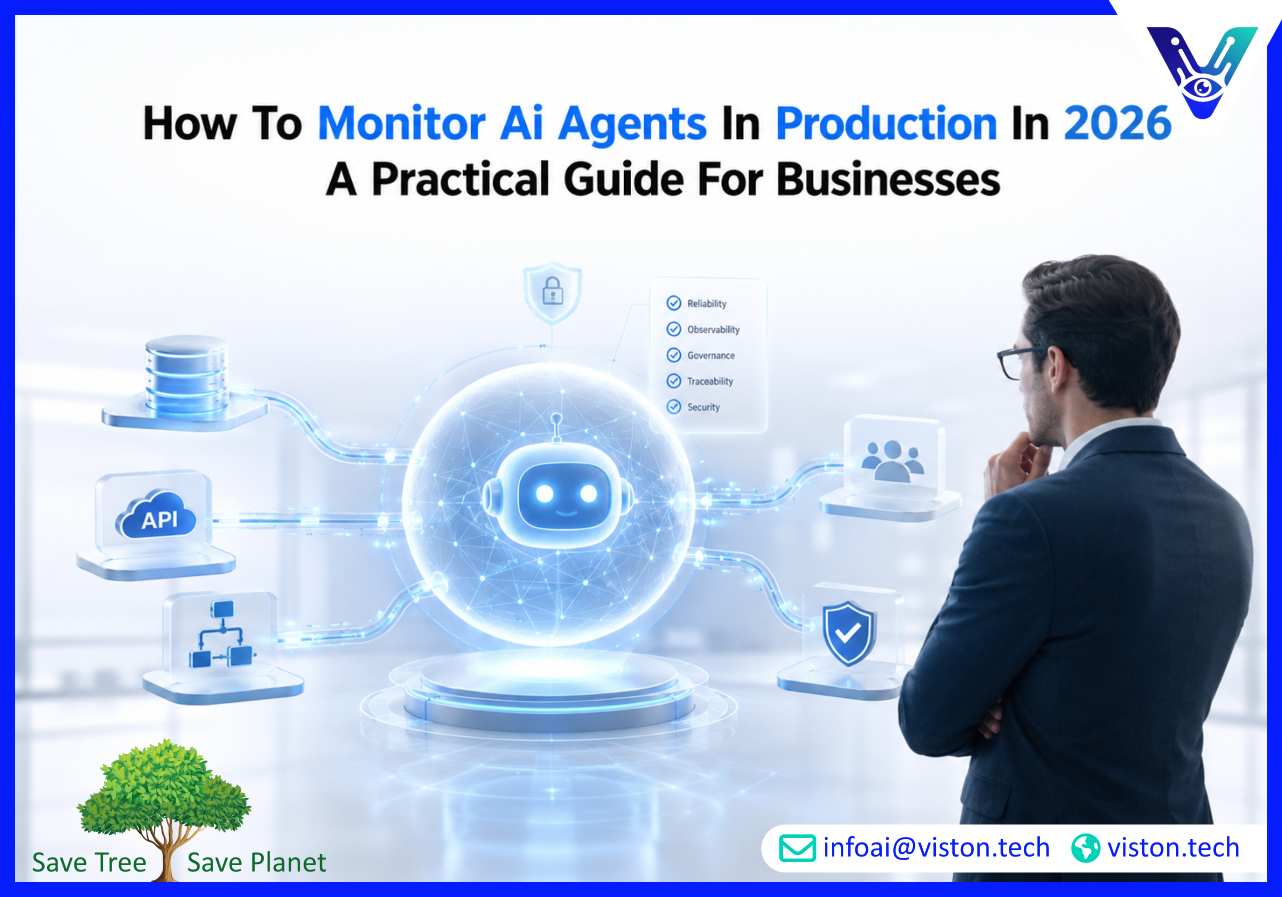
How to Monitor AI Agents in Production in 2026: A Practical Guide for Businesses
Introduction
Deploying AI agents into production is no longer the difficult part for many businesses in 2026. The bigger challenge is keeping them reliable after launch. As AI agents increasingly make decisions, interact with systems, and execute tasks autonomously, organizations need visibility into how those agents behave in real-world environments and whether they continue delivering safe and measurable outcomes.
What Does Monitoring AI Agents in Production Mean?
Monitoring AI agents in production is the ongoing process of observing, measuring, and evaluating how AI agents perform after deployment.Unlike traditional software monitoring, AI agent monitoring goes beyond server uptime or API latency. Production AI agents can reason, choose actions, use tools, access data sources, and interact with users independently. Their behavior can change depending on context, data quality, model updates, or external systems.Effective monitoring helps answer important operational questions:
Is the agent completing tasks correctly?
Is response quality degrading?
Are costs increasing unexpectedly?
Is the agent using tools appropriately?
Are security or compliance risks emerging?
When should humans intervene?
For businesses deploying customer support agents, sales assistants, workflow automation agents, internal knowledge systems, or multi-agent workflows, monitoring becomes a critical operational function rather than a technical add-on.
Why AI Agent Monitoring Matters More in 2026
Many organizations initially focused on getting AI agents into production quickly. As adoption matured, attention shifted toward reliability, governance, and measurable business outcomes.Several factors are driving this change:
Increased autonomy
Modern agents increasingly perform multi-step actions independently:
Querying databases
Sending emails
Updating CRM systems
Triggering workflows
Accessing internal tools
Calling external APIs
More autonomy creates more potential failure points.
Regulatory and compliance expectations
Organizations handling customer data, healthcare records, financial information, or sensitive internal systems face growing expectations around:
Auditability
Explainability
Access controls
Data governance
Security monitoring
Operational cost management
AI agents operating continuously can generate substantial infrastructure and token costs if not optimized.Without monitoring, teams often discover cost problems after spending has already escalated.
User trust
An agent that occasionally produces inaccurate actions or inconsistent outputs can damage confidence quickly.Trust depends on consistency.
The Key Metrics to Monitor for AI Agents
Production monitoring should combine technical performance indicators with business outcomes.
1. Task success rate
Measure whether the agent successfully completes assigned goals.Examples include:
Customer requests resolved
Tickets closed correctly
Appointments scheduled
Workflows executed successfully
A high response rate does not necessarily indicate a high success rate.
2. Accuracy and output quality
Agents can appear fluent while still producing poor decisions.Track:
Hallucination frequency
Incorrect actions
Invalid recommendations
Response relevance
Human review outcomes
Human feedback loops remain important.
3. Latency and response time
Slow agents create friction.Monitor:
First response latency
Total task completion time
External API delays
Tool execution times
Users may tolerate a delay if an agent solves a complex issue, but excessive delays reduce adoption.
4. Token and infrastructure usage
AI agent deployment costs can rise unexpectedly.Track:
Token consumption
Model inference costs
Memory usage
Tool call frequency
Resource allocation
Monitoring costs early prevents inefficient scaling.
5. Tool usage behavior
Agents increasingly rely on external systems and tools.Monitor:
Failed tool calls
Repeated actions
Unnecessary API requests
Incorrect tool selection
Escalation frequency
Unexpected tool behavior often reveals deeper reasoning problems.
6. Security events
Production agents frequently interact with sensitive systems.Watch for:
Unauthorized access attempts
Prompt injection attempts
Suspicious requests
Data exposure risks
Permission misuse
Security monitoring should be integrated into deployment architecture from the beginning.
Common Production Risks Businesses Overlook
Organizations frequently assume that an agent working in testing environments will behave similarly at production scale.That assumption creates problems.
Context drift
Over time, user behavior changes.An internal HR assistant trained on previous policies may begin producing outdated recommendations after organizational changes.
Data quality degradation
If connected systems contain incomplete or inaccurate data, agents can produce poor outputs.The issue may not be the model itself.
Agent loops
Autonomous agents can occasionally repeat actions or become trapped in cycles.For example:
Repeated retries
Duplicate emails
Continuous API calls
Endless task delegation between agents
Without monitoring, these issues can remain unnoticed.
Silent failures
Traditional software often crashes visibly.AI agents sometimes fail quietly:
Producing plausible but incorrect outputs
Taking incomplete actions
Missing edge cases
These failures can be difficult to identify without behavioral monitoring.
How to Build an Effective AI Agent Monitoring Framework
Successful monitoring requires more than adding dashboards.
Define business objectives first
Start with outcomes rather than technical metrics.Examples:
Reduce customer response time by 40%
Automate invoice processing
Increase lead qualification speed
Improve internal productivity
Monitoring should measure progress toward these goals.
Create layered observability
Effective AI monitoring usually includes multiple layers:
Infrastructure monitoring
CPU usage
Memory
Network performance
Application monitoring
API calls
Errors
Response times
Model monitoring
Output quality
Drift detection
Hallucinations
Business monitoring
Revenue impact
Workflow completion
Customer satisfaction
Maintain traceability
Teams should understand how an agent reached a decision.Useful tracing may include:
User input
Reasoning steps
Tool usage
External calls
Final outputs
Traceability improves debugging and governance.
Introduce human review processes
Not every decision should be fully autonomous.Many organizations implement:
Human approval workflows
Escalation thresholds
Risk-based intervention rules
Human oversight remains important for critical processes.
Industry Use Cases for Production Monitoring
Different industries monitor AI agents differently.
Customer support
Key metrics:
Resolution rates
Escalation frequency
Customer satisfaction
Response accuracy
Healthcare
Key metrics:
Data security
Audit logs
Compliance controls
Recommendation reliability
Financial services
Key metrics:
Transaction accuracy
Fraud indicators
Access monitoring
Regulatory reporting
Enterprise operations
Key metrics:
Workflow completion
Productivity gains
Process bottlenecks
System integration performance
How Viston AI Supports Reliable AI Agent Development and Deployment
Monitoring becomes significantly easier when AI agents are designed with production realities in mind rather than treated as isolated experiments.Viston AI focuses on AI agent development and deployment for businesses that need practical systems integrated into real operational environments. Production deployment increasingly requires more than selecting a model or creating prompts. Organizations need structured workflows, integration capabilities, governance controls, and ongoing optimization processes that align with business objectives.For companies implementing AI agents across customer service, operations, internal knowledge systems, sales workflows, or multi-step automation processes, several challenges frequently emerge:
Managing agent behavior at scale
Integrating with business systems
Maintaining security controls
Improving reliability over time
Reducing operational risk
Tracking measurable outcomes
A practical deployment approach typically includes observability considerations from the beginning rather than introducing monitoring after launch. This includes workflow visibility, behavioral tracing, escalation mechanisms, system integrations, performance tracking, and operational feedback loops.As businesses increasingly move from pilot projects into production AI environments in 2026, reliable deployment approaches matter as much as model performance itself. Organizations deploying agents globally or across growing enterprise environments often prioritize scalability, maintainability, and operational consistency alongside automation benefits.
Best Practices for Long-Term AI Agent Monitoring
Production environments continuously evolve.Organizations should adopt ongoing monitoring practices:
Continuously retrain or refine workflows where needed
Review agent behavior regularly
Establish performance thresholds
Test edge cases
Audit permissions and access
Maintain version control
Track business impact metrics
Monitoring should become part of an ongoing operational cycle rather than a one-time setup activity.
Frequently Asked Questions
How often should AI agents be monitored in production?
Critical production agents typically require continuous monitoring with automated alerts. Performance reviews and optimization cycles often occur weekly or monthly depending on business requirements.
What is the difference between AI model monitoring and AI agent monitoring?
Model monitoring focuses primarily on prediction quality and performance. AI agent monitoring covers broader operational behavior, including decision-making, tool usage, workflow execution, and business outcomes.
Which metrics matter most for AI agent deployment?
Important metrics usually include task completion rates, response quality, latency, operational costs, tool usage behavior, and security events.
Can AI agents run safely without human oversight?
It depends on the use case. Low-risk workflows may operate autonomously, while sensitive activities involving finance, healthcare, or customer decisions often require human approval processes.
How does Viston AI help businesses deploy monitored AI agents?
Viston AI supports AI agent development and deployment with an emphasis on practical implementation, integrations, scalability, and production readiness for business environments.
Conclusion
Understanding how to monitor AI agents in production has become essential as organizations move from experimentation toward business-critical deployments. Reliable AI agent development and deployment requires more than building intelligent systems; it requires visibility into how those systems perform over time. Businesses that invest in monitoring frameworks, observability, governance, and measurable outcomes are better positioned to scale safely and confidently. As AI agents become increasingly integrated into daily operations, organizations that prioritize production reliability will gain stronger operational control and long-term value.