
Affordable AI Deployment Services: What B2B Buyers Need to Know in 2026
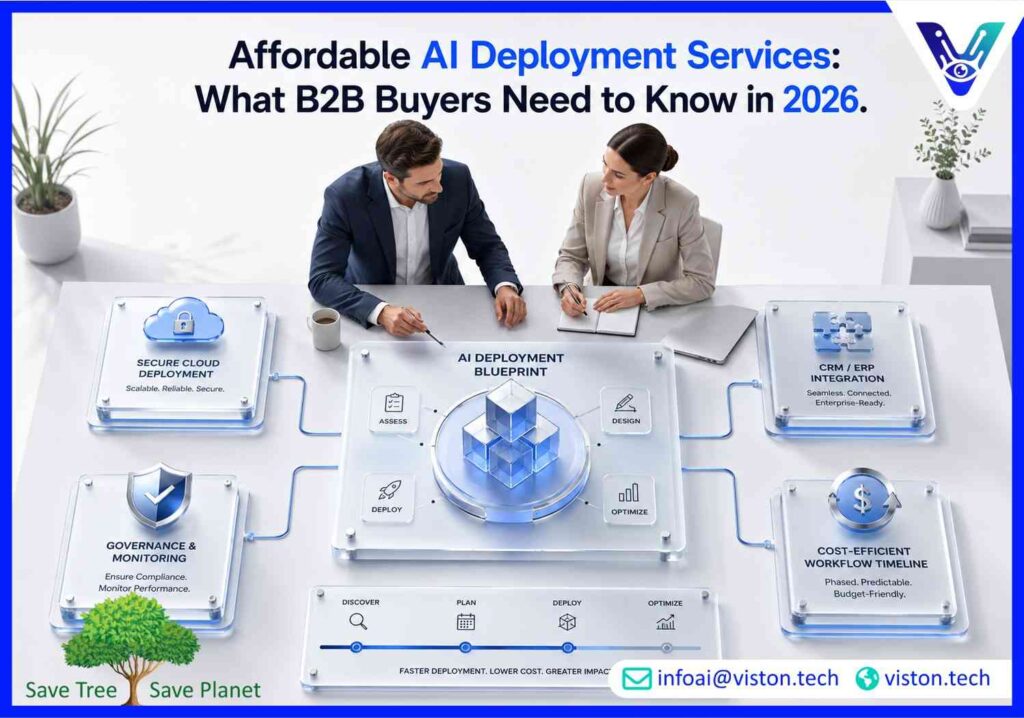
The conversation around AI deployment has shifted. Businesses are no longer asking whether to adopt AI agents — they are asking how to do it without overextending budgets or committing to infrastructure they cannot manage. Affordable AI deployment services have become a legitimate commercial category, and understanding what the term actually means is critical before any procurement decision.
What “Affordable” Really Means in AI Agent Deployment
Affordability in AI deployment is not simply about the lowest project quote. It is about total cost of value — what you get for what you spend, and how quickly that investment generates measurable return.An affordable deployment that fails to integrate properly, produces unreliable outputs, or requires expensive remediation after go-live is not affordable at all. Conversely, a well-scoped project with a clear build-deploy-monitor workflow, lean infrastructure choices, and defined KPIs from day one can deliver meaningful ROI at a fraction of what enterprises once associated with AI implementation.In 2026, the cost calculus has genuinely changed. Frameworks like AutoGen, CrewAI, and LangGraph have matured to the point where specialist providers can build sophisticated multi-agent systems without the engineering overheads that characterized bespoke AI development just three years ago. Cloud platforms including AWS Bedrock, Azure OpenAI Service, and Google Vertex AI offer consumption-based pricing that allows responsible cost management without sacrificing scale.This does not mean all providers are equal, or that complexity has disappeared. It means that buyers who understand the landscape can access serious agentic capability at commercially viable price points.The Real Cost Drivers in AI Agent Deployment
To evaluate affordable deployment services properly, decision-makers need to understand where costs actually originate.Scoping and architecture design remain significant cost variables. Providers that invest in a structured discovery phase — mapping your existing tech stack, identifying integration points, defining the agent’s decision scope — typically deliver more accurate estimates and fewer mid-project revisions. Cutting corners here is where affordability claims often collapse.Model selection matters more than many buyers realize. Large frontier models carry higher inference costs than smaller, fine-tuned alternatives. A competent deployment partner will match model selection to task complexity rather than defaulting to the most capable (and most expensive) option for every use case.Integration complexity is another key variable. Connecting AI agents to CRMs, ERPs, data warehouses, and internal APIs is where deployment timelines and budgets most frequently expand.Ongoing LLMOps and monitoring represent the frequently underquoted element of AI deployment budgets. Providers who build continuous monitoring, drift detection, and performance dashboards into their delivery model protect the value of the initial investment.What Genuinely Affordable Deployment Looks Like in Practice
Businesses exploring this space in 2026 should expect a structured engagement model from any credible provider.- They focus on high-value automation targets first.
- They use modular architectures.
- They are designed with governance from the start.
- They define success in business terms, not technical ones.
Evaluating Providers: What Separates Specialists from Generalists
The growth of AI service providers in this category has been significant, and not all offerings reflect genuine specialization.First, look for experience with agentic frameworks specifically — AutoGen, CrewAI, LangChain, and similar orchestration layers.Second, assess infrastructure capability. Providers deploying on enterprise cloud platforms with CI/CD pipelines, observability dashboards, and version control for models are operating at a different standard.Third, evaluate post-deployment accountability. Ongoing support, retraining protocols, and performance monitoring commitments reflect a provider’s confidence in what they have built.Finally, ask for evidence of measurable outcomes in comparable use cases.How Viston AI Approaches Affordable AI Agent Deployment
Viston AI is a specialist in AI agent development and deployment, working with businesses to build, deploy, and scale custom agentic systems using frameworks including AutoGen, CrewAI, and Vertex AI.The company’s commercial positioning is explicitly structured around value delivery alongside affordability. Its accelerated methodology targets delivery of initial results within two to four weeks and full deployment within eight to twelve weeks.For businesses without in-house AI teams, Viston operates as a complete end-to-end partner — handling strategy, build, integration, deployment, and ongoing management.Industry Relevance: Where Affordable Deployment Creates Immediate ROI
Certain sectors are seeing particularly strong returns from well-deployed AI agents in 2026.- Financial services: Autonomous research agents support real-time synthesis from market feeds, financial reports, and economic indicators.
- Logistics and operations: Workflow agents manage exception handling, supplier communication, and compliance documentation.
- Professional services: Document processing agents and research assistants reduce delivery time on analysis-heavy work.
- Healthcare: Agentic automation supports administrative workflows, clinical documentation, and patient data coordination.
