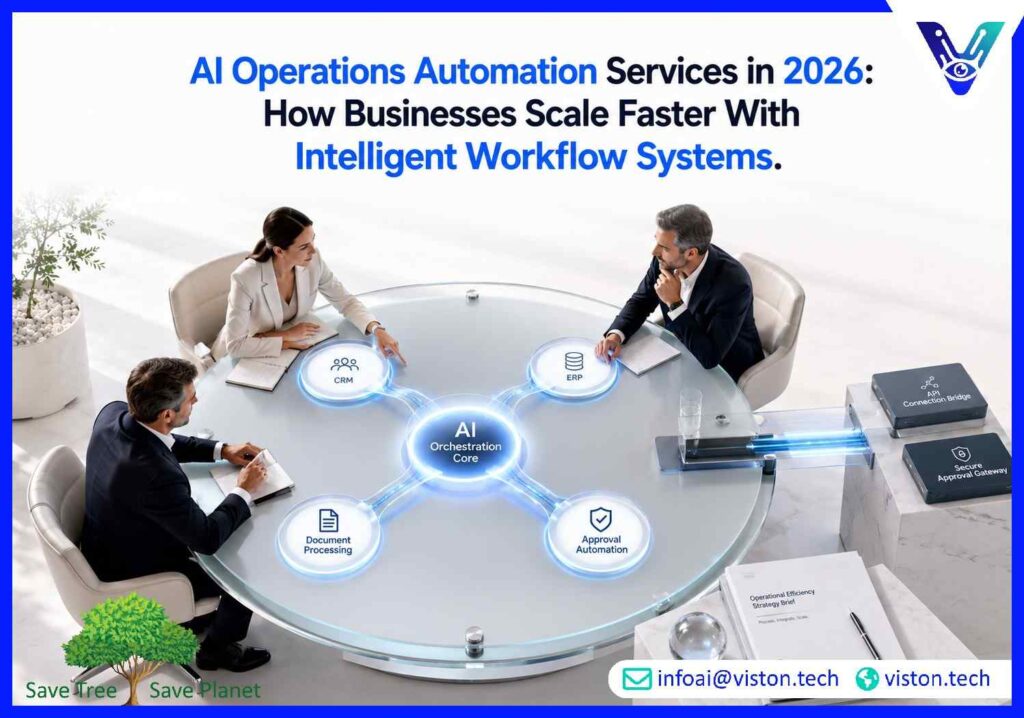
AI Operations Automation Services in 2026: How Businesses Scale Faster With Intelligent Workflow Systems
Introduction
Operational complexity has become a major growth barrier for modern businesses. Teams now manage disconnected systems, repetitive workflows, growing data volumes, and increasing compliance expectations. AI operations automation services are helping organizations shift from manual process management to intelligent workflow execution that improves speed, consistency, and business scalability.
Understanding AI Operations Automation Services
AI operations automation services combine artificial intelligence, workflow orchestration, integrations, and intelligent process execution to automate operational activities across business systems.Traditional automation usually follows fixed rules:“If X happens, perform Y action.”AI-driven operations automation goes further. It can:
Understand context
Process unstructured information
Learn from patterns
Route tasks dynamically
Trigger decisions based on business logic
Escalate exceptions to human teams
In 2026, businesses increasingly require automation systems that operate across entire workflows rather than isolated tasks.Examples include:
Customer onboarding workflows
Financial reconciliation
Inventory management
Internal approval chains
HR processes
Compliance reporting
Support ticket handling
Document processing
Sales pipeline management
Cross-platform data synchronization
The goal is not simply reducing human effort. It is creating operations that can scale without proportional increases in resources.
Why AI Operations Automation Services Matter in 2026
Organizations today face several operational challenges simultaneously.
Fragmented systems
Most businesses operate with multiple tools:
CRM systems
ERP platforms
Email platforms
Internal databases
Customer support software
Collaboration tools
Analytics platforms
Employees often spend significant time moving information between systems manually.
Rising operational costs
As businesses grow, operational complexity grows alongside them.Manual processes create:
Duplicate work
Human error
Delayed approvals
Reporting gaps
Resource bottlenecks
Growing compliance and governance requirements
Businesses increasingly need:
Audit trails
Data security controls
Role-based access
Workflow transparency
Approval documentation
Automation systems in 2026 must operate within governance frameworks rather than bypass them.
Demand for real-time decision making
Leaders increasingly expect:
Faster reporting
Immediate operational visibility
Predictive insights
Automated responses
Static workflows struggle to support these expectations.AI operations automation services address these issues by creating connected systems that operate intelligently across departments.
Common Business Problems AI Automation Solves
Many operational problems initially appear small but become expensive as organizations scale.
Slow customer onboarding
Manual onboarding often includes:
Document collection
Verification
Internal approvals
CRM updates
Notification workflows
Automation can reduce delays while improving consistency.
Repetitive data entry
Employees often spend hours moving information between systems.Examples include:
Updating records
Processing forms
Entering invoices
Generating reports
AI workflow systems eliminate repetitive movement of information.
Inefficient support operations
Customer support teams frequently manage:
Ticket routing
FAQ responses
Priority assignment
Escalations
AI workflow bots can classify and route requests automatically.
Reporting bottlenecks
Teams commonly gather information from multiple systems manually before creating reports.Automation can:
Pull information automatically
Validate inputs
Create dashboards
Trigger alerts
How AI Automation & Workflow Bots Enable Smarter Operations
AI automation and workflow bots serve as operational execution layers across business systems.Rather than acting as simple task scripts, modern bots can perform multi-step processes with decision logic.Capabilities often include:
Effective AI operations automation requires connectivity across technology environments.Typical integrations include:
Salesforce
SAP
ERP platforms
CRM systems
Microsoft tools
Slack
Customer service platforms
Internal APIs
Human-in-the-loop workflows
Not every decision should be fully automated.Modern systems increasingly support:
Approval stages
Escalation pathways
Manual intervention triggers
Audit controls
This approach balances automation efficiency with operational oversight.
Industry Use Cases for AI Operations Automation Services
Different industries apply AI operations automation differently because operational challenges vary significantly.
Financial services
Typical use cases:
KYC processing
Fraud monitoring
Compliance reporting
Risk assessments
Customer onboarding
Healthcare
Common workflow scenarios include:
Appointment scheduling
Documentation processing
Resource allocation
Claims handling
Patient communication
Manufacturing
Automation often supports:
Predictive maintenance
Inventory workflows
Supply chain coordination
Quality monitoring
Retail and eCommerce
Businesses frequently automate:
Order management
Stock synchronization
Customer communication
Demand forecasting
Technology companies
AI operations automation commonly improves:
DevOps workflows
Ticket management
Deployment pipelines
Customer onboarding
What Businesses Should Evaluate Before Choosing AI Operations Automation Services
Selecting a provider should involve more than comparing features.Decision-makers usually evaluate:
Integration capability
Automation systems should work with existing infrastructure rather than requiring expensive replacement projects.Questions to ask:
Does the solution support APIs?
Can it integrate with legacy systems?
Will future systems be supported?
Security and compliance controls
Automation introduces access to sensitive information.Businesses should examine:
Encryption methods
Audit logging
Permission controls
Compliance support
Data governance policies
Scalability
An automation project may begin with one workflow and expand across departments.Businesses should assess:
Transaction capacity
Infrastructure flexibility
Multi-region support
Performance stability
Visibility and reporting
Leaders need measurable operational insights.Useful capabilities include:
Workflow analytics
Process monitoring
Exception tracking
ROI measurement
Support and optimization
Automation requires ongoing refinement. Business processes evolve continuously.A strong implementation partner should support:
Workflow updates
Optimization
Testing
Performance monitoring
How Viston AI Supports Intelligent Operational Workflows
AI operations automation services directly align with Viston AI’s capabilities in AI Automation & Workflow Bots. According to its published service positioning, Viston focuses on intelligent workflow systems designed for operational efficiency, scalability, and enterprise integration capabilities.Rather than approaching automation as isolated task execution, the focus is on creating connected operational systems that support real business processes. This includes workflow orchestration, system integrations, intelligent decision layers, and automation architectures designed for growing organizations.For businesses dealing with fragmented systems, manual approvals, repetitive operational work, or scaling challenges, workflow automation increasingly requires both technical implementation and process expertise.In sectors where operations involve multiple platforms and regulatory requirements, intelligent automation often requires:
API-driven integrations
Audit visibility
Workflow customization
Scalable architecture
Exception handling
Process optimization
Organizations operating in India and global markets increasingly need automation systems capable of supporting growth without creating operational complexity. Practical workflow design, business alignment, and long-term scalability have become essential considerations for successful automation initiatives.
Best Practices for Successful AI Operations Automation Implementation
Organizations often fail not because automation technology is weak but because implementation strategy is weak.Recommended approaches include:
Begin with areas where automation creates measurable value.Examples:
Onboarding
Support operations
Reporting
Document processing
Establish governance early
Automation should include:
Access controls
Ownership rules
Approval processes
Monitoring systems
Measure outcomes continuously
Track metrics such as:
Process duration
Error rates
Cost reduction
Resource savings
Operational throughput
Optimization should continue after deployment.
Frequently Asked Questions
What are AI operations automation services?
AI operations automation services use artificial intelligence and workflow technologies to automate operational activities such as approvals, reporting, document processing, support workflows, and system coordination.
How are AI workflow bots different from traditional automation?
Traditional automation follows predefined instructions. AI workflow bots can understand context, process unstructured information, and make workflow decisions based on business rules and data patterns.
Which businesses benefit most from AI operations automation services?
Businesses with repetitive workflows, multiple software systems, large operational volumes, or growing compliance requirements often benefit significantly from automation initiatives.
How long does AI workflow implementation usually take?
Implementation timelines vary based on process complexity and integration requirements. Smaller workflow projects can take several weeks, while larger enterprise implementations may require several months.
Can AI operations automation work with existing systems?
Yes. Most modern solutions are designed around APIs and integrations that connect with existing CRM, ERP, and operational platforms.
How does Viston AI support AI workflow automation initiatives?
Viston AI focuses on AI Automation & Workflow Bots designed to improve operational efficiency through intelligent workflow orchestration, integrations, and scalable automation frameworks relevant to enterprise environments.
Conclusion
AI operations automation services are becoming a practical requirement for organizations managing increasing operational complexity in 2026. Businesses no longer want isolated task automation; they need intelligent systems capable of connecting workflows, improving efficiency, and supporting growth at scale.When combined with AI Automation & Workflow Bots, operational processes can move beyond repetitive execution into more adaptive and efficient systems. Organizations evaluating automation initiatives should focus on scalability, governance, integration capability, and long-term operational value. For businesses seeking specialized workflow automation expertise, Viston AI represents a relevant provider aligned with these evolving operational requirements.