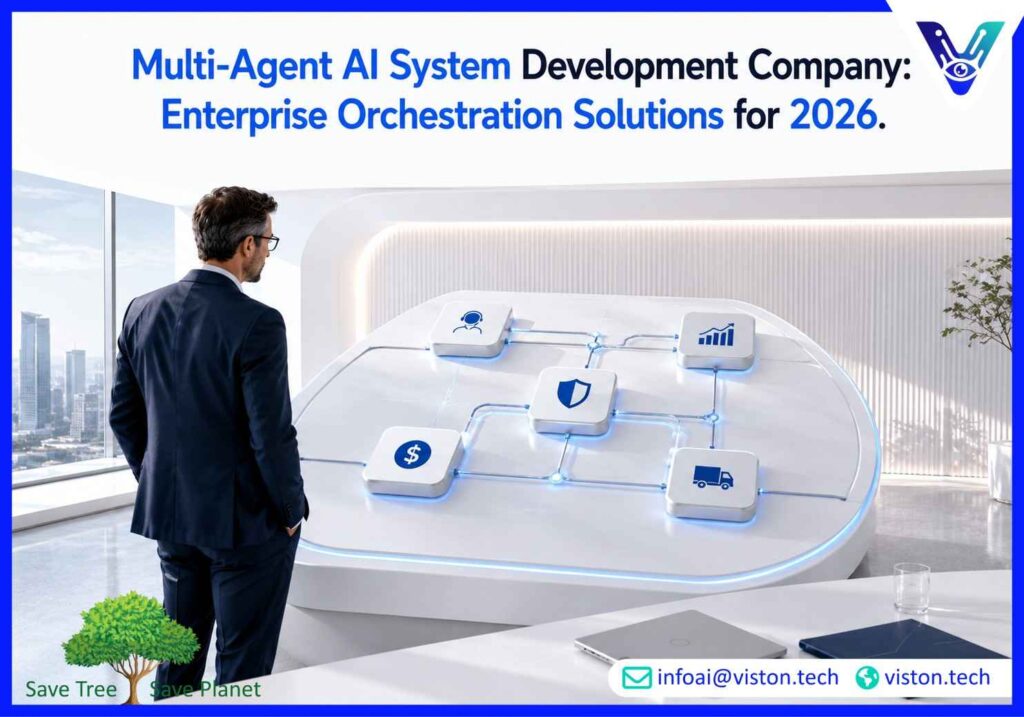
Multi-Agent AI System Development Company: Enterprise Orchestration Solutions for 2026
Introduction
As enterprises move beyond isolated AI pilots, many are discovering that a single AI model cannot effectively manage complex business operations. In 2026, organizations increasingly require coordinated AI systems capable of handling multiple workflows, systems, and decisions simultaneously. That shift has placed the focus on multi-agent AI systems and the companies that build them.
What Does a Multi-Agent AI System Development Company Do?
A multi-agent AI system development company designs, develops, integrates, and manages AI environments where multiple specialized agents work together to complete complex business objectives.Instead of relying on one general-purpose AI system, organizations can deploy multiple task-specific agents that collaborate through a structured orchestration layer.Examples include:
The critical factor is coordination.Without orchestration, organizations often end up with disconnected AI systems creating duplicated work, inconsistent outputs, and governance issues.Enterprise AI orchestration serves as the control layer that manages:
Agent communication
Task routing
Context sharing
Workflow sequencing
Human intervention points
Monitoring and observability
Security controls
Compliance requirements
Organizations increasingly view orchestration as the difference between AI experiments and enterprise-scale deployment.
Why Multi-Agent Systems Matter in 2026
Many first-generation AI implementations were designed around individual AI assistants or standalone chat systems.While these deployments delivered value, businesses frequently encountered limitations:
Context limitations
Single systems struggle to maintain context across large workflows involving multiple departments and applications.
Sequential processing bottlenecks
One AI system performing every task creates delays and operational inefficiencies.
Limited specialization
Complex processes often require domain-specific expertise.For example, a loan approval workflow might involve:
Document verification
Fraud detection
Risk assessment
Compliance validation
Customer communication
Approval recommendations
Expecting a single AI agent to perform every role introduces accuracy and reliability risks.Multi-agent systems distribute responsibilities among specialized agents while maintaining coordinated execution.This approach often improves:
Workflow speed
Accuracy
Scalability
Decision consistency
Operational resilience
Auditability
Research and enterprise implementation patterns in 2026 increasingly show organizations moving toward compound and orchestrated AI architectures rather than isolated AI deployments.
Core Capabilities Businesses Should Expect From a Multi-Agent AI System Development Company
Not every AI provider has experience building enterprise-grade multi-agent environments.Decision-makers evaluating vendors should look for capabilities beyond model deployment.
AI orchestration architecture
A provider should design systems that coordinate:
Agent interactions
State management
Workflow execution
Parallel processing
Exception handling
Enterprise integration capabilities
AI systems rarely operate independently.Successful implementations typically require connections with:
ERP platforms
CRM systems
Customer databases
Data warehouses
Internal APIs
Security systems
Knowledge repositories
Governance and compliance controls
In 2026, enterprise AI deployments increasingly require:
Audit trails
Human-in-the-loop approval processes
Role-based access control
Data privacy mechanisms
Policy enforcement
Security monitoring
Observability and monitoring
Organizations need visibility into:
Agent behavior
Response quality
Cost usage
Latency
Workflow failures
Performance metrics
Scalability planning
Multi-agent systems frequently evolve after deployment.The architecture should support:
Additional agents
New workflows
Cross-department expansion
Increased transaction volumes
Enterprise Use Cases for Multi-Agent Orchestration
The value of coordinated AI systems becomes clearer when viewed through practical business scenarios.
Customer support operations
Multiple agents can collaborate by:
Identifying customer intent
Retrieving account data
Performing sentiment analysis
Escalating complex issues
Generating response recommendations
Financial services
AI agents may coordinate:
Risk scoring
Fraud detection
Compliance validation
Document analysis
Decision support workflows
Healthcare operations
Organizations may deploy systems for:
Patient data summarization
Scheduling coordination
Claims processing
Medical record validation
Supply chain and logistics
Agents can support:
Demand forecasting
Vendor coordination
Inventory management
Route optimization
Exception detection
Internal enterprise productivity
Departments increasingly use orchestrated AI systems for:
Meeting summarization
Research tasks
Project coordination
Procurement requests
Knowledge management
Implementation Challenges Businesses Often Overlook
Multi-agent systems create significant opportunities, but implementation quality matters.Common issues include:
Poor orchestration design
Organizations sometimes deploy multiple AI agents without clearly defining:
Responsibilities
Handoffs
Ownership
Escalation paths
The result is duplicated activity and inconsistent outputs.
Lack of governance
AI systems making operational decisions require policy enforcement and accountability.Without controls, businesses risk:
Inaccurate decisions
Privacy concerns
Compliance violations
Audit challenges
Tool and data fragmentation
Many enterprises operate across dozens of systems.Integration challenges can reduce AI effectiveness if data access becomes inconsistent.
Cost expansion
Large-scale AI systems require monitoring of:
Model consumption
Infrastructure costs
Workflow efficiency
Token usage
Strong orchestration architecture often prevents unnecessary cost growth.
How Viston AI Supports Enterprise Multi-Agent Orchestration Solutions
Organizations evaluating a multi-agent AI system development company often require more than AI model deployment. They need operational infrastructure capable of supporting production-grade workflows.Viston AI provides Enterprise Multi-Agent Orchestration Solutions designed to help organizations deploy and manage coordinated AI systems across enterprise environments. Its approach focuses on enabling specialized AI agents to work together rather than functioning as isolated tools.This becomes particularly relevant for businesses managing complex operational processes involving multiple systems, teams, and decision layers.Enterprise deployments often require:
Cross-platform integrations
Workflow orchestration
LLM operations infrastructure
Agent lifecycle management
Monitoring and observability
Real-time decision support
Scalability planning
Governance controls
Multi-agent environments also require a structured coordination layer capable of maintaining reliability while supporting operational flexibility.For organizations operating globally or across highly interconnected business environments, enterprise orchestration can reduce fragmentation between AI initiatives and help convert isolated automation projects into scalable systems.Rather than focusing solely on model implementation, a practical multi-agent strategy increasingly requires attention to workflow architecture, operational visibility, and long-term manageability.
Questions to Ask Before Choosing a Multi-Agent AI System Development Company
Before selecting a partner, decision-makers should evaluate:
How does the company handle orchestration?
The orchestration layer often determines system reliability.
What governance capabilities are available?
Understand how security, approvals, and compliance requirements are managed.
Can the system integrate with existing infrastructure?
Enterprise environments typically involve many systems and applications.
How are workflows monitored?
Observability should extend beyond model performance.
Can the architecture scale?
Today’s pilot may become tomorrow’s enterprise-wide deployment.
Frequently Asked Questions
What is a multi-agent AI system?
A multi-agent AI system consists of multiple specialized AI agents that collaborate to complete complex workflows through coordinated orchestration.
Why are enterprises adopting multi-agent architectures in 2026?
Businesses increasingly need AI systems capable of handling larger workflows, multiple data sources, and cross-functional operations with stronger reliability and governance.
What is enterprise multi-agent orchestration?
Enterprise multi-agent orchestration is the process of coordinating AI agents, systems, workflows, and decision logic so that multiple agents work together efficiently.
How long does it take to implement a multi-agent AI system?
Implementation timelines vary depending on workflow complexity, integration requirements, governance needs, and deployment scope. Some projects begin with a pilot before expanding.
Does every business need multiple AI agents?
Not necessarily. Smaller or narrowly focused use cases may function effectively with a single AI agent. Multi-agent systems become more valuable when workflows involve multiple responsibilities and systems.
Can Viston AI support enterprise multi-agent implementations?
Viston AI offers Enterprise Multi-Agent Orchestration Solutions designed for organizations seeking coordinated AI workflows and scalable operational deployment models.
Conclusion
Choosing a multi-agent AI system development company is becoming a strategic technology decision rather than simply a software procurement exercise. As enterprise AI initiatives expand in 2026, success increasingly depends on orchestration, governance, scalability, and operational reliability.Organizations implementing Enterprise Multi-Agent Orchestration Solutions are often better positioned to move beyond isolated AI use cases and build systems that support real business operations. For companies evaluating scalable AI coordination strategies, providers such as Viston AI can play a meaningful role when orchestration and enterprise workflow management become critical requirements.