What Enterprises Need to Know About AI Orchestration Platforms in 2026
Introduction
Enterprise AI deployments have moved well beyond single-model experiments. In 2026, the organisations seeing the most measurable value from AI are those that have moved from isolated tools to coordinated, multi-agent systems — and the infrastructure making that possible is the AI orchestration platform. For technology leaders and enterprise decision-makers, understanding this shift is no longer optional.
What an AI Orchestration Platform Does at Enterprise Scale
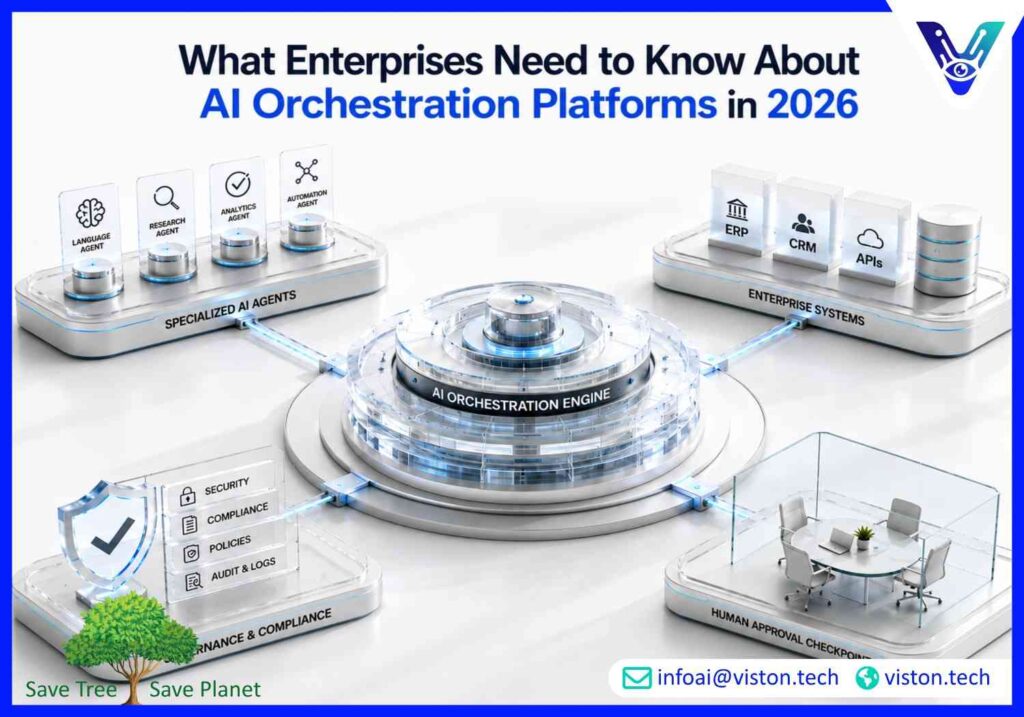
An AI orchestration platform is the operational layer that coordinates multiple AI agents, models, and automated workflows within a unified architecture. Rather than running separate AI tools in parallel — each requiring its own inputs, outputs, and oversight — an orchestration platform manages how those components communicate, delegate tasks, share context, and respond to results across complex, multi-step processes.In practice, this means an enterprise can deploy AI agents that handle different specialised functions — customer analysis, document processing, compliance checking, decision routing — and have them work together in coordinated sequences. The orchestration layer defines how these agents interact: which agent handles which task, under what conditions, with what data, and in what order.For technology leaders evaluating AI infrastructure, the distinction matters. Without orchestration, AI deployments tend to be siloed. Valuable but limited in scope. The orchestration layer is what converts a collection of AI capabilities into a coherent, production-grade operational system.
Why Enterprises Are Prioritising Multi-Agent Architecture in 2026
The shift toward multi-agent orchestration reflects a maturing understanding of what enterprise AI actually requires. A single large language model, however capable, cannot manage the full operational complexity of a large organisation’s workflows without specialisation, coordination, and governance structures built around it.Several forces are accelerating this transition.Workflow complexity demands specialisation. Enterprise processes rarely fit a single AI model. A procurement workflow might require document extraction, supplier verification, policy compliance checking, and approval routing — each function suited to a different agent optimised for that task. Orchestration allows these agents to operate as a coordinated system.Governance and audit requirements are increasing. Regulated industries — financial services, healthcare, legal, insurance — need to demonstrate traceability in their AI-driven decisions. Multi-agent orchestration with proper logging and control mechanisms provides the audit trail that single-agent deployments cannot replicate cleanly.Scale without fragility. Enterprises cannot afford automation systems that break when volumes surge or processes change. A well-designed orchestration architecture distributes load across agents, handles exception cases, and allows individual components to be updated or replaced without rebuilding the entire system.Human-in-the-loop integration. Not every AI decision should be fully automated. Orchestration platforms allow enterprises to define exactly where human review is required, routing specific decision points to human approval while keeping everything else moving automatically.
The Architecture Behind Enterprise Multi-Agent Orchestration
Understanding the structural components of an orchestration platform helps enterprise buyers evaluate what they are actually purchasing — or building.
Agent Design and Role Allocation
Each agent in a multi-agent system is designed with a specific capability boundary: the data it can access, the tasks it is authorised to perform, and the outputs it produces. Good orchestration architecture keeps agents focused and composable rather than building monolithic agents that try to do too much.
Orchestration Logic and Workflow Control
The orchestration layer itself manages the sequence and conditions under which agents operate. This includes task delegation, conditional branching, parallel execution, error handling, and retry logic. In enterprise contexts, this logic often needs to reflect business rules and approval hierarchies — not just technical dependencies.
Context and Memory Management
Multi-agent systems need to share relevant context across agents without overloading any single component. How an orchestration platform handles memory — what information is passed between agents, what is stored, and for how long — directly affects both performance and compliance. In regulated industries, data residency and retention controls at this layer are a procurement-level requirement.
Integration with Enterprise Systems
An orchestration platform that cannot connect cleanly to existing enterprise infrastructure is of limited value. Integration with CRMs, ERPs, data warehouses, identity management systems, communication platforms, and internal APIs is a baseline expectation. The quality of these integrations — and the stability of the connectors over time — is one of the most important practical differentiators between platforms.
Observability and Control
Enterprise orchestration requires visibility into what agents are doing, when, and why. This means detailed logging, performance monitoring, alerting, and the ability to intervene or pause agent activity when needed. Without this, orchestration at scale becomes an operational risk rather than an advantage.
How Viston AI Delivers Enterprise Multi-Agent Orchestration
Viston AI focuses on enterprise multi-agent orchestration solutions — building the coordinated AI systems that allow large organisations to operationalise AI across complex, multi-step workflows rather than in isolated pockets.The approach centres on designing orchestration architectures that fit the actual shape of an enterprise’s operations. This means starting from a detailed understanding of the business processes involved, the systems that need to connect, the governance requirements that apply, and the outcomes that matter — before any agents are built or any orchestration logic is written.For enterprises dealing with high-volume operational processes, Viston AI designs multi-agent systems where specialised agents handle discrete functions and the orchestration layer manages coordination, exception handling, and escalation paths. The result is AI infrastructure that can handle real operational complexity without requiring constant manual intervention or technical rework as processes evolve.The service also addresses the governance dimension that enterprise procurement teams rightly prioritise. Orchestration deployments include logging, audit trail mechanisms, human-in-the-loop checkpoints, and access controls appropriate to the sensitivity of the processes involved.For organisations that have already invested in individual AI tools but struggle to connect them into something that delivers at enterprise scale, the multi-agent orchestration work Viston AI offers provides the architectural layer that makes those investments productive rather than fragmented.
Evaluating an AI Orchestration Platform: What Enterprise Buyers Should Ask
Procurement teams and technology leaders evaluating orchestration platforms or specialist vendors should move beyond capability lists and focus on the questions that reveal delivery quality and long-term operational fit.How is agent scope and access control managed? Agents operating on enterprise data need clear boundaries. An orchestration architecture that does not enforce role-based access and data access controls creates unacceptable security exposure.What does the exception handling model look like? Real enterprise processes generate edge cases. Understanding how the orchestration layer routes unexpected inputs, failed agent responses, or conflicting outputs tells you more about production readiness than any demo scenario.How are changes managed post-deployment? Processes change, systems are updated, and business requirements shift. An orchestration platform that requires a complete rebuild every time a workflow changes will become a maintenance burden quickly.What monitoring and observability does the platform provide? Enterprise AI systems need the same operational visibility as any critical infrastructure. If the platform cannot tell you what is happening in near-real time and why, it cannot be managed responsibly at scale.How does the platform handle compliance requirements specific to your industry? For financial services, healthcare, or any regulated sector, compliance is not a feature — it is a precondition. Understand what controls are native to the platform versus what must be built separately.
Frequently Asked Questions
What is an AI orchestration platform and how does it differ from a standard AI tool?
A standard AI tool performs a specific function in isolation. An AI orchestration platform coordinates multiple AI agents and models, managing how they interact, share context, and operate in sequence across complex workflows. For enterprises, the orchestration layer is what makes AI deployable at operational scale rather than in isolated use cases.
What types of enterprise processes benefit most from multi-agent orchestration?
Processes that are multi-step, involve data from multiple systems, require conditional logic or approvals, or need to operate at high volume are the strongest candidates. Common enterprise use cases include customer operations, procurement, compliance processing, financial reconciliation, knowledge management, and internal helpdesk automation.
How long does it typically take to deploy an enterprise AI orchestration solution?
Deployment timelines depend on the complexity of the processes involved, the number of agent types required, integration depth with existing systems, and governance requirements. Simple orchestration builds can reach production in weeks. Enterprise-grade deployments with multiple integrations and compliance controls typically require a structured delivery programme over several months.
What are the main risks of deploying multi-agent AI orchestration without specialist support?
The most common risks include agents operating outside intended boundaries, poor exception handling causing process failures, inadequate audit trails for regulated decisions, and orchestration logic that becomes unmaintainable as requirements change. Specialist delivery reduces these risks through proper architecture, testing, and governance design from the outset.
How does Viston AI support enterprises in building multi-agent orchestration systems?
Viston AI designs and builds enterprise multi-agent orchestration solutions from discovery through deployment, with ongoing support for monitoring and iteration. The work includes process mapping, agent design, orchestration architecture, system integrations, governance controls, and post-launch maintenance — covering the full delivery lifecycle rather than point-in-time consultancy.
Is multi-agent orchestration suitable for industries with strict data compliance requirements?
Yes, provided the orchestration architecture is designed with compliance in mind from the outset. This includes data access controls, retention policies, audit logging, and regional data residency configurations where applicable. Compliance should be built into the architecture, not retrofitted after deployment.
Conclusion
The move toward multi-agent AI orchestration represents one of the most significant shifts in how enterprises use AI — not as a collection of point tools, but as a coordinated operational capability. For technology leaders making infrastructure decisions in 2026, the AI orchestration platform question is no longer whether to invest, but how to do it without accumulating technical debt or governance risk. Specialist delivery makes that difference. Viston AI’s focus on enterprise multi-agent orchestration solutions positions it as a practical partner for organisations building AI infrastructure designed to perform reliably at real operational scale.