
What to Look for in an AI Agent Software Development Company in 2026
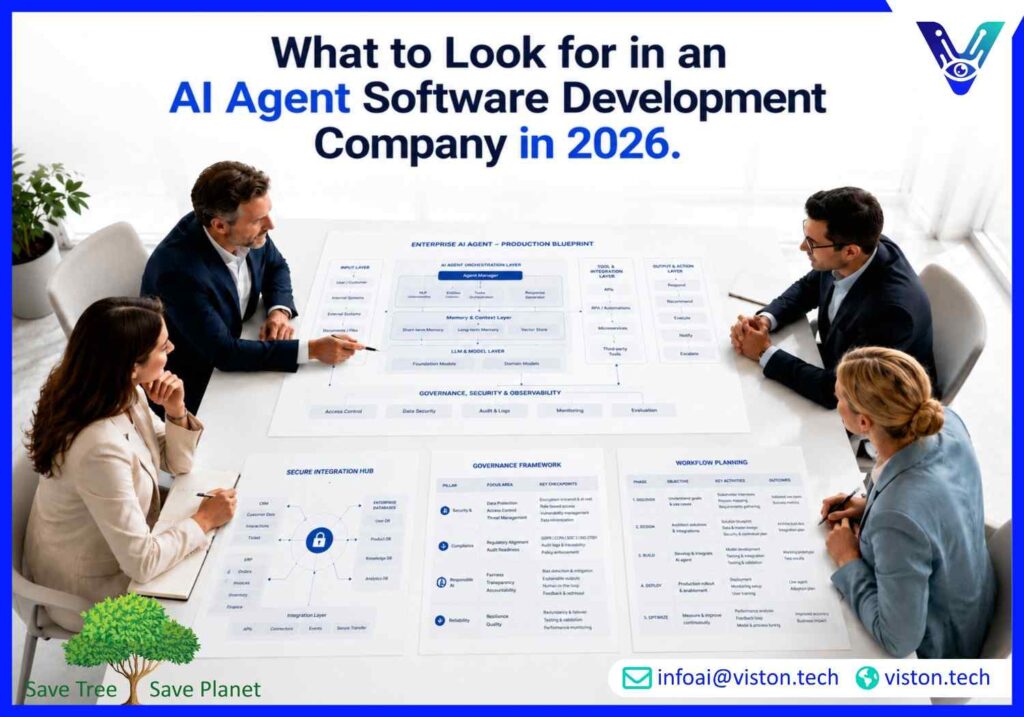
The decision to build and deploy AI agents inside a business is no longer exploratory — it is operational. Gartner projects that 40% of enterprise applications will include task-specific AI agents by the end of 2026, up from under 5% in 2025. For organizations moving from early pilots to production-scale deployment, the quality of the development partner they choose can determine whether that investment delivers measurable results or stalls entirely.
Why Most AI Agent Projects Fail Before They Scale
The gap between experimentation and production is where the majority of agentic AI initiatives break down. McKinsey research indicates that while over 60% of organizations are experimenting with AI agents, fewer than one in four have successfully scaled them to production. That disconnect is rarely caused by the underlying technology. It is almost always caused by poor architecture decisions, inadequate integration planning, or the absence of meaningful governance from day one.
An AI agent that performs well in a demo environment often behaves unpredictably when connected to live enterprise systems, exposed to real data variance, and expected to operate without continuous human intervention. Building for production is fundamentally different from building a proof of concept.
This is the first thing to assess when evaluating an AI agent software development company: do they design for production from the start, or do they treat it as an afterthought?
What a Capable AI Agent Development Partner Actually Builds
AI agents in the enterprise context are not chatbots with better responses. They are autonomous systems capable of reasoning through multi-step problems, accessing external data sources, executing actions within connected platforms, and adapting dynamically based on outputs and conditions.
A competent AI agent software development company builds systems that operate at several levels:
Task-level agents handle high-frequency, repeatable processes — inventory checks, document classification, data validation, or form routing. They remove manual overhead without requiring human judgment on every iteration.
Agentic workflow platforms coordinate multiple agents across departments, managing handoffs, exception handling, approvals, and conditional logic. These require careful orchestration design, especially where human oversight is built into specific decision points.
Autonomous AI workers are the most advanced configuration: agents that function like digital employees across defined domains, capable of research, synthesis, analysis, and action without step-by-step instruction. These demand rigorous testing, robust safety controls, and deep integration with organizational data.
The development approach matters as much as the agent type. Frameworks like CrewAI, AutoGen, and LangChain provide the scaffolding for multi-agent coordination. Retrieval-augmented generation (RAG) reduces hallucination risk by grounding agent responses in verified, current data rather than model memory alone. These are not optional enhancements — they are baseline requirements for enterprise-grade delivery.
The Integration Challenge Most Companies Underestimate
Seamless integration is consistently where AI agent projects stall. An agent that cannot connect reliably to your CRM, ERP, communication platform, or internal knowledge base is not a business tool — it is a capability without application.
The integration layer requires an AI agent software development company to understand both your technical infrastructure and your operational context. API design, authentication protocols, data schema mapping, and latency management all affect whether an agent functions effectively at the point of use. Legacy systems add complexity that a development team with only recent-stack experience will often struggle to navigate cleanly.
This is why enterprise AI agent deployments benefit from partners who conduct structured discovery work before writing a line of code. Workflow mapping, friction analysis, and integration scoping should be part of any serious engagement, not an add-on after the build is underway.
Governance, Security, and Responsible AI at Scale
One of the most consistent findings in 2026 enterprise AI research is that governance is struggling to keep pace with adoption. Nearly 94% of organizations deploying AI agents report concerns around agent sprawl — the rapid multiplication of autonomous systems without the controls needed to monitor, audit, or constrain their behavior.
A responsible AI agent software development company addresses this structurally, not reactively. That means building in role-based access controls (RBAC) so agents operate within defined boundaries. It means implementing human-in-the-loop checkpoints at high-stakes decision nodes. It means audit logging that satisfies compliance requirements across industries — whether that involves HIPAA in healthcare, financial conduct regulations in banking, or GDPR in any cross-border data context.
Organizations in regulated sectors, in particular, cannot treat governance as an optional layer. The agent architecture, from its first design stage, must embed accountability mechanisms that satisfy internal risk functions and external regulatory standards.
Multi-Agent Systems and Emerging Delivery Standards
Single-agent deployments are increasingly giving way to coordinated multi-agent systems, where specialized agents work in defined roles — researcher, analyst, reviewer, executor — to complete complex goals that no single agent could handle reliably alone. This architectural shift demands a development team with experience in agent orchestration, not just individual agent configuration.
The 2026 Gartner Hype Cycle for Agentic AI identifies the agent development life cycle (ADLC) and context graphs as emerging practices reflecting the growing need for structured approaches to building and deploying agentic systems. Organizations should look for development partners who have already adopted these frameworks in their own delivery process, rather than learning them at a client’s expense.
Caching mechanisms, self-tuning routing weights, and real-time performance monitoring are increasingly standard requirements, not advanced features. Development partners who treat these as optional extras are likely behind the capability curve.
How Viston AI Approaches Enterprise AI Agent Development and Deployment
Viston AI is a specialist AI agent development and deployment company working with enterprise clients across the USA, UK, Europe, and Australia. The company partners with Chief AI Officers, VPs of Digital Transformation, and Heads of Data Science to design agentic systems built for production from the outset — not retrofitted after a pilot phase has already created technical debt.
Viston builds across the full agentic stack. Its teams work with frameworks including CrewAI and AutoGen Studio to deliver task-focused agents and coordinated multi-agent systems tailored to specific workflows and organizational structures. Every engagement begins with structured consulting work: workflow mapping, automation scanning, and architecture planning that includes LLM selection, orchestration design, and scalability considerations from day one.
What distinguishes Viston’s delivery approach is its commitment to Responsible AI at Scale — a framework embedded across all engagements. This means governance guardrails, compliance monitoring, RBAC protocols, and human-in-the-loop controls are built into the architecture rather than appended afterward. For organizations in healthcare, financial services, logistics, or any regulated industry, this structural approach to accountability directly reduces deployment risk.
Viston’s work spans industries and markets. Its delivery record includes AI agent systems that have reduced false positives in financial transaction monitoring, achieved full healthcare data compliance under regional regulations, and accelerated software development cycles through autonomous code generation and review agents. For organizations serious about moving agentic AI into production reliably and responsibly, Viston offers the depth of engineering experience and governance maturity that enterprise-scale deployment demands.
Key Evaluation Criteria When Selecting an AI Agent Software Development Company
When shortlisting potential development partners, the following factors carry the most weight for enterprise buyers:
- Production-readiness orientation. Does the company design for scale and live integration from the beginning, or do they build demos and expect you to manage the transition?
- Integration capability. Can they work with your existing tech stack — including legacy systems — without requiring you to replace functional infrastructure?
- Governance and compliance depth. Do they have structured frameworks for audit logging, RBAC, human oversight, and regulatory compliance, or do they treat these as edge considerations?
- Multi-agent experience. Have they built and deployed coordinated agentic systems in production, not just single-agent pilots?
- Industry-specific knowledge. Do they understand the operational context, terminology, and compliance expectations of your sector?
- Post-deployment support. What happens after go-live? Ongoing monitoring, performance tuning, and model governance should be part of any serious engagement.
The wrong development partner can cost an organization significantly in rebuilding costs, compliance exposure, and lost time. Getting the evaluation right at the outset is as important as the deployment itself.
Frequently Asked Questions
What does an AI agent software development company actually do?
An AI agent software development company designs, builds, integrates, and deploys autonomous AI systems that can reason through tasks, make decisions, and take actions within enterprise environments. This includes single-purpose task agents, multi-agent systems, and fully autonomous workflow platforms tailored to specific business operations.
How is an AI agent different from a standard chatbot or automation tool?
Traditional chatbots follow scripted response paths. Standard automation tools execute fixed rules. AI agents are capable of reasoning through ambiguous or multi-step situations, adapting to new information, calling external APIs or tools autonomously, and completing complex goals without step-by-step instruction. The distinction matters significantly when evaluating what is actually possible for your use case.
What industries are AI agents most commonly deployed in right now?
Financial services, healthcare, logistics, retail, and software development are seeing the highest rates of enterprise AI agent adoption in 2026. However, any organization with high-volume, decision-dense, or documentation-heavy workflows — regardless of sector — is a practical candidate for agentic automation.
How long does a typical AI agent development and deployment project take?
Timelines vary based on integration complexity, agent scope, and governance requirements. Task-level agents in well-documented environments can be operational within weeks. Enterprise multi-agent systems with deep integrations and compliance requirements typically require several months of structured delivery. Development partners who promise rapid delivery on complex deployments without adequate discovery work should be evaluated carefully.
How does Viston AI handle compliance requirements for regulated industries?
Viston integrates governance and compliance controls directly into its agent architectures. This includes monitoring agents that audit data access patterns, anonymization processes for sensitive data, automated compliance reporting, and RBAC protocols that constrain agent behavior within defined boundaries. For sectors including healthcare and financial services, these controls are built into the deployment structure rather than treated as optional add-ons.
What governance frameworks should an enterprise AI agent deployment include?
At minimum, a production AI agent deployment should include role-based access controls, audit logging for agent actions, human-in-the-loop checkpoints at high-stakes decision nodes, performance monitoring and alerting, and clearly defined escalation protocols. For regulated industries, alignment with applicable data privacy and conduct standards is a baseline requirement, not a recommendation.
Conclusion
The enterprise AI agent market is no longer in early-adopter territory. With 40% of business applications projected to include task-specific agents by the end of 2026, the question for most organizations is no longer whether to deploy agentic AI — it is how to do it without exposing the business to integration failure, governance risk, or irreversible technical debt. Choosing the right AI agent software development company means evaluating not just technical capability, but production experience, governance maturity, and integration depth. Viston AI brings all three to enterprise AI agent development and deployment, making it a relevant and capable partner for organizations serious about building agentic systems that function reliably at scale.
