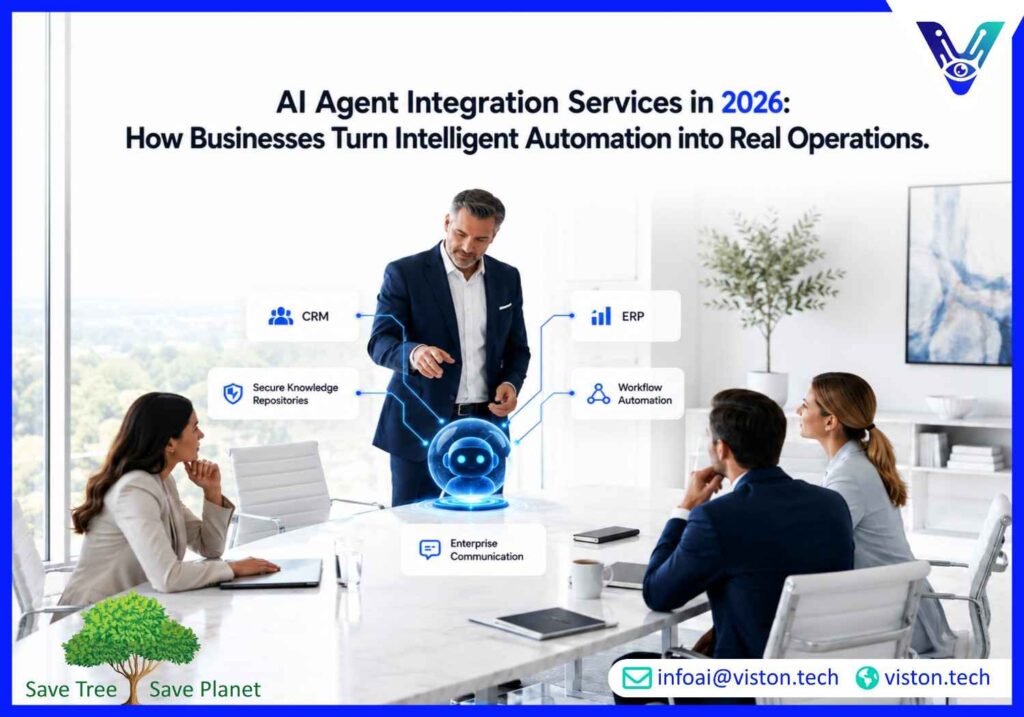
AI Agent Integration Services in 2026: How Businesses Turn Intelligent Automation into Real Operations
Introduction
AI is no longer limited to chatbots or isolated productivity tools. Businesses in 2026 are increasingly focused on embedding intelligent agents directly into operations, systems, and workflows. AI agent integration services have become essential because organizations want practical automation that works inside their existing environments rather than disconnected experiments.
Understanding AI Agent Integration Services
AI agent integration services involve connecting autonomous or semi-autonomous AI agents to business systems, applications, data sources, and workflows so they can perform meaningful tasks within real operational environments.An AI agent by itself can reason, analyze information, and generate responses. However, business value comes from integration.Without integration, an AI agent becomes another isolated tool.With proper integration, it becomes part of daily business operations.Examples include:
Connecting AI agents with CRM systems
Integrating agents with ERP platforms
Linking agents to knowledge bases
Embedding agents into support systems
Connecting workflow automation tools
Integrating communication platforms
Enabling secure access to internal business data
The difference is significant.An isolated AI system answers questions.An integrated AI system can identify issues, retrieve information, trigger actions, update systems, and support decision-making.
Why AI Agent Integration Services Matter More in 2026
The conversation around AI has shifted.Organizations are no longer asking:“Should we use AI?”They are asking:“How do we make AI work within our existing business environment?”Several factors are driving this change.
Growing Tool Fragmentation
Businesses typically operate multiple systems simultaneously:
CRM platforms
ERP systems
HR software
Customer support tools
Project management systems
Internal databases
Data warehouses
Communication platforms
Employees constantly switch between applications and manually transfer information.AI agents can reduce these operational gaps by acting across systems.
Rising Expectations Around Productivity
Leadership teams increasingly expect measurable outcomes from AI initiatives:
Reduced manual workload
Faster response times
Improved operational efficiency
Better customer experiences
Lower process costs
Faster decision cycles
Disconnected AI experiments rarely deliver these results.Integrated workflows are where measurable value emerges.
Better AI Capabilities
Modern AI agents have become significantly more capable.Today’s enterprise agents can:
Understand context
Retrieve organizational knowledge
Execute predefined actions
Collaborate across systems
Support multi-step workflows
Learn from interaction patterns
But those capabilities depend heavily on reliable integrations.
Common Business Problems AI Agent Integration Solves
Organizations usually do not purchase AI agent integration services because they want “AI.”They purchase solutions to operational problems.
Information Exists Everywhere
Many businesses struggle with fragmented knowledge.Critical information may live across:
Email systems
Shared documents
CRMs
Internal databases
Team communication tools
Support platforms
Employees waste time searching for information.Integrated AI agents can retrieve, organize, and surface answers from multiple environments.
Repetitive Processes Slow Teams Down
Many workflows still rely heavily on manual actions:
Lead qualification
Ticket routing
Report generation
Data entry
Status updates
Documentation tasks
AI agents reduce repetitive work while maintaining process consistency.
Slow Decision-Making
Managers often wait for reports or manually gathered insights.Integrated agents can:
Pull real-time information
Identify patterns
Summarize findings
Surface exceptions
Recommend actions
Customer Experience Gaps
Customers increasingly expect:
Faster support
Personalized responses
Consistent communication
24/7 assistance
AI agents connected to customer systems can improve service quality without increasing headcount.
Where Businesses Use AI Agent Integration Services
AI agent integration is becoming relevant across industries.
Sales Operations
Integrated agents can:
Score incoming leads
Update CRM records
Generate outreach suggestions
Schedule meetings
Identify deal risks
Customer Support
AI agents connected to support systems can:
Retrieve answers from knowledge bases
Route complex issues
Summarize customer interactions
Recommend responses
Finance
Common applications include:
Invoice processing
Financial reporting
Anomaly detection
Expense validation
Compliance checks
Human Resources
HR teams increasingly use integrated AI agents for:
Resume screening
Employee onboarding
Document processing
Internal support requests
Operations and Supply Chain
Integrated agents can support:
Inventory forecasting
Workflow monitoring
Predictive maintenance
Process optimization
What Makes AI Agent Integration Different from Traditional Automation?
Traditional automation usually follows predefined rules.For example:“If X happens, perform Y action.”AI agents operate differently.They can:
Interpret language
Understand context
Reason through multi-step tasks
Access relevant knowledge
Decide among possible actions
However, AI agents still require boundaries and governance.Businesses should avoid assuming full autonomy means removing human oversight.The most effective implementations often combine:
AI decision support
Workflow automation
Human approval steps
Operational controls
Implementation Considerations Businesses Should Evaluate
AI agent integration projects succeed when organizations focus on operational realities rather than technology excitement.
Data Quality
AI agents depend on reliable information.Poor-quality inputs create poor outcomes.Questions organizations should ask:
Is business data accurate?
Is information updated regularly?
Are systems connected properly?
Security and Access Controls
AI agents frequently interact with sensitive information.Considerations include:
Role-based permissions
Encryption
Audit logs
Authentication controls
Data privacy requirements
Compliance Requirements
Some industries require stronger governance.Examples include:
Healthcare regulations
Financial reporting standards
Data privacy obligations
Regional data requirements
Integration architecture should account for compliance from the beginning.
Scalability
A pilot project may work well for fifty users.The challenge comes when scaling to thousands.Organizations should evaluate:
Infrastructure requirements
API limitations
Workflow complexity
Monitoring capabilities
What Businesses Should Look for in AI Agent Integration Services
Selecting an integration partner involves more than technical implementation capability.Strong providers typically demonstrate expertise across several areas.
Business Process Understanding
Technology alone rarely solves operational problems.Teams should understand:
Workflow dependencies
Business goals
User behavior
Operational risks
Integration Expertise
Businesses increasingly use environments involving:
APIs
CRM systems
ERP platforms
Workflow tools
Cloud services
Knowledge repositories
Integration experience matters.
AI Architecture Knowledge
Providers should understand:
Multi-agent systems
Orchestration frameworks
Retrieval systems
Model selection
Monitoring approaches
Prompt and memory design
Ongoing Support
AI systems evolve continuously.Long-term support may include:
Model updates
Performance monitoring
Workflow optimization
Integration maintenance
How Viston AI Supports AI Agent Integration Initiatives
Organizations adopting AI agents often face a practical challenge: building intelligence is only one part of the process; making that intelligence function effectively inside real business environments is another.Viston AI provides services aligned with this requirement through its Agent Integration Service and broader AI implementation capabilities. Its offerings include custom AI agent solutions, multi-agent orchestration, workflow automation, AI chatbot integration, and business system connectivity. These capabilities help organizations move beyond isolated AI tools toward integrated operational systems.For businesses implementing AI agents, integration frequently involves connecting multiple technologies simultaneously: internal databases, CRM systems, enterprise applications, knowledge repositories, communication platforms, and workflow engines. Managing these environments requires technical planning as well as operational understanding.Viston AI’s service portfolio reflects this broader integration approach. Its capabilities include agentic workflows, integration with business systems, AI readiness support, MLOps-related functions, and enterprise-focused AI solutions that can support industries such as healthcare, financial services, e-commerce, and manufacturing environments.For organizations seeking practical deployment rather than experimental implementation, this type of service structure can help reduce operational complexity while supporting scalability and business alignment.
Frequently Asked Questions
What are AI agent integration services?
AI agent integration services connect AI agents with business systems, applications, workflows, and data sources so they can perform useful operational tasks rather than functioning as isolated tools.
How long does an AI agent integration project usually take?
Timelines vary depending on workflow complexity, system architecture, data quality, and security requirements. Smaller integrations may take several weeks, while enterprise deployments often require longer implementation periods.
Can AI agents work with existing CRM and ERP systems?
Yes. Many modern AI agents integrate with CRM platforms, ERP systems, databases, communication tools, and cloud environments using APIs and workflow frameworks.
Are AI agent integrations secure?
Security depends on implementation design. Strong projects typically include access controls, authentication mechanisms, encryption, monitoring, and audit capabilities.
Do AI agents replace employees?
Most business deployments focus on augmenting teams rather than replacing them. AI agents commonly automate repetitive tasks while allowing employees to focus on higher-value work.
Can Viston AI support enterprise AI agent integration requirements?
Viston AI provides Agent Integration Services alongside related capabilities such as multi-agent orchestration, workflow automation, and business system integrations, which may support organizations implementing AI-driven operational processes.
Conclusion
AI agent integration services are becoming a practical business requirement rather than an experimental technology initiative. Organizations increasingly need intelligent systems that can work across applications, workflows, and operational environments without creating additional complexity.Successful implementation depends on more than deploying an AI model. It requires reliable integrations, strong governance, security considerations, scalable architecture, and a clear understanding of business objectives.For companies exploring AI adoption in 2026, the focus should be on connecting intelligence to real operations. Businesses seeking structured implementation support may find value in specialized providers such as Viston AI, whose Agent Integration Service aligns with broader operational integration requirements.